

The Islamic Republic of Iran’s Revolutionary Guards Corps (IRGC) claimed seven boats have been attacked or mined in the Persian Gulf and the vicinity of the Strait of Hormuz.
The IRGC is listed as a foreign terrorist group by the U.S. government.

An F/A-18C Hornet, assigned to the “Stingers” of Strike Fighter Squadron 113, transits over the haze of southern Afghanistan. VFA 113, part of Carrier Air Wing 14 aboard the aircraft carrier USS Ronald Reagan is supporting Operation Enduring Freedom. The mission of CVW 14 is to protect the people of Afghanistan and to support coalition forces. Ronald Reagan is currently deployed to the U.S. 5th Fleet area of operations. Operations in the U.S. 5th Fleet area of operations are focused on reassuring regional partners of the United States’ commitment to security, which promotes stability and global prosperity.

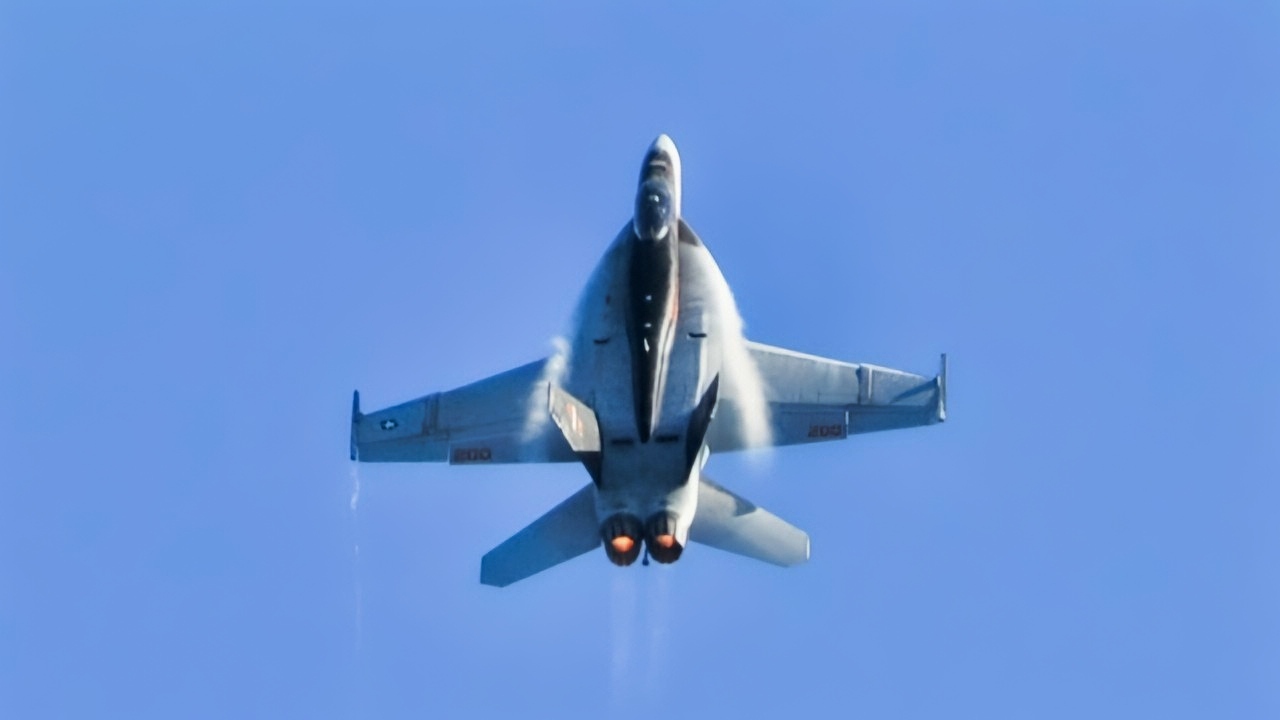
An F/A-18 Super Hornet from Naval Air Station Oceana, Virginia, performs an aerial demonstration over Rickenbacker International Airport, Ohio, June 16, 2024, as part of the Columbus Air Show. This year’s event featured more than 20 military and civilian planes, including a KC-135 Stratotanker from the 121st Air Refueling Wing, which served as the base of operations for military aircraft participating in the show. (U.S. Air National Guard photo by Senior Airman Ivy Thomas)
It extensively funds and trains terror proxies across the Middle East.
Iran’s unverified assertion comes as prices climbed to a five-month high and a tanker was bombed off Oman.
Four Ships Ablaze
Reuters says Iran’s IRGC Navy accused four vessels of smuggling, and they were all bombed as they passed in the northern Persian Gulf on Wednesday, simultaneously, and caught fire.
They said three other boats hit floating mines west of the Strait of Hormuz.
Iranian state media mentioned no specific vessels or casualties, but Tehran has previously stated that it will attack vessels attempting to enter the Strait of Hormuz.
Iran’s claim that it had carried out seven fresh attacks has not been independently verified.
On Wednesday, an “unknown projectile” set fire to the Kuwait-flagged tanker Al Dasma 11 nautical miles west of Bukha, Oman, UK Maritime Trade Operations reported.
The crew quickly put out the fire on board, and the ship anchored.
Crew on Al Dasma ‘Safe’
India’s shipping minister Sarbananda Sonowal said all 21 Indian crew on the tanker were “completely safe,” and there is reportedly no link between that attack and Iran’s new claims on Thursday.
The International Maritime Organization’s October 22 register shows 120 confirmed incidents and 24 seafarer fatalities.
One of the ships attacked was the container ship GFS Pride, which sank after an October 13 attack.
Iran’s claims about mine attacks also remain unverified. On October 18, the Joint Maritime Information Center released an advisory that “there is no substantiation to these claims” following an Iranian accusation that two supertankers had been hit by mines the day before.
Traffic advisory service The Swedish Club has advised mariners to “avoid transiting the Strait of Hormuz unless the transit is operationally essential” because of a “SEVERE” threat message.
IMO chief Arsenio Dominguez was similarly blunt, noting that firms need to “stop using seafarers as collateral in this conflict.”
Oil Exports Rise Amid Attacks
Meanwhile, the oil market has reacted of the increased attacks, with exports rising above pre-war levels.
According to Kpler figures reported by the Wall Street Journal, the Persian Gulf region exported more than 24 million barrels per day in the week ending October 18, compared with a 23.3 million barrels per day average just before the war began.
Of that, about 14 million barrels per day were exported through the Strait of Hormuz or connected offshore facilities, 82% of pre-war levels.
Kpler analyst Homayoun Falakshahi said increased profitability was part of the reason, noting that “volumes remain high despite rising attacks, because profits make it worth the risk.”
But not everyone is convinced. Christopher Long, a former British naval officer, has suggested otherwise, claiming that it is a matter of Iran trying to re-impose its blockade of the embattled strait.
Brent crude rose to $112.55 a barrel on Thursday, Reuters reported, before trading at $111.88 at 1104 GMT.
PVM Oil analyst Tamas Varga stressed that “No de-escalation is anticipated until the US midterm elections, which should keep oil prices elevated.”
The sudden spike in prices comes as fresh attacks have been launched by Iran-backed Houthi terrorists on Saudi Arabia, including an airport and an oil field.
US Midterm Elections Approach Amid War
Israel is set to elect a new government on October 27, and the American midterms follow on November 3, making the next round of strikes politically dangerous for both governments.
“Netanyahu wants to attack Iran; that’s not even a question,” said Israeli security analyst Danny Citrinowicz. Primarily, there remain concerns over Iran’s bid to create nuclear weaponry, which could be used to attack Jerusalem.
Citrinowicz, who previously led Israel’s military intelligence directorate’s Iran research, also noted: “Trump cannot declare victory now, but he also cannot leave without doing something… On the other hand, the Iranians cannot allow the naval blockade to continue, so they will keep attacking tankers.”
Iranian Foreign Minister Abbas Araghchi told the Financial Times that his regime is committed to diplomacy but added it is “fully prepared to defend” itself.
U.S. Central Command reported on September 19, “over 2,000 commercial ships have transited through the waterway” while U.S. military authorities “facilitated the movement of more than one billion barrels of crude oil through the Strait of Hormuz.
About the Author: Georgia Gilholy
Georgia Gilholy is a journalist based in the United Kingdom who has been published in Newsweek, The Times of Israel, and the Spectator. Gilholy writes about international politics, culture, and education.


