

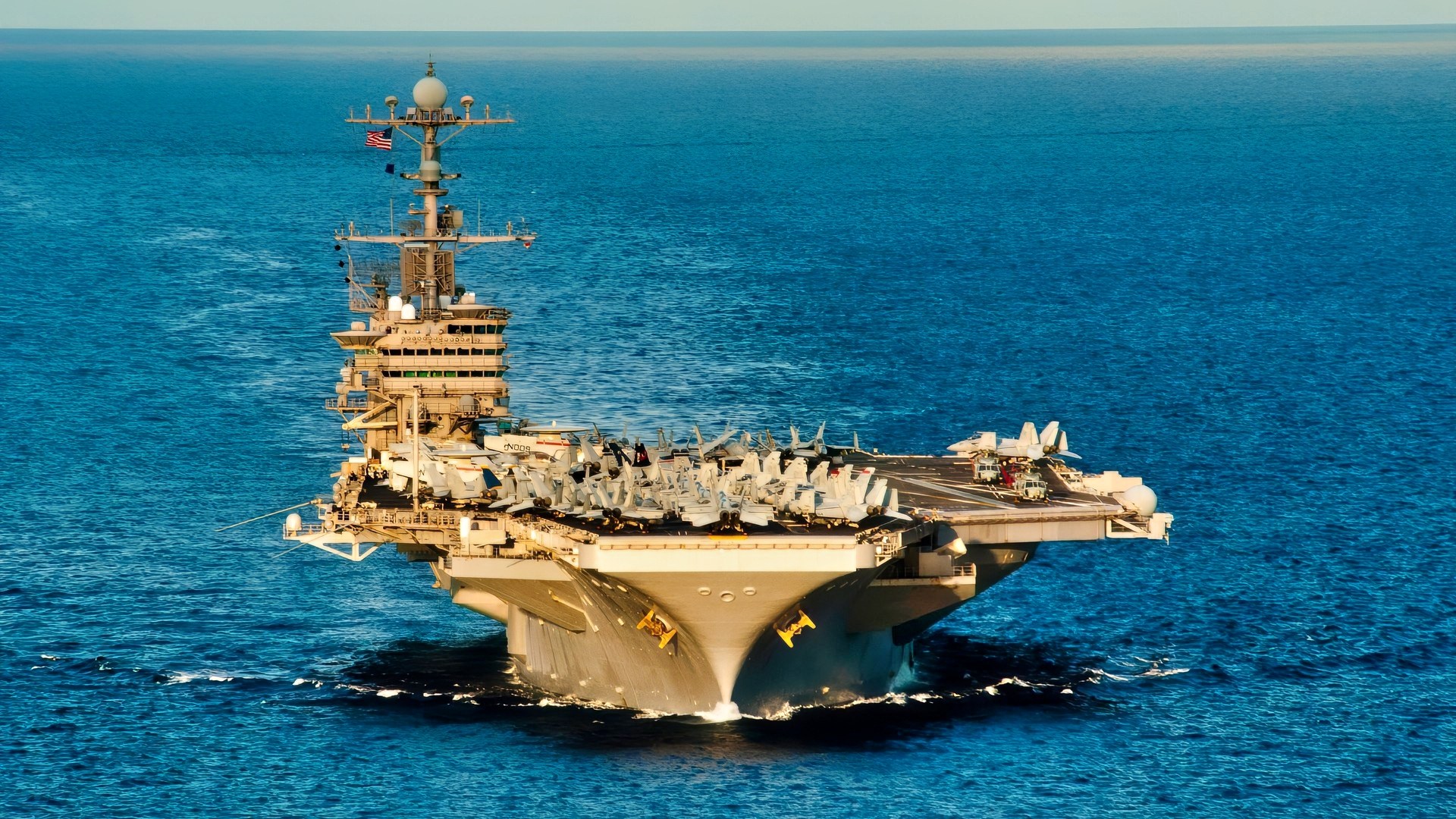
Despite facing significant economic challenges at home, Iran’s embattled regime is intent on pushing back against the blockade of its ports by the United States Navy, in place since mid-July following the resumption of hostilities between American and Iranian forces.
Speaking during a Monday press conference, Iran’s Foreign Ministry spokesperson Esmaeil Baghaei was unequivocal. “We will definitely not tolerate it (the blockade), and we will use all our tools to confront this US aggression.”
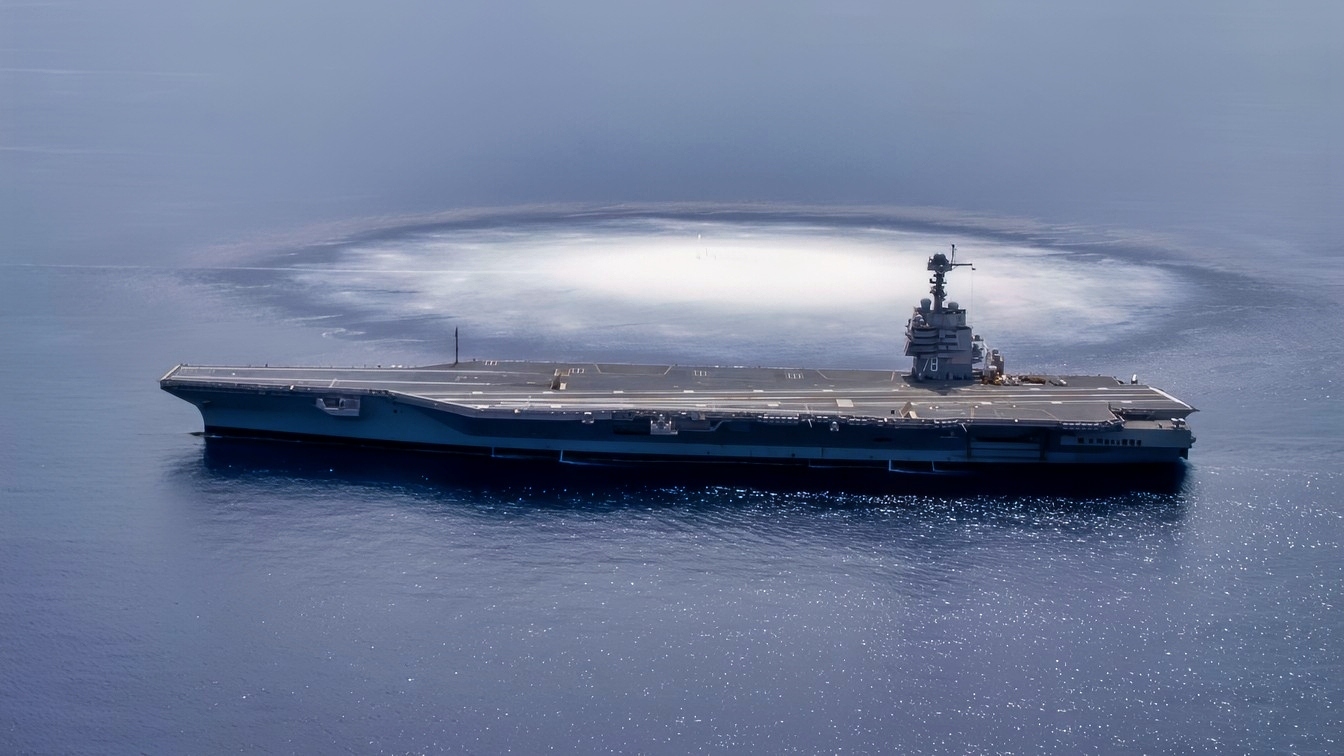
The aircraft carrier USS Gerald R. Ford (CVN 78) completes the first scheduled explosive event of Full Ship Shock Trials while underway in the Atlantic Ocean, June 18, 2021. The U.S. Navy conducts shock trials of new ship designs using live explosives to confirm that our warships can continue to meet demanding mission requirements under harsh conditions they might encounter in battle. (U.S. Navy photo by Mass Communication Specialist 3rd Class Riley B. McDowell)
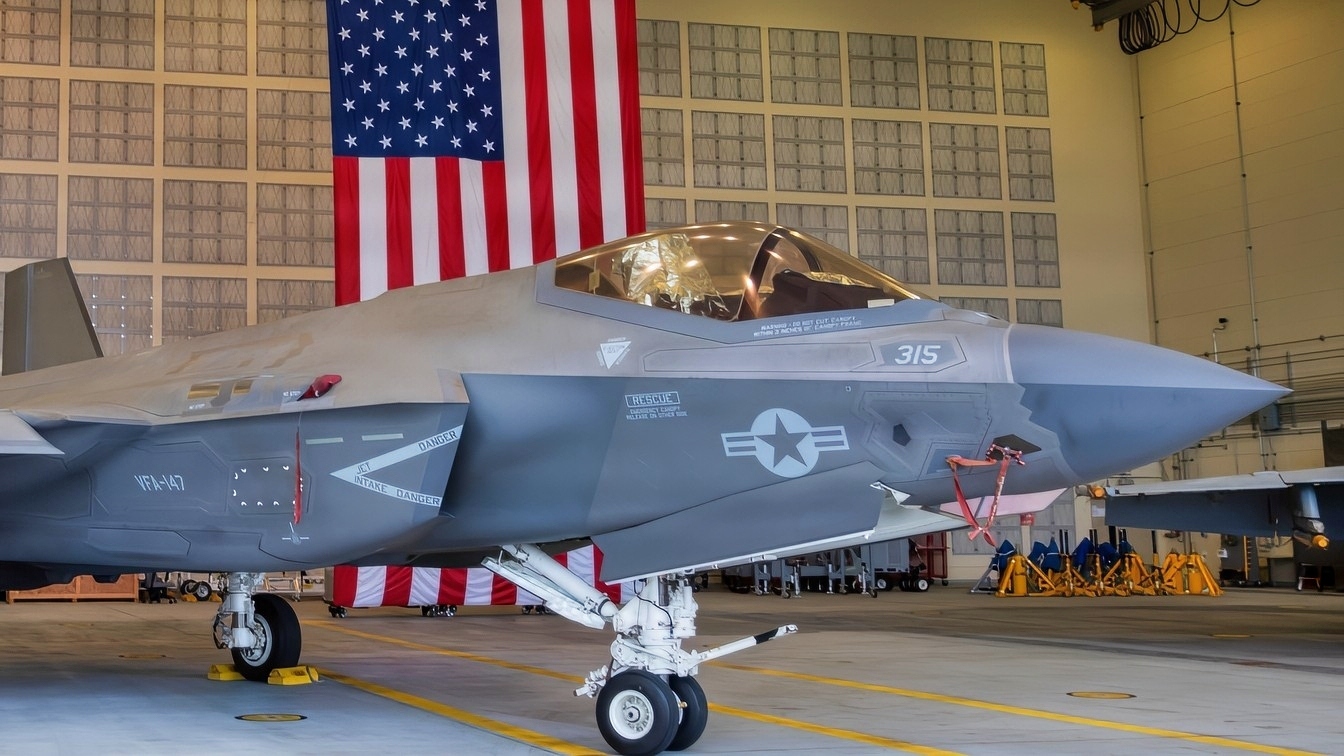
A U.S. Navy F-35C Lightning II static display from Strike Fighter Squadron (VFA) 102, Carrier Air Wing (CVW) 5 inside of Hangar 5300 during Friendship Day at MCAS Iwakuni, May 3, 2026. Since 1973, MCAS Iwakuni has held an air show designed to foster positive relationships and offer an exciting experience that displays the communal support between the U.S. and Japan. The air show encompassed various U.S. and Japanese static display aircraft, aerial performances, food and entertainment. (U.S. Marine Corps photo by Lance Cpl. Isaac De Leon)
“The naval blockade… is considered a military aggression,” Baghaei said, adding that “Iran has the right to use any available tool to defend itself in this regard.”
A Resumption of Iranian Oil Loading in the Gulf?
Just last week, reports emerged that Iran had resumed loading oil in the Gulf, transferring crude via ship-to-ship transfer. But Reuters reports that Mr. Baghaei pushed back against those reports, calling them “speculations” rather than facts.
Though Iran’s ports along its Gulf coast are blocked by the United States Navy, a throttling that has seen the country’s oil exports plunge precipitously to virtually nothing, some vessels transporting Gulf oil have decided to run the gauntlet that the embattled regime in Tehran has made of the Strait of Hormuz.
And while Iran insists that it controls the strait, the passage of ships is firm evidence to the contrary.
Oil flows from the Gulf via the strait briefly approached — then, shockingly, surpassed — the levels seen before the war in October, a bounce-back that had not been widely predicted before the outbreak of hostilities between Tehran and Washington.
Those export levels had, however, dipped down somewhat by November.
The resumption of flows helped ensure that global markets did not experience a complete dearth of oil availability.
However, prices remained elevated thanks to increased freight and shipping costs, an increase ultimately witnessed at the pump.
Fresh Strikes on the Horizon?
High at-the-pump prices are partly responsible for the shellacking American President Donald Trump’s Republican Party experienced during the recent midterm elections.
President Trump had publicly eschewed fresh strikes against the Iranian regime in the lead-up to the midterms, but some strikes had been carried out.
According to the Pentagon, however, they were mostly of a defensive nature.
But with the midterms now over, the President’s hand is somewhat freer than before — and some recent reporting from CBS News, an American television broadcaster, has indicated that the Commander-in-Chief is mulling fresh strikes in tandem with Israel.
The United States has a considerable amount of military firepower in the region.
Available to United States Central Command, the American military command that oversees operations in the Middle East, is a formidable array of assets.
A pair of nuclear-powered aircraft carriers are in the region:the USS Theodore Roosevelt, which recently arrived in theater, and the USS George H. W. Bush.
In addition, there are more than a dozen other warships in the region, one of which is the USS Boxer, which carries an Amphibious Ready Group, as well as its own organic aircraft wing.
There was previously a third aircraft carrier in the Middle East, the USS George Washington, but it has since departed.
Fresh targets that could be hit by the United States are naturally unknown, though a pair of targets that could well find themselves in American or Israeli crosshairs are Iran’s Pickaxe Mountain as well as Natanz, both of which are highly fortified underground nuclear facilities.
Previously hit in airstrikes earlier in the war, the sites are believed to be where Iran’s enriched uranium stocks are located.

NAVAL AIR STATION NORTH ISLAND, Calif. (July 10, 2024) USS George Washington (CVN 73) arrives at Naval Air Station North Island, July 10, 2024. USS George Washington and crew are in the process of completing a homeport change, replacing USS Ronald Reagan (CVN 76) as the forward-deployed U.S. Naval Forces Japan aircraft carrier at Fleet Activities Yokosuka, Japan.(U.S. Navy photo by Mass Communication Specialist 1st Class Keenan Daniels)
Iran is believed to have had about 900 kilograms, or roughly 2,000 pounds, of enriched uranium. And while that uranium is not highly enriched — that is, 90 percent purity — it could move to enrich its uranium relatively quickly.
Will the United States, and perhaps with the participation of Israel, commence striking Iran again? President Trump has flip-flopped, at times describing the United States as “locked and loaded” to once more bombard Iran, while at other times the Commander-in-Chief has demurred, asserting that the war is essentially over and that the United States has won the conflict.
The regime ensconced in Tehran, however, would disagree. Both Iran and its proxies, the Houthis, the rebel group vying for control over Yemen, are still able to launch attacks against their neighbors in the region. And while most of Iran’s aerial thrusts have been successfully parried, a reeruption of the conflict would usher in a new and particularly dangerous phase of the fighting.
About the Author: Caleb Larson
Caleb Larson is an American multiformat journalist based in Berlin, Germany. His work covers the intersection of conflict and society, focusing on American foreign policy and European security. He has reported from Germany, Russia, and the United States. Most recently, he covered the war in Ukraine, reporting extensively on the war’s shifting battle lines from Donbas and writing on the war’s civilian and humanitarian toll. Previously, he worked as a Defense Reporter for POLITICO Europe. You can follow his latest work on X.


