

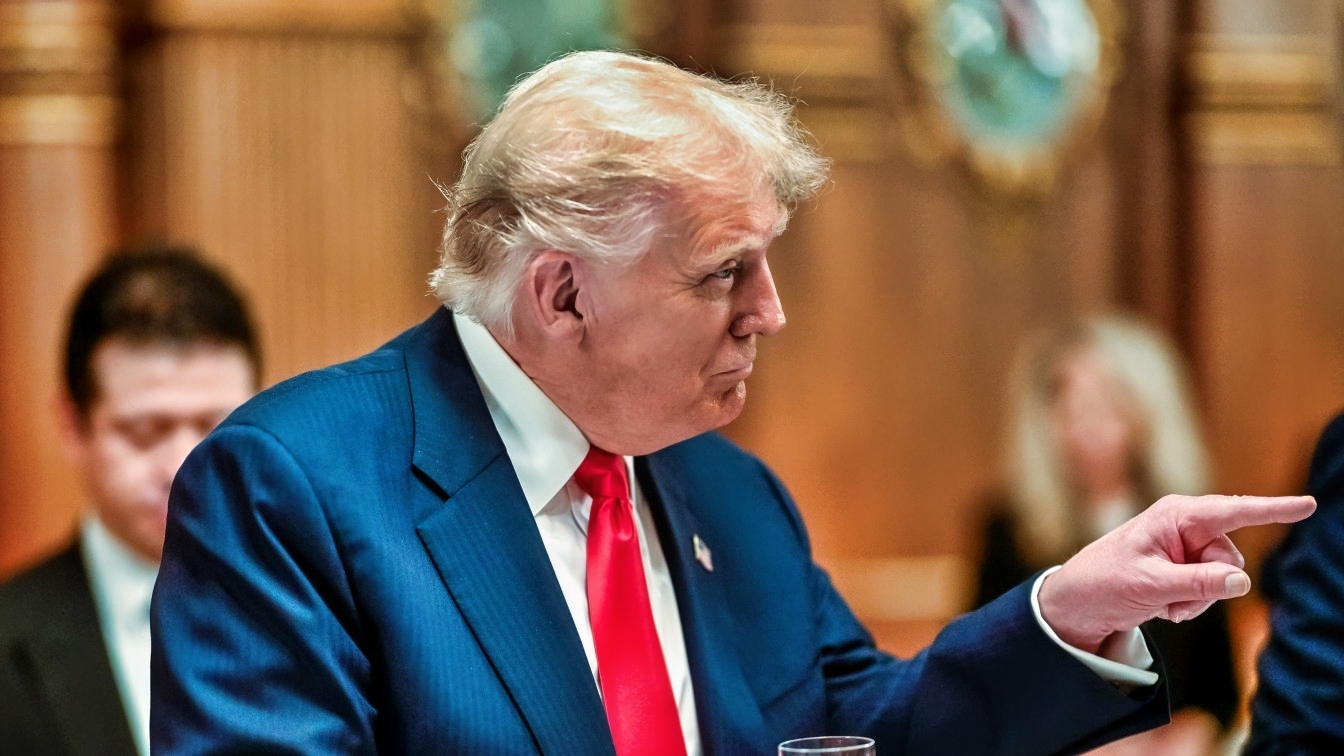
A proposed summit between President Donald Trump, Vladimir Putin and China’s Xi Jinping has once again drawn parallels to the 1945 Yalta Conference.
The summit, which took place in the Ukrainian resort city on what is now Russian-occupied Crimea, saw the leaders of the US, Britain and the Soviet Union negotiate the future of postwar Europe – ceding swathes of Europe to Moscow.

President Donald J. Trump welcomes Russian President Vladimir Putin to Joint Base Elmendorf-Richardson, Anchorage, Alaska, August 15, 2025 (DoD photo by Benjamin Applebaum)
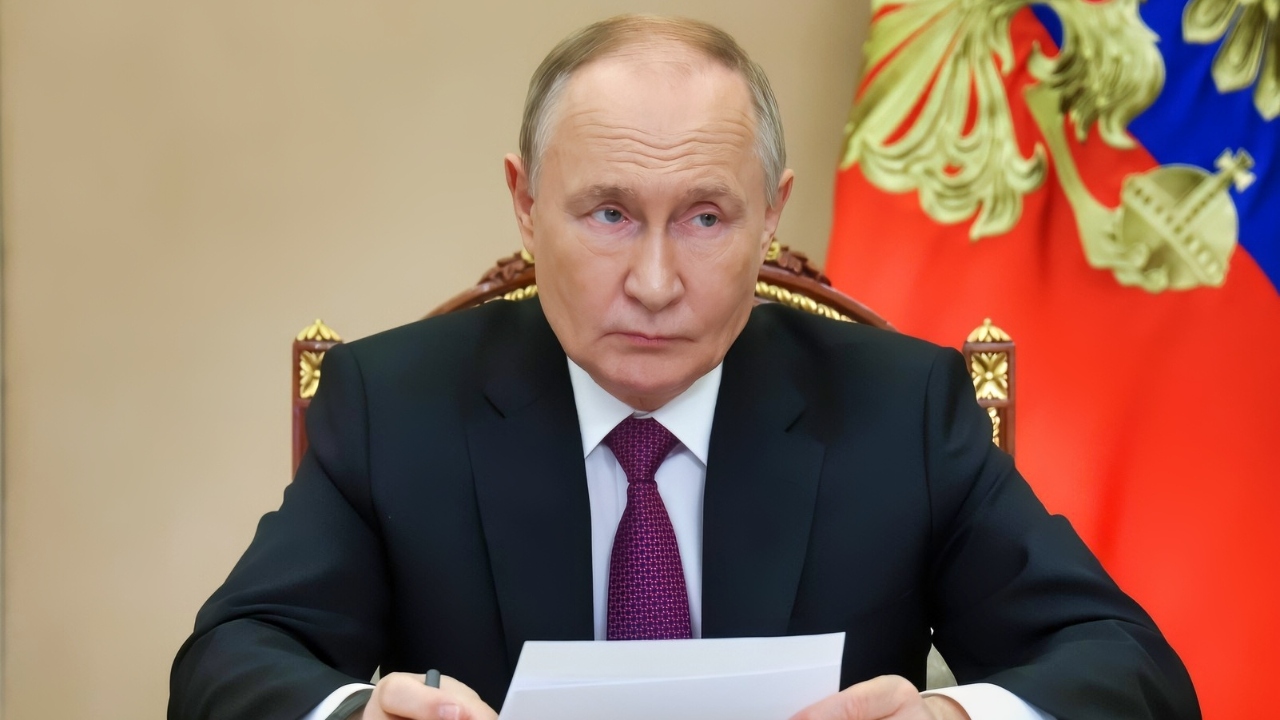
Russia’s President Putin Sitting at a Desk. Image Credit: Creative Commons.
In a recent guest essay for the New York Times, historian Michael Kimmage, director of the Kennan Institute, questioned how much impact such a meeting could actually have.
Speaking to Deutsche Welle, Kimmage said Europe’s financial and military backing had allowed Kyiv to influence the course of the war, whatever deal the three leaders could propose.
“The optics and the reality are not quite the same,” he said.
His statements followed Moscow’s suggestion that it was prepared to hold independent negotiations with Ukraine and the United States next month.
Another Yalta?
The Russian president proposed meeting Trump and Xi during November’s Asia-Pacific Economic Cooperation summit in Shenzhen, China, according to a Wall Street Journal report.
He apparently wants a deal of end the war that favors Moscow.
The paper reported that he anticipated something like another Yalta Conference, with major powers negotiating territorial and political control.
The Kremlin acknowledged raising the possibility of a meeting on October 19, but spokesperson Dmitry Peskov said it had not agreed on the arrangements or agenda.
Trump, meanwhile, suggested that a meeting with Putin and Xi could focus on nuclear disarmament, and not necessarily Ukraine.
“I would do it, not so much for Ukraine,” he detailed, stating that he wanted to discuss nuclear disarmament.
Ukrainian foreign minister Andrii Sybiha objected to the proposal, arguing that a meeting between Washington, Beijing and Moscow without Kyiv would only “encourage Putin to continue this war.”
Zelenskyy: Don’t Do This Without Us
President Volodymyr Zelenskyy has supported resuming negotiations, provided Ukraine takes part.
“It’s important to negotiate trilaterally,” he told Fox News on October 21, referring to Ukraine, Russia and the United States.
He added that he would also welcome European countries’ participation.
“I always said that we are open to negotiate in any format, any topic,” Zelenskyy said, asking that decisions about Ukraine not be made without its representatives.
The disagreement comes as relations between Trump and Zelenskyy continue to cool over Ukrainian attacks on Russian oil refineries.
On October 10, Trump advocated replacing Ukraine’s president.
“I suggest they get a new leader who can make a deal,” Trump told reporters.
The day before, Washington announced an agreement allowing more Russian diesel exports, which Trump defended as a way of lowering fuel prices.
Zelenskyy condemned the arrangement as an investment in Russia’s war, arguing that it would give Moscow additional revenue.
Putin offers to restart talks in November.
Nevertheless, diplomacy has made progress.
Following a three-hour meeting with US envoy Steve Witkoff in St. Petersburg on October 21, Kremlin aide Yuri Ushakov said Putin was prepared to resume negotiations involving Russia, Ukraine and the United States, separate from the Shenzhen proposal.
“Our president informed Steve Witkoff that we are, in principle, prepared to resume the aforementioned trilateral negotiations around the 10th of November,” Ushakov told reporters.
The proposal would have teams from the United States, Russia and Ukraine negotiating, potentially in Abu Dhabi.
Ushakov said another round of negotiations would focus on post-war security arrangements for Russia and Ukraine.
Witkoff had returned to St. Petersburg after talks with Zelenskyy and European leaders in Oslo the previous day, but the Kremlin showed little interest in the ideas he took back.
Ushakov acknowledged that Kyiv and its European allies had put forward new ideas, but dismissed them as offering little practical use in ending the war.
Washington and Kyiv have also clashed over American military assistance. On Wednesday, Zelenskyy said sharing intelligence with the US was working again, but limits on Starlink and Starshield had not yet been lifted.
He said he had raised the issue with Secretary of State Marco Rubio, who promised to look into it. Rubio has disputed Zelenskyy’s account of an interruption in intelligence sharing, saying Washington never suspended the service.
Why Europe Still Has a Say
Kimmage does not believe that excluding European leaders from a summit would deprive them of influence.
He pointed to the money and weapons European governments have given to Ukraine, and their growing role in arms production, arguing that German assistance has been especially important, Kimmage told Deutsche Welle.
“And that support equals leverage,” he said.
About the Author: Georgia Gilholy
Georgia Gilholy is a journalist based in the United Kingdom who has been published in Newsweek, The Times of Israel, and the Spectator. Gilholy writes about international politics, culture, and education.


