


Ukraine launched 7,000 drones into Russia in March 2026 — the first month of the war that Kyiv outfired Moscow. The strikes have hit Russian oil refineries from the Black Sea to the Ural Mountains, cut Russian oil exports by 17%, and forced Moscow to truncate Russia’s May 9 Red Square parade for the first time in nearly two decades.
Ukraine Makes Drone History Against Russia
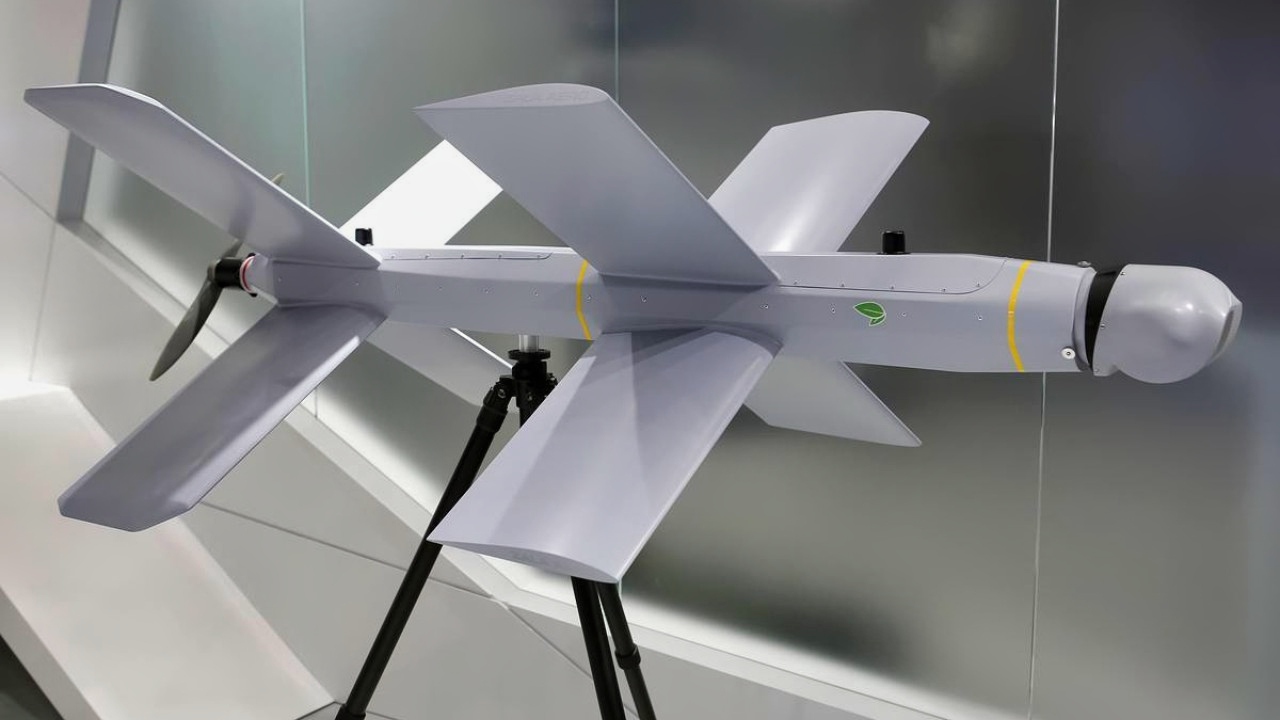
Lancet Drone. Image Credit: Russian State Media.

Lancet Drone from Russia. Image Credit: Creative Commons.
Ukrainian forces have launched multiple waves of drone strikes against Russian oil infrastructure, taking a significant percentage of Russia’s oil export and processing ability offline.
One of the most striking attacks by Ukraine against Russia’s oil facilities was at an important oil refinery near the Black Sea. Over a two-week period, Ukraine launched four successful waves of strikes against the site in Tuapse.
Though Russian fire control services initially contained the blaze, subsequent strikes reignited it, spewing waves of acrid black smoke and oil into the surrounding air. Residents of the area have shot photos and videos of sooty, oily rain falling from the sky and coating anything outside.
According to some environmentalists, it could be one of the worst environmental disasters in Russia’s post-Cold War history.
Ukrainian drones have struck targets thousands of miles from the front lines in Ukraine, evading Russian air defenses sprinkled throughout the country. So great is the paranoia of strikes that Russia has curbed its May 9th celebrations, the holiday that commemorates the Soviet Union’s victory over Nazi Germany during World War Two, called the Great Patriotic War in Russia.
Though normally the site of an enormous military parade, Moscow’s Red Square will this year take place without the military component, which typically includes tanks, armored personnel carriers, intercontinental ballistic missiles, and other military kit — the first time the celebrations have been truncated in nearly two decades.

Ukraine Switchblade Drone. Image Credit: Creative Commons.

Switchblade Drone. Image Credit: Industry Handout.
Other Ukrainian strikes much further afield — at Russian wells and refineries near Perm, just west of Russia’s Ural Mountains that run roughly north to south through the center of the country — have demonstrated just how vulnerable Russia’s valuable oil infrastructure is.
One of the world’s leading oil exporters, Russia has taken a one-two punch. Its shadow fleet, decrepit oil tankers that transport sanctioned oil illicitly to customers around the world, has also been pinched, straining the Kremlin’s coffers.
Running on Fumes
2026 heralded a turning point for Ukraine. Ukraine has held Russian forces on the battlefield to a near standstill — in some cases securing modest territorial gains too — while simultaneously hitting Russia’s ability to finance the war in Ukraine.
Over twenty waves of Ukrainian strikes against oil facilities in Russia have been reported, attacks that targeted oil export terminals, oil processing and refining sites, and oil pipelines.
March 2026 marked the first time in the course of the war that Ukraine launched more drones into Russia than Russia launched into Ukraine. Ukraine launched around 1,000 drones in August 2024, 3,000 in July 2025, and about 7,000 in March this year.
The squeeze on Russian oil comes at a particularly acute moment for world oil markets, catalyzed by the war in Iran.
With perhaps as much as 20 percent of the world’s oil exports ground to a near-halt thanks to the stoppage of the Strait of Hormuz, Russian oil revenue would have been poised for record sales. Instead, Russian oil exports have dipped precipitously by nearly 17 percent. Revenues are also markedly lower than expected, even despite record oil prices, thanks to Ukrainian strikes.
Improving Capabilities
Ukraine’s success in targeting Russia’s oil infrastructure is thanks to the rapid adoption of improvements to its strike drones, in both quantity and quality, Michael Kofman, one of the leading analysts of the war in Ukraine, explained to The Washington Post.
“Not only has Ukraine demonstrated that it has substantially increased the number of long-range strike zones, but there has also been a qualitative step change in the technology employed and how they are organizing these strikes now,” Kofman explained. “That’s why they are achieving greater effect.”
Budgetary Spillover Effects
The costs to the Russian economy are hard to ignore, Craig Kennedy, a Russia expert with Harvard University’s Davis Center for Russia and Eurasian Studies, explained.
If Russia were to meet its budgetary plans for this year, global oil prices would have to average about $115 per barrel. In tandem, Russia has been forced to curb oil production significantly as a result of Ukraine’s concerted strikes against Russian oil infrastructure.
“When you have record-high prices, the last thing you want to be doing is cutting production capacity, and that could be due to a combination of damage to storage facilities both at refineries and ports, as well as damage to infrastructure pipeline systems,” Kennedy explained to The Washington Post.
About the Author: Caleb Larson
Caleb Larson is an American multiformat journalist based in Berlin, Germany. His work covers the intersection of conflict and society, focusing on American foreign policy and European security. He has reported from Germany, Russia, and the United States. Most recently, he covered the war in Ukraine, reporting extensively on the shifting battle lines in Donbas and writing about the war’s civilian and humanitarian toll. Previously, he worked as a Defense Reporter for POLITICO Europe. You can follow his latest work on X.


