

Iran says it has attacked a U.S. early-warning radar in Bahrain, while its navy said a liquefied gas tanker hit a mine in the Strait of Hormuz, one day after President Donald Trump declared it under U.S. control. These claims have not been independently confirmed.
Iran Says it Hit Target in Bahrain as ‘Warning’
Iran’s Islamic Revolutionary Guard Corps (IRGC) said its forces had “targeted and destroyed” the radar in retaliation for an alleged airstrike on a telecoms tower in Sirik in southern Iran on Friday.

A U.S. Air Force F-16 Fighting Falcon flies over the U.S. Central Command area of responsibility Oct. 14, 2020. The F-16 Fighting Falcon is a compact, multirole fighter aircraft that has proven itself in both air-to-air combat and air-to-surface attack. (U.S. Air Force photo by Senior Airman Duncan C. Bevan)
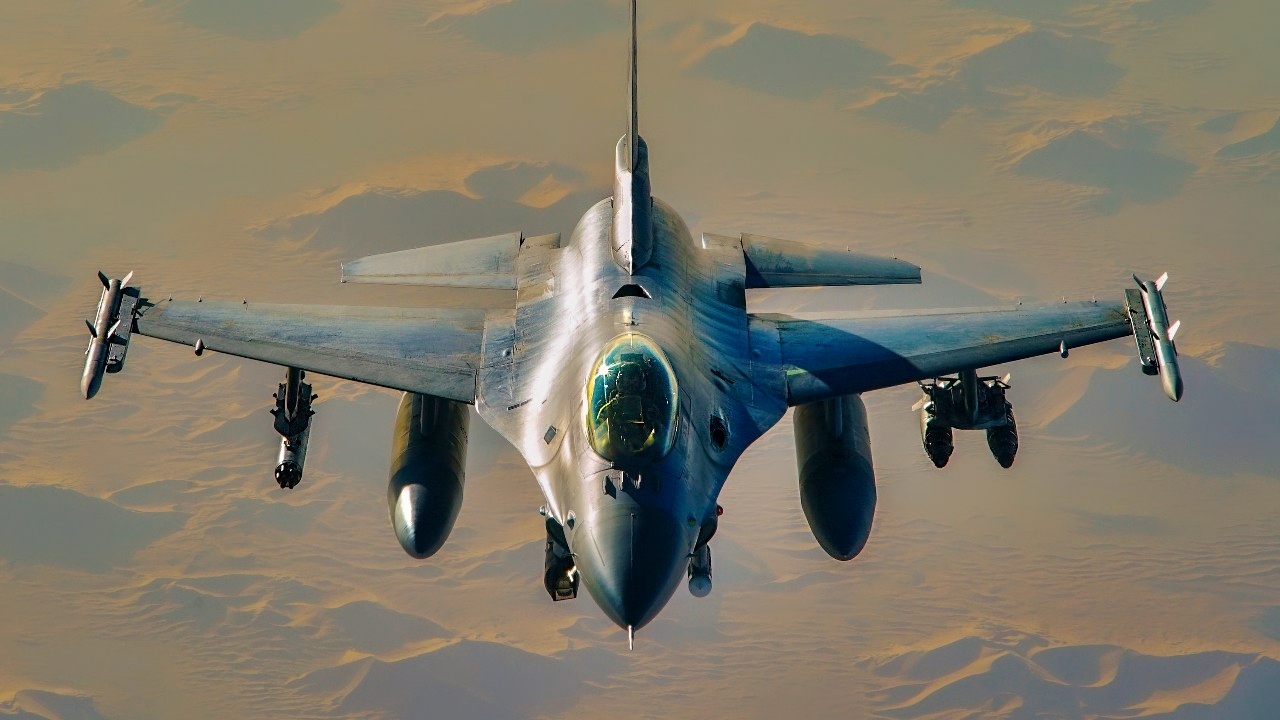
A U.S. Air Force F-16 Fighting Falcon based in the Central Command area of operations conducts armed aerial patrols in Somalia in support of Operation Octave Quartz, Jan. 9, 2020. The F-16s support to OOQ demonstrates the U.S. military’s reach and power projection across vast distances to hold adversaries such as al-Shabaab at risk with flexible, precise and lethal force that is capable of rapidly responding anywhere on the globe. The mission of OOQ is to reposition U.S. Department of Defense personnel from Somalia to other locations in East Africa. (U.S. Air Force photo by Staff Sgt. Taylor Harrison)
Iran’s state news agency (IRNA) quoted the IRGC, which Washington lists as a terrorist organization, as blaming the U.S. for the Sirik strike.
At the same time, a statement carried by Tasnim called it a “serious warning” to Washington.
The U.S. Central Command said on Friday that “no damage” had been sustained in the attack.
It is the first time Tehran has claimed to have attacked U.S. military infrastructure in a Gulf state since early September.
Bahrain is home to the headquarters of the U.S. Navy’s Fifth Fleet.
Iran attacked bases in Bahrain and other Gulf states after the U.S. and Israel attacked Iran on February 28, but Washington later placed a naval blockade on Iranian ports.
‘Unknown Vessel’
The navy said the tanker ignored repeated warnings and sailed along an “unauthorized and dangerous route.”
However, the Iranian statement made no mention of the name of the tanker or details of the crew. There has also been no report from the United Kingdom Maritime Trade Operations, a UK military body that monitors maritime incidents.
The statement said in Persian that the ship was carrying liquefied gas.
However, Tasnim’s English service, the AP, and Reuters all say the vessel carried liquefied petroleum gas. Reuters’ brief states the tanker was carrying liquefied gas.
Four Oil Tankers Attacked
Iran’s military said on Thursday that four oil tankers were attacked in explosions. However, the Joint Maritime Information Center said an “unknown projectile” struck the Liberia-flagged oil tanker Dominica Prosperity on November 11, prompting an engine room fire.
India’s Minister for Shipping, Sarbananda Sonowal, said all 22 crew members were “swiftly and safely evacuated by the UAE Coast Guard.”
All 19 Indian nationals aboard were unharmed.
The maritime center said the threat level in Hormuz was severe on Thursday; however, commercial activity is still down compared to 2025.
During November 8-11, there were 135 U.S.-facilitated crossings.
Trump: U.S. Has Full Control Of Hormuz
“We control it. Totally control it,” Trump told radio presenter Hugh Hewitt on Thursday. When asked if he would be reluctant to use military force again, he added, “No. No hesitation.” Earlier, Trump posted on Truth Social, “We don’t need a deal with Iran,” and told his Vice President JD Vance to focus on alleged crime and corruption in Democratic-run cities and states.
Iran’s parliament speaker and chief negotiator Mohammad Bagher Ghalibaf told Al Jazeera on Wednesday that Hormuz would “never return” to its prewar status. He added that Iran had sent seven demands through Qatar asking for the blockade to be lifted, sanctions removed, and frozen Iranian money released. “The ball is now in the American court,” he said.
10+ Vessels Attacked in First 10 Days of November
According to data from the Washington Institute for Near East Policy, at least 10 vessels were attacked in the first 10 days of November, after 37 attacks were recorded in October – the most in a single month since the start of the war.
The International Maritime Organization said on November 6 they had confirmed at least 130 attacks on commercial vessels since the start of the war.
Secretary-General Arsenio Dominguez lamented that crews “continue to lose their lives, suffer serious injuries, face abandonment.” The organization said the attack on November 5 on the tanker Velos Sapphire brought the death toll to 25.
The International Energy Agency said there are “tentative signs of rebalancing” after exports from the Gulf began to recover.
They now expect the world to be oversupplied by 1.7 million barrels per day in the fourth quarter, rather than undersupplied as previously forecast.
However, they said that “attacks on shipping undermine maritime security,” which is needed for a lasting recovery.
Brent crude futures were up 0.4% at $96.21 per barrel at noon GMT on Friday and are set to fall around 2% for the week.
About the Author: Georgia Gilholy
Georgia Gilholy is a journalist based in the United Kingdom who has been published in Newsweek, The Times of Israel, and the Spectator. Gilholy writes about international politics, culture, and education.


