

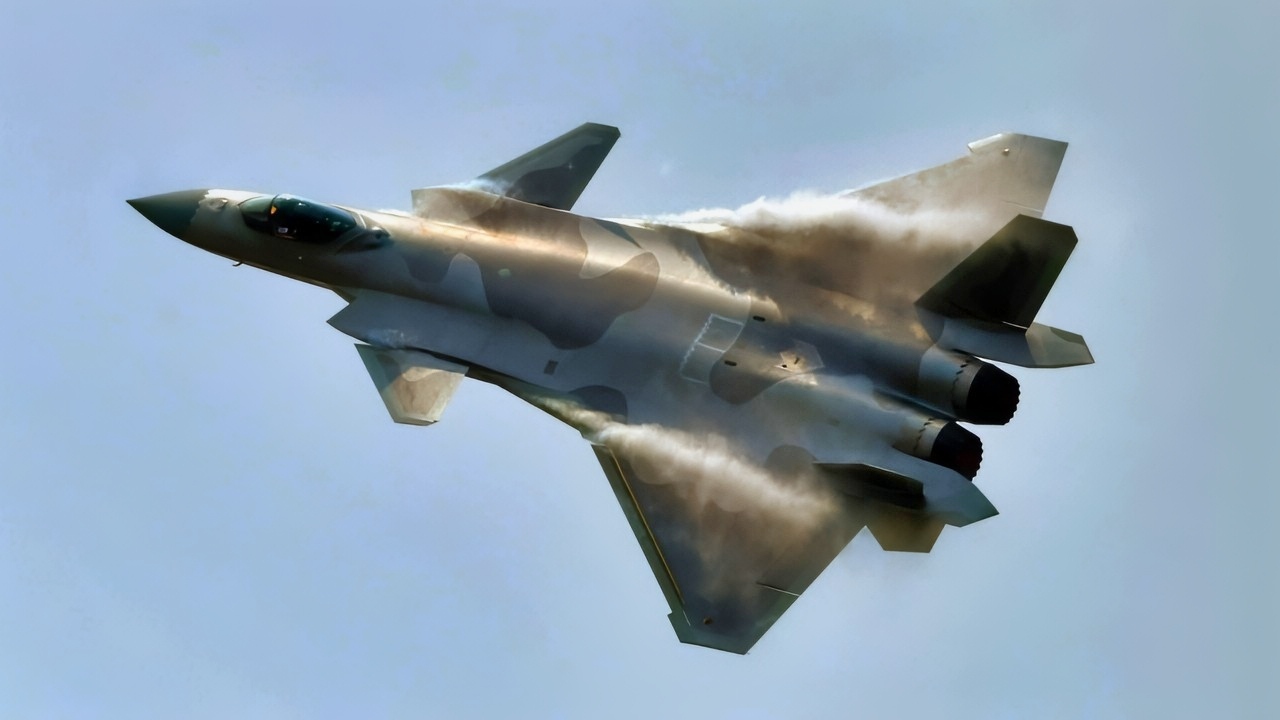
Key Points and Summary – Beyond speed and stealth, this analysis dives into which 5th-generation fighter is the better “quarterback in the sky”—America’s F-22/F-35 or China’s J-20.
-It explores the sensor fusion, networking, and drone-controlling abilities of each platform.
-While the J-20, particularly its two-seat variant, has impressive capabilities to network with other assets, it still lags in key areas.
-The F-35’s superior data fusion and software integration—combined with the combat-proven experience of U.S. platforms—give it the decisive edge in this critical quarterback duel.
Does China’s J-20 Have the “Quarterbacking” Abilities of the F-22 and the F-35?
One of the great ongoing debates in the realm of modern military aviation is the question of which country has the best 5th-generation stealth fighter: the United States of America with the F-22 Raptor and F-35 Lightning II (both built by Lockheed Martin’s legendary Skunk Works division), or the People’s Republic of China with the Chengdu J-20 Weilong (“Mighty Dragon;” NATO reporting name “Fagin”). (Yes, Russia has the Sukhoi Su-57 “Felon,” but it’s not as respected as the American and Chinese stealth offerings.)
Objectively speaking, the “Fagin” does have certain advantages over its US-made adversaries/counterparts: (1) a max airspeed speed advantage over the F-35 (Mach 2.0 versus a mere Mach 1.6); and (2) a combat range advantage over both the Lightning II and Raptor (1,100 nautical miles vs. 760 nautical miles and 750 nautical miles, respectively).
However, another question worth pondering is this: Is the J-20 as good a sensor platform and (to use an American football analogy) so-called “Quarterback in the sky” as the F-22 and F-35?
F-22 AS A QB
The F-22 is the oldest of all the operational stealth fighters, having officially debuted 20 years ago. It also suffers from the misfortune of no longer being in production, thanks to then-US Secretary of Defense (SECDEF) Bob Gates’s incredibly boneheaded and short-sighted decision back in 2009 to kill the Raptor after only 187 airframes were built out of the original 381 planned.
Despite its combination of growth stunting and comparative age, the Raptor proves quite capable as an aerial sensor and “aerial quarterback.”
As explained by then-Col. (now Maj. Gen.) Larry Broadwell, the Commander of the 1st Operations Group at Joint Base Langley-Eustis, Virginia, during a 2015 interview, “Because of its sensors, the F-22 is uniquely able to improve the battlefield awareness—not just for airborne F-22s but the other platforms that are airborne as well …The addition of SAR mapping has certainly enhanced our air-to-ground capability. Previously, we would have to take off with pre-determined target coordinates. Now, we have an ability to more dynamically use the SAR to pinpoint a target while airborne.”
“SAR” as in Synthetic Aperture Radar, which uses electromagnetic signals or “pings” to deliver a picture or rendering of the terrain below, allows for better target identification.
F-35 AS A QB
The F-35 is highly renowned for its interoperability. Indeed, as Air Commodore (equivalent of a Brigadier General/O-7 in the USAF) Angus Porter, the then-Air Attaché at the Australian in Embassy in Washington DC, told me during an April 2024 speaking engagement hosted by the Australian Returned and Services League (RSL) Washington DC Sub Branch, the Joint Strike Fighter’s interoperability and ability to communicate with the JSFs of foreign allies in the Indo-Pacific region is one of the warbird’s most desirable features.
As noted in a Lockheed Martin press release from late 2024, the Lightning II “has the capability to control drones, including the US Air Force’s future fleet of Collaborative Combat Aircraft. Recently, Lockheed Martin and industry partners demonstrated end-to-end connectivity including the seamless integration of AI technologies to control a drone in flight utilizing the same hardware and software architectures built for future F-35 flight testing.
These AI-enabled architectures allow Lockheed Martin to not only prove out piloted-drone teaming capabilities, but also incrementally improve them, bringing the US Air Force’s family of systems vision to life.”
J-20 AS A QB?
So then, how does the “Mighty Dragon” compare in that arena? Evidently, it’s no slouch. It’s equipped with high-speed data links that enable it to share sensor and targeting data with other aircraft, ground stations, and unmanned systems.
These capabilities are further boosted in the two-seater version of the warbird, the J-20S. The second crew member serves as a force multiplier, playing the roles of mission systems operator, managing ISR (intelligence, surveillance, reconnaissance) tasks, coordinating with drones, and interpreting sensor data in complex combat scenarios. This variant strengthens the aircraft’s ability to function as a command-and-control (C2) node in a broader ISR network.
However, it still has some weaknesses as a “QB” compared with the F-35, as it lags behind the Skunk Works plane in overall data fusion, software integration, interoperability, and battlefield connectivity. The Lightning II, whose avionics are designed to operate as part of a larger combat network, remains a more versatile platform in joint operations. Moreover, the F-22 and F-35 are both combat-proven platforms (the latter in the hands of American and Israeli fighter jocks alike).
By contrast, the J-20 and its crews are totally untested in real-world battle, which is unsurprising considering the fact that China hasn’t been in a major shooting war since the 1979 Sino-Vietnamese War.
So, at present, the F-35 and F-22 alike would still beat the J-20 in the metaphorical quarterback duel. Touchdown, USA.
About the Author: Christian D. Orr, Defense Expert
Christian D. Orr is a Senior Defense Editor. He is a former Air Force Security Forces officer, Federal law enforcement officer, and private military contractor (with assignments worked in Iraq, the United Arab Emirates, Kosovo, Japan, Germany, and the Pentagon). Chris holds a B.A. in International Relations from the University of Southern California (USC) and an M.A. in Intelligence Studies (concentration in Terrorism Studies) from American Military University (AMU).
Military Affairs
China’s Stealth Air Force Has 1 Mission


