


Key Points and Summary – The U.S. Navy has shelved its ambitious electromagnetic railgun, citing cost, technical risk, and brutal rail-wear issues.
-Japan is taking the opposite approach. Tokyo’s Acquisition, Technology & Logistics Agency has spent nearly a decade on its own railgun and recently conducted the first known firing of a ship-mounted system at a real target at sea.
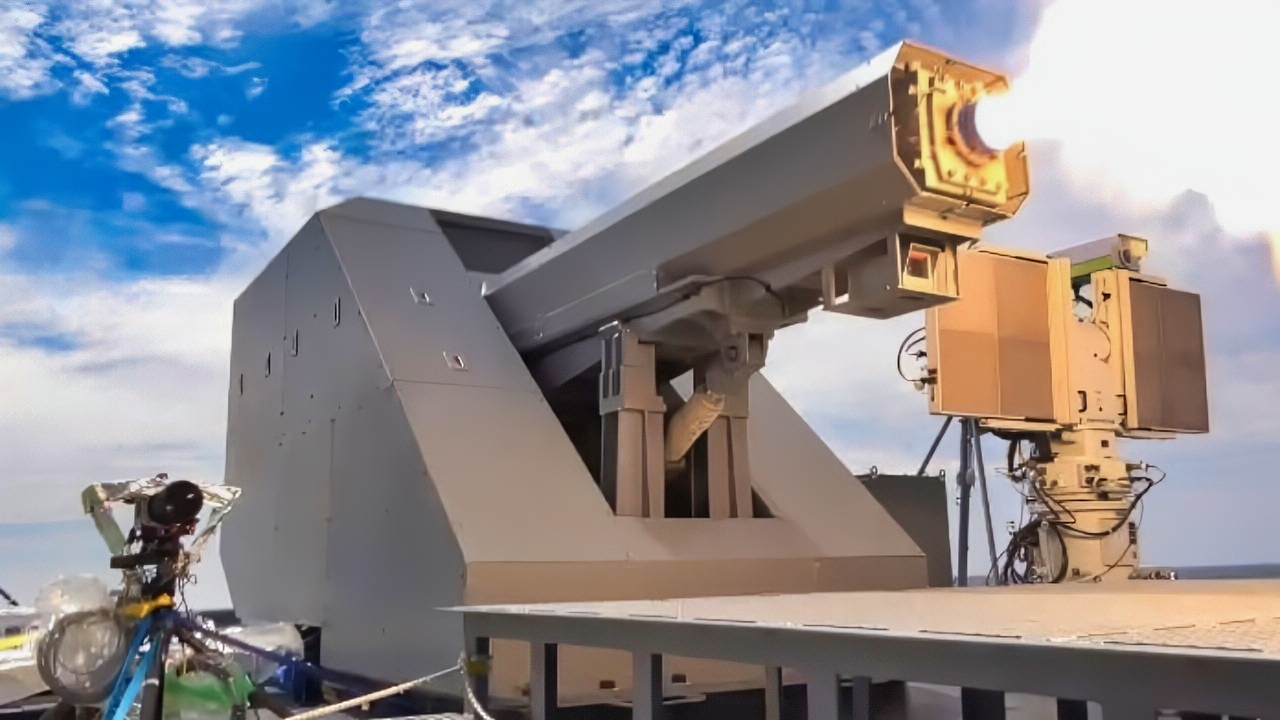
Japan Railgun X Screenshot. Image Credit: X.
-While the American hardware now lives on in university labs as a research tool, Japanese engineers are still chasing an operational weapon.
-With General Atomics quietly pitching a railgun for Trump’s proposed “Golden Dome,” the technology’s future may hinge more on politics than physics.
Japan’s Shipboard Railgun Test Shows the Weapon Isn’t Dead Yet
The weapon is a naval commander’s dream: a powerful, long-range system that can punch holes through warships many miles distant, rendering them unstoppable by conventional air defense measures, including kinetic interceptors.
Eschewing traditional explosive propellants, the railgun instead harnesses massive amounts of electrical power to hurl non-explosive metal projectiles.
The weapon in question—the railgun—is deeply alluring.
But it also presents complex engineering challenges, problems that, in the United States Navy at least, have been deemed too complex, too expensive, and too difficult to pursue. But there is another country that, despite the Navy’s gloomy assessment, is doubling down on the technology, unconvinced that the difficulties it presents are insurmountable: Japan.
Work Continues in Tokyo
Japan’s Acquisition, Technology & Logistics Agency, roughly analogous to the Pentagon’s Office of the Under Secretary of Defense for Acquisition and Sustainment, does have a railgun still in development for the Japan Self-Defense Forces—and that agency hopes it can develop the technology despite the railgun’s lack of future in the United States military.

U.S. Navy Railgun Test. Image Credit: Creative Commons.
The Japanese agency informed the public about the testing on X, formerly Twitter. “#ATLA conducted the Shipboard #Railgun Shooting Test from June to early July this year with the support of the Japan Maritime Self-Defense Force.” The agency also said that the recent testing event was “the first time that a ship-mounted railgun was successfully fired at a real ship.”
Similar to the Pentagon’s Office of the Under Secretary of Defense for Acquisition and Sustainment, the ATLA within Japan’s Ministry of Defense conducts research and development on various defense equipment to maintain Japan’s technological edge in the region.
Material published by Japan’s Ministry of Defense provides an overview of both the role that a railgun could play within the Japanese Self-Defense Forces and the materials and technologies crucial to the program.
The Acquisition, Technology & Logistics Agency began testing the railgun at sea in 2023, although the overall railgun research effort has been ongoing for almost ten years. It faces complex engineering challenges.
One of the principal difficulties the ATLA has faced—and indeed, other railgun research projects as well—is degradation of the system’s rails. The blisteringly high speeds to which railgun rails are subjected often result in rapid component degradation and rail wear.
Japan is not the only country to have seriously pursued railgun research. Captivated by the allure of inexpensive and very deep magazines, the technology promises, the US Navy was an early party to the railgun. But despite America’s early foray into the technology, the project was recently abandoned, with the Navy citing significant technological barriers and high costs.
However, while the US Navy no longer has an acute interest in the railgun weapon project, its efforts have been given new life, not by the Pentagon, but at the university level.
A Future in Academia?
While the railgun initiative pursued by the United States Navy ultimately proved unsuccessful, it may not mark the end of research into the technology. Following the end of their program, the U.S. Navy opted to donate its railgun equipment to a research university rather than let the progress made go to waste.
“When technology is constantly evolving, eventually the equipment used to operate high-power systems loses functionality,” the US Navy wrote in 2022. “However,” it added, “this doesn’t mean that the equipment can’t still serve a purpose. What is unusable to one person is valuable to another.”
It has since enjoyed a second lease on life. The US Navy explained that “the universities will benefit from obtaining this older equipment as they can now conduct high-energy, high-current experiments in their own labs. It provides a hands-on opportunity for students to learn about pulse power.”
While the U.S. Navy deemed the railgun too technically complex and difficult to scale, there is a glimmer of hope for the technology in the United States—albeit not with the US Navy, but in academia.
What Happens Now to the Railgun?
Just last month, General Atomics pitched its railgun during the annual Association of the United States Army gathering. Though GA’s railgun project has long been on ice, the company believes its railgun could be useful in supporting President Donald Trump’s proposed Golden Dome initiative.
“Just the idea of the muzzle velocity and the standoff capability, and particularly from our perspective, from a terminal defense for air [and] missile defense. Just this with the tungsten pellets as the warhead,” Mike Rucker, Head of GA-EMS Weapons, told Naval News.
Experts have questioned the viability of the Golden Dome, which, if realized, would potentially cost up to $175 billion over a three-year period. If that project comes to fruition, would the railgun be one of its components? For now, only time—and the Japanese—will tell.
About the Author: Caleb Larson
Caleb Larson is an American multiformat journalist based in Berlin, Germany. His work covers the intersection of conflict and society, focusing on American foreign policy and European security. He has reported from Germany, Russia, and the United States. Most recently, he covered the war in Ukraine, reporting extensively on the war’s shifting battle lines from Donbas and writing on the war’s civilian and humanitarian toll. Previously, he worked as a Defense Reporter for POLITICO Europe. You can follow his latest work on X.
The U.S. Navy’s Constellation-Class Frigate Crisis Keeps Getting Worse
China’s New H-20 Stealth Bomber Might Have a 10,000 km Range
Even Mach 3 Speeds Could Not Save the Titanium SR-71 Blackbird
The U.S. Navy’s New DDG(X) Destroyer Is Sailing Into Stormy Waters


