

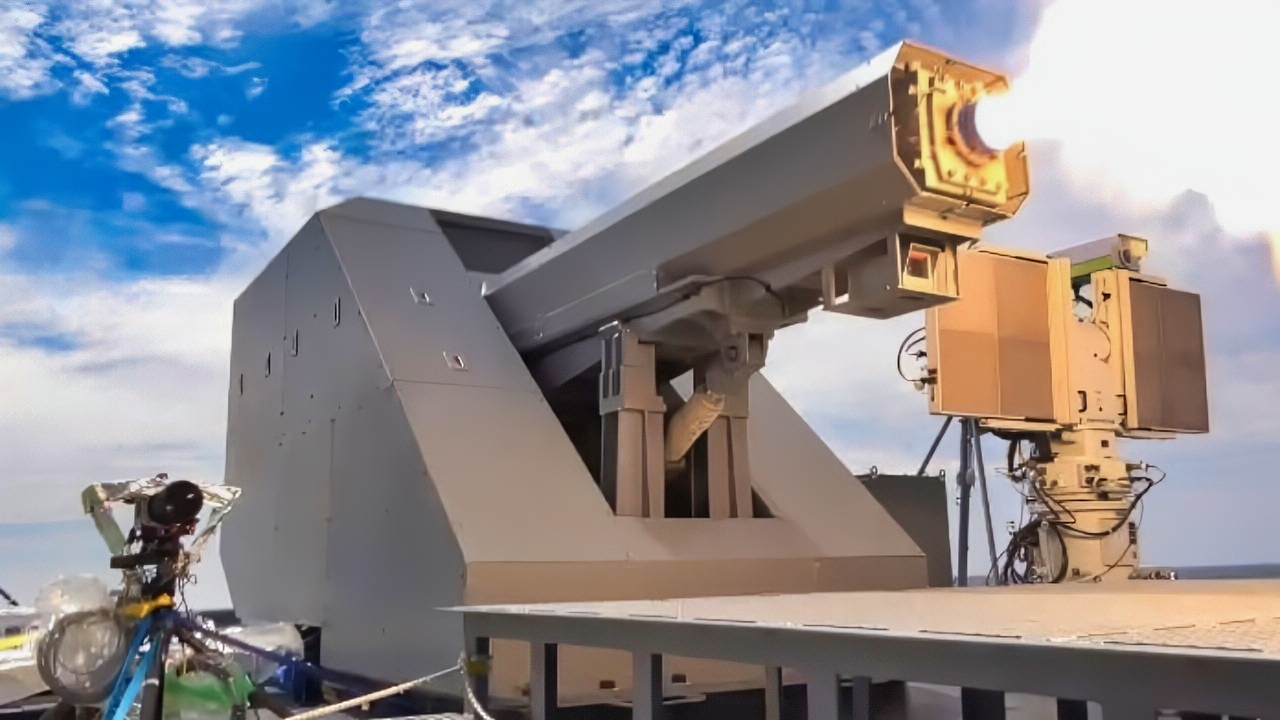
It was to be the naval weapon technology of the future, holding the tantalizing promise of very low per-shot shots, deep magazines, high precision, and long range. In 2007, the U.S. Navy even wrote that the tech represented the “next generation of naval guns.” The weapon in question? The railgun.
And yet, years later, the U.S. Navy still fields no railgun, while Japan is making significant strides in this technology. Why?
What Is a Railgun?
The railgun, as a concept, relies not on chemical propellants to launch projectiles but instead uses a series of magnets and vast amounts of electrical power to launch metal projectiles at mind-numbingly fast speeds.
Railgun projectiles are unique as well: rather than packing an explosive payload at their core, they are often of a uniform metallic construction and slam into targets with more force than a conventional warhead would be capable of.
At speeds in excess of Mach 6 or Mach 7 — six or seven times the speed of sound — the railgun’s destructive potential is formidable.
Insurmountable Technological Hurdles for the U.S. Navy
The Naval Surface Warfare Center Dahlgren Division led the railgun charge for the U.S. Navy and contracted with BAE Systems and General Atomics.
The grouping enjoyed some successes, with multiple test firings that showed promise. The project even managed to hit targets over 100 nautical miles distant, affirming that, in theory at least, the project was viable.
But the Navy also encountered some significant issues, despite the early successes.
Ultimately, however, the United States Navy decided to conclude its research into railgun technology in 2021.
Several engineering challenges proved too difficult to overcome. Among these was excessive barrel wear caused by the railgun projectile’s incredibly high speeds.
Another issue was how to integrate the weapon onboard U.S. Navy ships within the context of their layered defensive and offensive weapon systems, as well as generating the requisite amounts of electrical energy required to launch railgun projectiles.
After just 30 or so firings, the Navy’s railgun barrel needed replacement. Compared to the hundreds, if not thousands of shots, a conventional naval gun barrel can withstand, this rate of barrel attrition was completely unsustainable.
Onboard ship power systems, designed without intense railgun energy demands in mind, struggled to accommodate the experimental weapon, and integrating not just the railgun, but also its power requirements was a challenge.
Fiscal constraints on the U.S. Navy’s railgun program was a potent force as well. With other technologies gaining funding priority, including hypersonic weapons and lasers, the impetus behind railgun technology sagged and eventually evaporated.
Hypersonic missiles could more readily be integrated into the Navy’s existing architecture inside containerized vertical launch tubes, and laser weapons could draw on existent Navy ship energy generation capabilities without the need for any kinds of projectiles onboard, either explosive or kinetic.
After investing hundreds of millions of dollars in research funds, the Navy concluded that it could not feasibly field a railgun within a realistic timeframe.
The aforementioned budgeting priorities, combined with budget constraints and the tug of funding away and toward other projects, led to the project’s termination.
A Second Life
Though the U.S. Navy’s initiative was ultimately unsuccessful, it is not the end of the line for the hardware involved in the effort — rather than simply tossing the technology to the wayside or letting it moulder in a warehouse somewhere for decades, the Navy instead decided to donate its railgun equipment to several prominent research universities, part of an effort tor further their STEM initiatives.
“When technology is constantly evolving, eventually the equipment used to operate high-power systems loses functionality,” the U.S. Navy wrote in 2022. “However,” it added, “this doesn’t mean that the equipment can’t still serve a purpose. What is unusable to one person is valuable to another.” It has since enjoyed a second lease on life. The U.S. Navy explained that “the universities will benefit from obtaining this older equipment as they can now conduct high-energy, high-current experiments in their own labs. It provides a hands-on opportunity for students to learn about pulse power.”
While railgun technology may not have a place in the present-day United States Navy, perhaps the future United States Navy may benefit from the work on the technology completed in academia.
Postscript
Interestingly, the railgun as a conceptual weapon on warships continues, not in the United States, but in Japan.
Just recently, the country’s Acquisition, Technology & Logistics Agency, a department within the Japanese Ministry of Defense, took to X, formerly Twitter, to announce what it called the world’s first successful firing of a ship-mounted railgun at another ship while at sea.
So while railguns appear dead in the water in the United States, they’re still the subject of intense research on the Japanese islands.
About the Author: Caleb Larson
Caleb Larson is an American multiformat journalist based in Berlin, Germany. His work covers the intersection of conflict and society, focusing on American foreign policy and European security. He has reported from Germany, Russia, and the United States. Most recently, he covered the war in Ukraine, reporting extensively on the war’s shifting battle lines from Donbas and writing on the war’s civilian and humanitarian toll. Previously, he worked as a Defense Reporter for POLITICO Europe. You can follow his latest work on X.
More Military
Is the Age of the Tank Over Thanks to Drones?
China’s ‘Navy’ J-35 Stealth Fighter is Doing Elephant Walks
The B-21 Raider Has a Surprising Secret Out in the Open


