


Key Points and Summary: The USS United States (CVA-58) was a radical, flush-deck supercarrier designed in the late 1940s to launch heavy nuclear bombers, challenging the Air Force’s strategic monopoly.
The Design: It featured no island, four deck-edge elevators, and massive steam catapults to handle aircraft weighing 100,000 pounds.
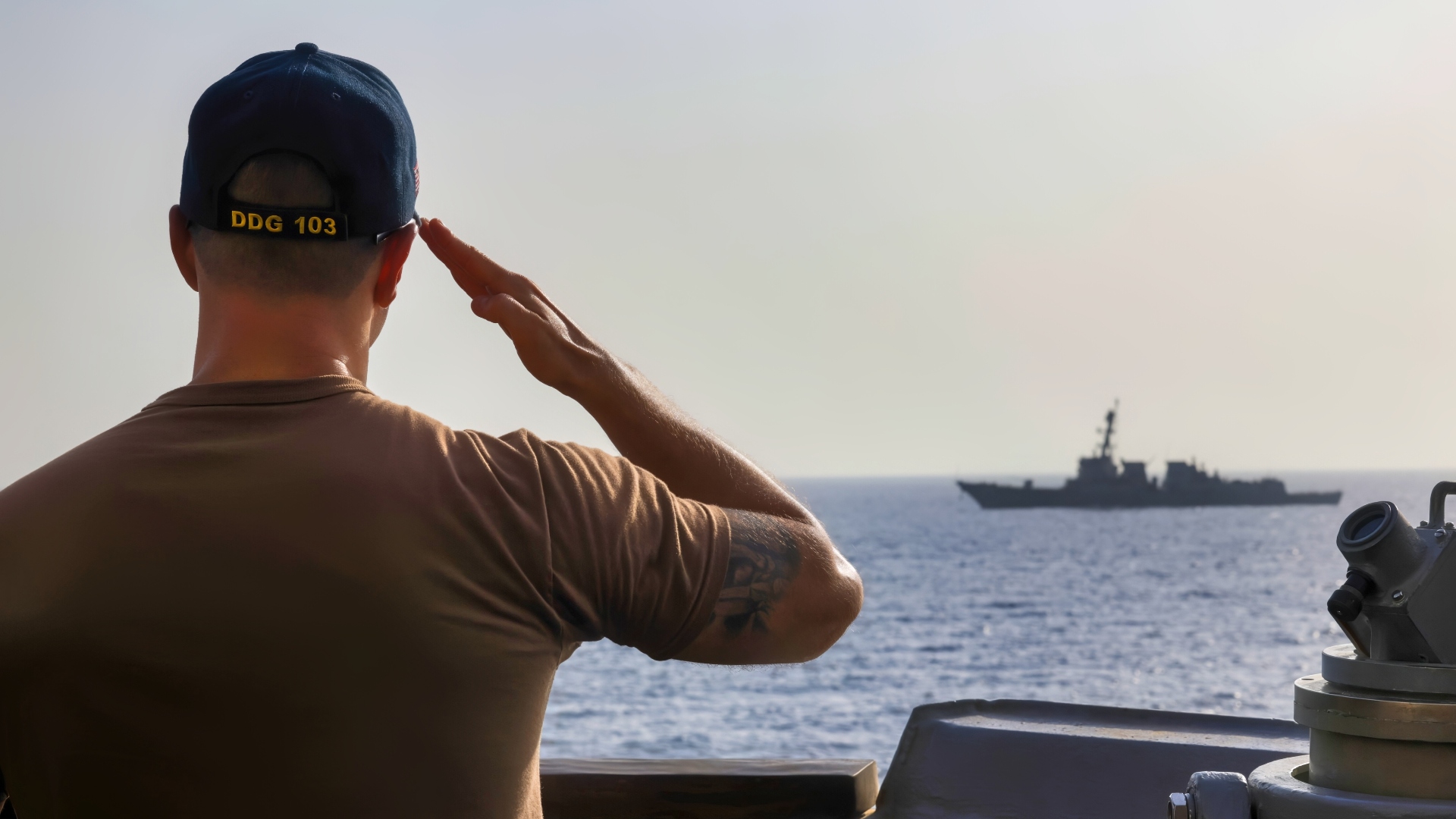
U.S. CENTRAL COMMAND AREA OF RESPONSIBILITY (Aug. 25, 2025) The executive officer of the Arleigh Burke-class guided-missile destroyer USS Truxtun (DDG 103) renders honors to the USS Forrest Sherman (DDG-98) aboard the USS Truxtun, in the U.S. Central Command area of responsibility. (Official U.S. Navy photo)
The Conflict: Canceled just five days after keel-laying by Defense Secretary Louis Johnson, it sparked the “Revolt of the Admirals” as the Navy fought for a nuclear role.
The Legacy: Though never built, its concepts—deck-edge elevators, stronger flight decks, and steam catapults—defined every supercarrier that followed, from the Forrestal to the Ford.
The USS United States Had a Message for the Air Force: ‘We Can Nuke Too’
In the late 1940s, the atomic bomb was huge, early jet bombers were heavier than anything seen at sea, and the Navy needed a credible way to deliver nuclear weapons independent of land bases.
The answer proposed by naval aviators was audacious: a carrier built from the keel up to launch long-range, heavy aircraft—essentially a sea-based strategic bomber force.
That ship became CVA-58, USS United States.
The idea wasn’t to replace the fleet’s attack aircraft carriers; it was to add a specialized flagship that could throw weight at intercontinental range and then let conventional carriers provide air cover, scouting, and day-to-day sea control.
The Design: Flush Deck, Giant Catapults, No Island for USS United States
CVA-58 looked like no previous American carrier. Designers erased the fixed island to clear the way for very large aircraft and parked the command and flight-control functions in movable or retractable gear.

Midway-Class. Image Credit: Creative Commons.
Four deck-edge elevators—kept off the strength deck to preserve structural integrity—were sized for bombers the Navy expected would mass around 100,000 pounds with early nuclear loads. Steam catapults were sited forward and along the deck edge, and the arresting gear and landing area were segregated to allow launch and recovery at the same time.
Even the stack arrangement was reconsidered, ducting exhaust away from the flight path to keep that vast deck as uncluttered as possible.
It was a purpose-built machine for one hard problem: getting enormous airplanes safely off—and back onto—a ship at sea.
Who Said “No,” and Why It Turned So Bitter
To the newly independent U.S. Air Force, a sea-based strategic bombing platform wasn’t a complement; it was a threat to roles, missions, and budgets. The Air Force had just staked the nation’s deterrence on the land-based B-36 and its successors.
Funding a parallel Navy nuclear option looked like duplication at best and sabotage at worst. Inside the Pentagon, Secretary of Defense Louis Johnson was under pressure to cut costs. A massive, novel carrier that implied a second strategic bombing arm was an inviting target
The fight spilled into public view. Senior Navy leaders argued the country needed survivable, mobile nuclear options; Air Force leaders countered that strategic bombing was their core mission and the cheapest path.
Five days after the keel-laying at Newport News in April 1949, Johnson canceled United States. The Secretary of the Navy resigned; Congress held hearings; careers were dented. We remember it as the “Revolt of the Admirals.” The ship became a shorthand for a larger brawl over what America’s military would be in the atomic age.
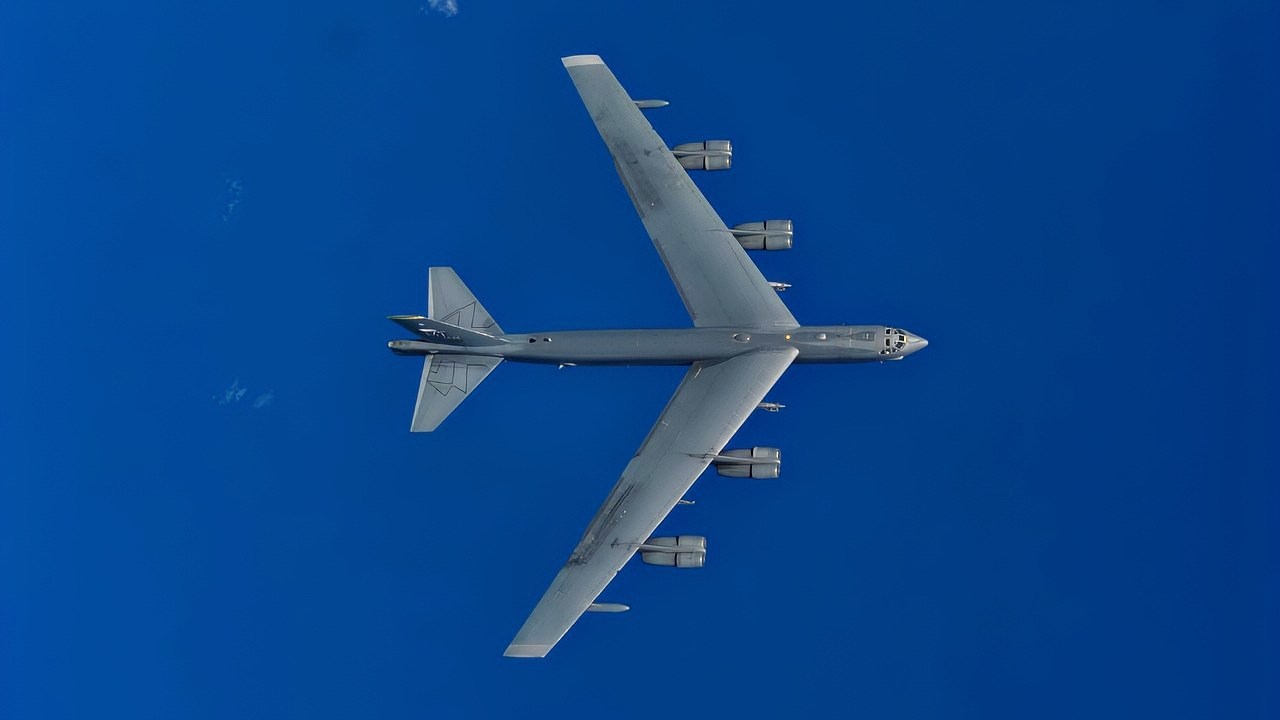
A B-52H Stratofortress from the 69th Bomb Squadron, Minot Air Force Base, N.D., flies over the Pacific Ocean during an international sinking exercise for Rim of the Pacific 2016 near Joint Base Pearl Harbor-Hickam, July 14, 2016. Twenty-six nations, more than 40 ships and submarines, more than 200 aircraft, and 25,000 personnel are participating in RIMPAC from June 30 to Aug. 4 in and around the Hawaiian Islands and Southern California. The world’s largest international maritime exercise, RIMPAC, provides a unique training opportunity that helps participants foster and sustain the cooperative relationships that are critical to ensuring the safety of sea lanes and security on the world’s oceans. RIMPAC 2016 is the 25th exercise in the series that began in 1971. (U.S. Air Force photo by Tech. Sgt. Aaron Oelrich/Released)
Why the Ship Was Canceled So Fast
Beyond the politics, there were practical reasons the axe fell quickly on USS United States:
Timing and Money. Postwar drawdowns collided with ambitious modernization. The easiest big bill to defer was the newest, least-understood one.
Mission Ownership. The Air Force’s strategic monopoly had strong backing, and the Joint Chiefs’ consensus fractured.
Technical Risk. A flush-deck carrier with no fixed island, handling unprecedented aircraft weights, would demand new procedures and hardware—achievable, but not cheap or quick.
When a major program lacks a unified champion and carries visible risk, cancellations move at speed.
USS United States: What the Navy Lost—and What It Quietly Kept
The abrupt kill felt like a strategic defeat for naval aviation. Yet the Navy walked away with more than hurt feelings. CVA-58 validated several ideas that would define the supercarrier era:
Bigger Decks, Bigger Machinery. The scale required for heavy jets—stronger decks, more powerful catapults and arresting gear—set the tone for the Forrestal class and beyond.
Deck-Edge Elevators. Moving big aircraft without punching holes in the flight deck proved so sensible it became standard.
Flight-Deck as Strength Deck. Building the ship around the flight deck’s structural role—stiff, robust, and ready for jet abuse—was baked into later designs.
Task-Group Thinking. The concept of pairing a “heavy hitter” with air-wing cover migrated into how supercarriers integrated with cruisers, destroyers, and later Aegis ships to fight as a single organism.
In other words: United States lost the budget fight and still steered the design conversation.
Could a Bomber Carrier Have Worked?
Operationally, yes—within its niche. Early nuclear weapons were bulky; early jet bombers were runway-hungry. A specialized ship with monster catapults would have solved that engineering problem.
But it would have done so at the price of flexibility. A deck optimized for a handful of giant bombers is not the same as a deck optimized for the 80–90 mixed aircraft that make a carrier decisive in day-to-day operations.
The Navy’s later path—build large, flexible supercarriers that can adapt with new air wings—turned out to be the more durable choice, especially after tactical nuclear weapons got smaller and aircraft more capable.

The Nimitz-class aircraft carrier USS Dwight D. Eisenhower conducts rudder turns during sea trials. Dwight D. Eisenhower completed a nine-month planned incremental availability at Norfolk Naval Ship Yard on June 10 and is scheduled to resume underway operations this summer.
The Korean War’s Verdict
The irony is that the very next year provided the clearest rebuttal to United States’ cancellation. In Korea, carriers proved they were indispensable—not as nuclear bomber trucks, but as mobile airfields for sustained conventional combat.
That experience hardened political support for carriers writ large, and it helped unlock the Forrestal program. The Navy didn’t get a bomber carrier; it got something better: big, flexible carriers that could evolve.
The Legacy: A Ship That Never Sailed but Still Won
Look at a Forrestal, a Kitty Hawk, a Nimitz, a Ford—big decks, powerful cats, deck-edge elevators, a strength deck that takes abuse, and an air wing that can morph with the times. Those are United States ideas, refined and made practical.
The flush-deck “no-island” concept fell away—radar, navigation, air traffic control, and flight-deck management needed a proper island as operations grew more complex—but the central lesson endured: scale matters when jet aircraft are your main battery.
CVA-58 didn’t launch a single airplane, but it launched an argument that the Navy ultimately won: carriers would remain central, not because they could sling the biggest bombers, but because they could adapt—to jets, to missiles, to networks, to whatever the next decade demands.
About the Author: Harry J. Kazianis
Harry J. Kazianis (@Grecianformula) is Editor-In-Chief and President of National Security Journal. He was the former Senior Director of National Security Affairs at the Center for the National Interest (CFTNI), a foreign policy think tank founded by Richard Nixon based in Washington, DC. Harry has over a decade of experience in think tanks and national security publishing. His ideas have been published in the NY Times, The Washington Post, The Wall Street Journal, CNN, and many other outlets worldwide. He has held positions at CSIS, the Heritage Foundation, the University of Nottingham, and several other institutions related to national security research and studies. He is the former Executive Editor of the National Interest and the Diplomat. He holds a Master’s degree focusing on international affairs from Harvard University.


