

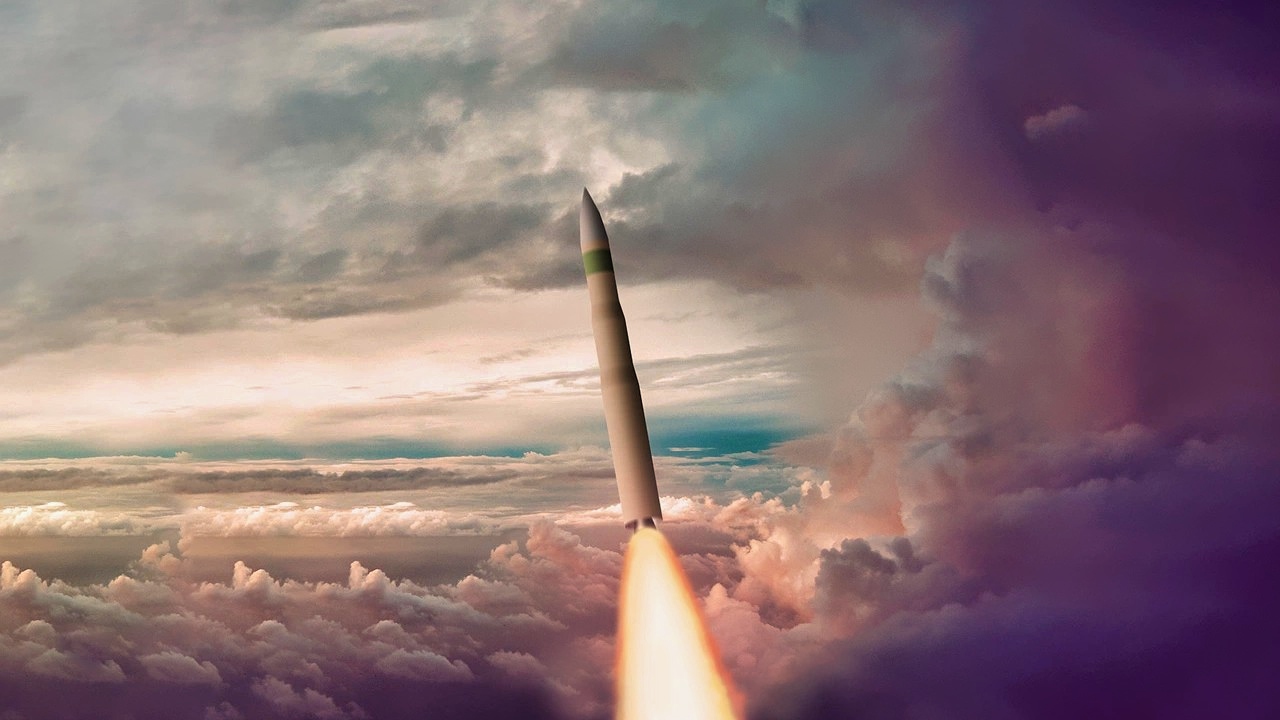
Lost in the shuffle of constant news of negotiations to finally end the U.S-Iranian war and the rise of fuel prices with a global oil shortage is the status of the American nuclear weapons program. Minuteman III ICBMs are aging and need to be replaced, but the expense is monumental. The newfangled Sentinel ICBM system is slated to cost $141 billion. That’s 81 percent higher than originally estimated.
Sentinel ICBM: Up, Up, and Away on Investment Costs

Sentinel ICBM. Image Credit: Creative Commons.
Secretary of Defense Pete Hegseth had highlighted the Sentinel as one of his 17 priorities at the beginning of his term. The new Department of the Air Force budget proposal for FY2027 requests $26.7 billion from the government. That’s double what it requested in FY2026.
The Air Force is now asking for over $1 billion for the Sentinel program. There needs to be 450 silos in five states. That also means hundreds of miles of new electrical lines and cables.
Three Air Force Bases Are Involved
This request comprises $632 million for F.E. Warren Air Force Base in Wyoming, $232 million for Minot Air Force Base in North Dakota, and $138.5 million for Malmstrom Air Force Base in Montana. The effort requires a huge rebuild of nuclear facilities.
Keeping Up with Russia and China
The Sentinel program is administered by Northrop Grumman, and this is the biggest nuclear infrastructure build-out in 60 years. China and Russia are improving their nuclear facilities and assembling more nuclear warheads. China has at least 600 nuclear warheads and wants 1,000 by 2030. The Department of Defense believes it must keep up and soldier on with the mega-expensive Sentinel program.
How Much Will We Spend?
The price tags on nuclear weapons are notoriously difficult to estimate. They almost invariably cost more than initially thought due to the complexity of manufacturing and the need to incorporate the latest scientific research into the painstaking process of nuclear detonation.
Congressional Oversight Law Is Triggered
In 2024, the Sentinel program incurred a Nunn-McCurdy breach. If a defense program exceeds a 25 percent cost overrun, Congress must be notified, and the program’s leaders are usually called to Capitol Hill to testify about what is causing the cost spike. Then the Pentagon must develop a plan to better cut expenses while still staying on schedule.
Waiting Until 2036
The Sentinel system may not be ready until 2036. This is hugely disappointing to lawmakers and the Pentagon, which have already invested so much time and money in the program.
The Sentinel ICBM is struggling to meet Milestone B, but could clear that hurdle this year. Milestone B is the manufacturing phase.
Groundwork Started in March
There has been some good news lately. Groundbreaking for a launch facility prototype has begun in Promontory, Utah.
“The silo prototype will validate a modular, repeatable construction approach designed to accelerate fielding, reduce cost growth, and enable learning before full-rate production. The shift to building new silos—rather than refurbishing legacy Minuteman III infrastructure—preserves uninterrupted alert coverage while enabling a modern, adaptable architecture,” the Air Force wrote in a news release.
Propulsion System Has Been Tested
Construction has also started on a new “Wing Command Center” at F.E. Warren Air Force Base, Wyoming, and the Sentinel missile program is advancing. Test firing on stages one, two, and three has started. There was also a “hot fire test” of the propulsion system. This evaluation period is going according to schedule as the program moves toward a scheduled flight test in 2027.
“This prototype is a critical step in proving the design and reducing risk before production,” said Brig. Gen. William S. Rogers, Air Force program executive officer for intercontinental ballistic missiles. “We are executing a disciplined acquisition strategy to deliver a fully integrated, operational weapon system on schedule.”
The Sentinel will be the largest construction project in the Air Force’s history. The Sentinel warheads will be gradually improved as the missiles come online.
Status of the Warhead
The Congressional Research Service wrote that “The Air Force plans to initially deploy the Sentinel with the W87-0 warhead currently on the Minuteman III. NNSA is developing the W87-1 warhead and plans to deliver a first production unit in FY2033. NNSA announced the qualification of the first war reserve plutonium pit for the W87-1 in October 2024. Lockheed Martin is developing the Mk21A reentry vehicle for the W87-1. DOD and NNSA are also modernizing the arming and fuzing assembly.”
Huge Tracts of Land
The Sentinel program is so complex because of the sheer size needed for the infrastructure. This requires 33,000 square miles – about the size of South Carolina, according to Air Force Global Strike Command Lt. Gen. Michael J. Lutton.
Once the program is complete, the Air Force will have 400 new Sentinel missiles that could serve into the 2070s.
Is This Program Worth It?
Concerned about the project’s cost overruns and long lead times. The Nunn-McCurdy breach has been disappointing, and the new construction that started in March looks like a decent development. But if this program needs a billion dollars a year, we are talking about a significant amount of money to keep this in business throughout the next decade.
Future Investment Is Needed for Trump Marquee Defense Projects
The Trump administration has requested a $1.5 trillion defense budget for FY2027, an unprecedented amount. But there are many “hungry mouth” programs with monikers like the “Golden Dome” and the “Golden Fleet” with price tags that have not been fully forecasted in out years.
Is There Really Strong Momentum for This Program?
Air Force leadership will likely point to the recent groundbreaking as evidence that momentum has been created in the program that has been so problematic, but the sheer amount of construction is intimidating to the Air Force, which is not known for civil engineering prowess. This is a branch more concerned with bombers and fighters, not a multi-state construction program across three air bases.
The Congressional Research Service is keeping a close eye on the program and will inform lawmakers on the current state of the effort to prevent another cost breach, but the Sentinel is such an ambitious project that there could be further delays and cost overruns. We will update you on the Sentinel’s progress and make sure that the Air Force does not have any more problems that could affect the readiness of this all-important ground segment of the U.S. nuclear triad.
About the Author: Brent M. Eastwood, PhD
Author of now over 3,500 articles on defense issues, Brent M. Eastwood, PhD, is the author of Don’t Turn Your Back On the World: A Conservative Foreign Policy and Humans, Machines, and Data: Future Trends in Warfare, plus two other books. Brent was the founder and CEO of a tech firm that predicted world events using artificial intelligence. He served as a legislative fellow for US Senator Tim Scott and advised the senator on defense and foreign policy issues. He has taught at American University, George Washington University, and George Mason University. Brent is a former US Army Infantry officer. He can be followed on X @BMEastwood.


