

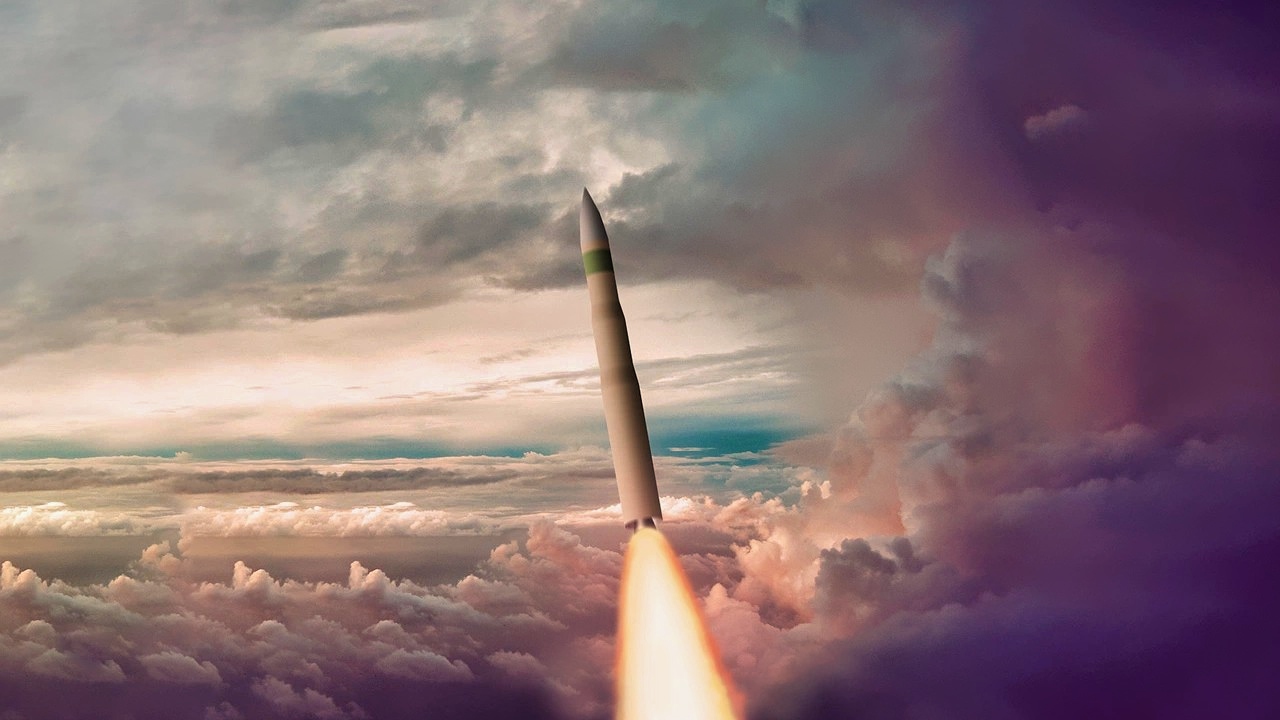
Key Points and Summary on the LGM-35A – The LGM-35A Sentinel program, intended to modernize the land-based leg of the U.S. nuclear triad, is a “nightmare” of mismanagement and cost overruns.
-The project, which replaces the 1970s-era Minuteman III ICBM, has breached the Nunn-McCurdy Act due to its budget soaring to nearly $141 billion and its schedule slipping by at least two years.

Russian Mobile ICBM Nuclear Weapons. Image Credit: Creative Commons.
-In a stunning oversight, the new missiles are too large for the existing silos, forcing costly and time-consuming new construction.
-These severe setbacks create a dangerous capability gap as adversaries like China and Russia rapidly expand their own nuclear arsenals.
The LGM-35A Sentinel Challenge
Dictionary.com defines the word “sentinel” as either “a person or thing that watches or stands as if watching” or “a soldier stationed as a guard to challenge all comers and prevent a surprise attack” (synonymous with the word “sentry”).
The second definition makes the word highly apropos as the moniker for America’s next generation of nuclear intercontinental ballistic missile (ICBM), standing ready to deter a nuclear attack from the adversaries of the US. The LGM-35A Sentinel is set to replace the aging stockpile of 400 Minuteman III ICBMs, which first entered service with the US Air Force back in 1970.
However, the Sentinel is running afoul of problems that are hampering its prospects for bringing the US nuclear arsenal up-to-date in a timely fashion.
Bottom Line Up Front (BLUF): Sentinel Shortcomings
It all boils down to two things: (1) the oh-so-dreaded cost and schedule overruns that infamously plague the US defense acquisition process (something that both President Donald Trump and Secretary of Defense [SECDEEF] Pete Hegseth are seeking to reform), and (2) a lack of adequate physical space in existing US missile silos.
Regarding the monetary issue, a July 12, 2025 article on the Archyde news aggregator website titled “Sentinel Missile Program Plummets Into Cost Overruns: “The Air Force recently notified Congress of a Nunn-McCurdy breach, indicating that the program’s expenditures have exceeded projected budgets by a substantial margin—perhaps 30 percent or more—and its timeline for initial operational capability has been delayed by at least two years. This progress has forced the Air Force to consider extending the service life of its current Minuteman ICBMs, a stopgap measure that underscores the gravity of the Sentinel program’s setbacks.”

DF-41 ICBM from China. Image Credit: Creative Commons.
As of May 2025, cost projections of the program had skyrocketed to nearly $141 billion.
The Nunn-McCurdy Amendment is named for now-retired Senator Sam Nunn (D-GA) and retired Congressman Dave McCurdy (D-OK) and was introduced as part of the 1982 Defense Authorization Act. It was designed to ensure accountability in defense spending, mandating that Congress be informed of significant cost or schedule deviations. A breach of this act typically triggers a mandatory review and requires high-level certification from the SECDEF to continue.
Regarding the spatial issue, the original plan was to simply reuse the original missile silos (or to use the official USAF jargon, “launch facilities (LFs)” currently housing the Minuteman IIIs as the new homes for the Sentinels.
However, upon further review, it turns out that the existing LFs are inadequate to host the proverbial new kids on the nuclear block, which will cost the USAF additional precious time and resources building new silos. In the words of Mackenzie Knight, a senior research associate for the Nuclear Information Project at the Federation of American Scientists (FAS), “I would say, at best it comes down to mismanagement and incompetence, and at worst, an intentional effort to downplay the complexities and challenges of the Sentinel program to make it appear like it would be the cheaper, easier option over just extending the service life of the current force.”
LGM-35A Technical Specifications and Vital Stats
Northrop Grumman has been tapped as the sole-source contractor for the new missile. Most of the physical dimensions of the Sentinel remain shrouded in secrecy. Once the height and diameter dimensions of the new missiles are finally released, it will be interesting to see exactly how much that has factored into the size incompatibility of the Minuteman III silos; the older missile is 59.9 feet (18.3 meters) in length and 5.5 feet (1.68 meters) in diameter.

Sentinel ICBM. Image Credit: Creative Commons.
Meanwhile, we do know that it will carry the standard W87 warhead and the W87-1 upgraded warhead, which pack payloads of 300 kilotons and 475 kilotons of TNT, respectively.
For the basis of comparison and contrast, the Minuteman III primarily employs the original W87 and, to a lesser extent, the W78 warhead, which yields a 335-350 kiloton payload.
The Way Forward?
The sense of urgency for the US to get the Sentinels up and running cannot be stressed enough in light of the ever-growing specter of the nuclear weapons programs of America’s adversaries.
For example, between 2014 and 2024, the People’s Republic of China doubled down on the size of its nuclear warhead arsenal, from 250 to 500. The Russian Federation’s nuke modernization and force expansion continue unabated.
The Democratic People’s Republic of Korea is enhancing its own ability to wage nuclear warfare via improvements to the accuracy of its ICBMs, enhancements to its tactical nukes, and the development of a nuclear-capable submarine. And despite the tactical success of Operation Midnight Hammer, the Islamic Republic of Iran remains determined to pursue nuclear power. However, that country’s officials still ostensibly insist that it’s merely for peaceful purposes.
MORE – A 7th Generation Fighter Could Fire Lasers
One bit of good news amongst all of these disturbing developments is that at least one component of the US nuclear strategic triad has already been upgraded in a timely fashion: the air-dropped—as in from a strategic bomber aircraft—nuclear gravity bombs.
Back on May 19, 2025, the National Nuclear Security Administration (NNSA) announced that production of the first B61-13 variant nuclear bomb was completed ahead of schedule at the Pantex plant in Amarillo, Texas.
One can only hope that the monetary and logistical obstacles to the Sentinel are cleared sooner rather than later, so the ICBM leg of America’s nuclear triad finally catches up with the strategic bomber leg.
About the Author: Christian D. Orr, Defense Expert
Christian D. Orr is a Senior Defense Editor. He is a former Air Force Security Forces officer, Federal law enforcement officer, and private military contractor (with assignments worked in Iraq, the United Arab Emirates, Kosovo, Japan, Germany, and the Pentagon). Chris holds a B.A. in International Relations from the University of Southern California (USC) and an M.A. in Intelligence Studies (concentration in Terrorism Studies) from American Military University (AMU).
More Military
The U.S. Navy’s Submarine Crisis Is Real


Don Winslow
July 14, 2025 at 10:29 pm
The Air Force has stated the Sentinel is lighter than the Minuteman III but more capable so size doesn’t seem to be an issue. This decrease in weight could also make a mobile version more viable. According to the AF these 50+ year old silos would need to last another 50 years if utilized for the Sentinel and that might not be feasible.