

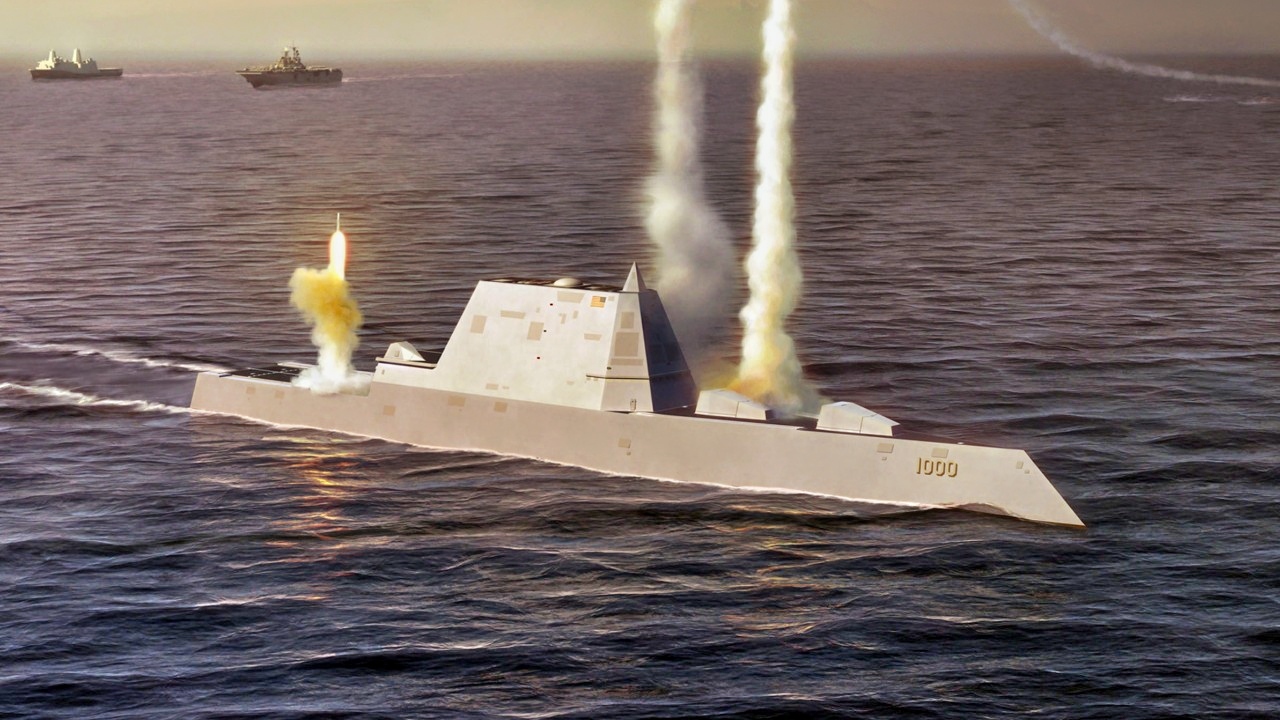
Key Points and Summary: The U.S. Navy plans to salvage the troubled Zumwalt-class destroyers by basing them in Hawaii and arming them with Conventional Prompt Strike (CPS) hypersonic missiles by 2030.
The Pivot: After the 155mm Advanced Gun System failed (with ammo costing $800,000 per round), the Navy is refitting the ships to launch Mach 5+ hypersonic glide vehicles.

Zumwalt-class Guided Missile Destroyer USS Michael Monsoor (DDG 1001) transits the Pacific Ocean, June 25, 2022. Twenty-six nations, 38 ships, four submarines, more than 170 aircraft and 25,000 personnel are participating in RIMPAC from June 29 to Aug 4 in and around Hawaiian Islands and Southern California. The world’s largest international maritime exercise, RIMPAC provides a unique training opportunity while fostering and sustaining cooperative relationships among participants critical to ensuring the safety of sea lanes and security on the world’s oceans. RIMPAC 2022 is the 28th exercise in the series that began in 1971.
The Strategy: Stationing the stealthy ships in Pearl Harbor places them closer to the Indo-Pacific, acting as a “force multiplier” against China’s A2/AD defenses.
Congresswoman Jill Tokuda is raising critical questions about infrastructure readiness in Hawaii and why the U.S. trails China in hypersonic development.
Zumwalt-Class Destroyer: Can The Navy Save the Stealth Warship?
A Hawaii congresswoman has questions for the U.S. Navy about the future of the Zumwalt-class destroyer. The Navy plans to base three Zumwalt-class guided-missile warships in Hawaii and arm them with the Conventional Prompt Strike (CPS), a planned hypersonic missile.
Representative Jill Tokuda is wondering how the three ships will fit into basing requirements that could affect the local economy and require infrastructure changes in the coming years. Tokuda wants more clarification by the Navy. She understands the strategic ramifications of the Department of Defense wanting more warships to transit the Indo-Pacific, but her district needs more exact information before she is fully on board with the proposal.
Can Hypersonic Weapons Save the Zumwalt-class From Failure?
The plan is to bring the destroyers to Pearl Harbor by 2030, when the CPS is ready to be deployed. The basing of the ships should have positive economic impacts for Hawaii due to more sailors being transferred there, but there are questions about housing and other requirements for the new personnel.

(July 28, 2022) U.S. Navy Zumwalt-class guided-missile destroyer USS Michael Monsoor (DDG 1001) sails in formation during Rim of the Pacific (RIMPAC) 2022, July 28. Twenty-six nations, 38 ships, three submarines, more than 30 unmanned systems, approximately 170 aircraft and 25,000 personnel are participating in RIMPAC from June 29 to Aug. 4 in and around the Hawaiian Islands and Southern California. The world’s largest international maritime exercise, RIMPAC provides a unique training opportunity while fostering and sustaining cooperative relationships among participants critical to ensuring the safety of sea lanes and security on the world’s oceans. RIMPAC 2022 is the 28th exercise in the series that began in 1971. (U.S. Navy photo by Mass Communication Specialist 3rd Class Aleksandr Freutel)
The congresswoman should also be concerned about the overall status of the Zumwalt-class. The three ships were once considered so stealthy that they would appear as a “small fishing boat” on radar. They have a distinct shape to absorb radar waves, with smooth curves and none of the sharp edges that would set off enemy sensors.
This Was a Program Filled with Headaches for the Navy
The Zumwalts were designed as next-generation multi-mission destroyers that would lean on stealth to better survive against enemy ships and airplanes.
The Navy once wanted 32 of these destroyers, but the cost overruns were prohibitive, and only three were built. The ships are also maintenance-heavy and expensive to keep in the water.
The main gun was faulty. Some critics have wondered if the money sunk into the Zumwalt-class would have been better spent building more submarines.
The first of the class, the USS Zumwalt (DDG-1000), was the largest and most costly destroyer ever built. General Dynamics spent $40 million just to make a special facility to produce the ships. That gives you an idea of the magnitude of the program and its expenses. The entire program ballooned to 50 percent greater cost than expected.
Gun System Is a Dud
The 155-mm main gun, known as the Advanced Gun System, never worked—and each round was going to cost $800,000. The Navy decided to mate the Zumwalts with hypersonic missiles instead.
But Conventional Prompt Strike Hypersonic Could Save the Day
The CPS will be able to strike after traveling at speeds greater than Mach 5; it will be maneuverable in flight and would be the first-sea based hypersonic weapon.
Having Zumwalts with CPS stationed in Hawaii would be a force multiplier for the Navy. It would place the missiles closer to East Asia, and the ships could be deployed with a carrier strike group to increase firepower for the flotilla.
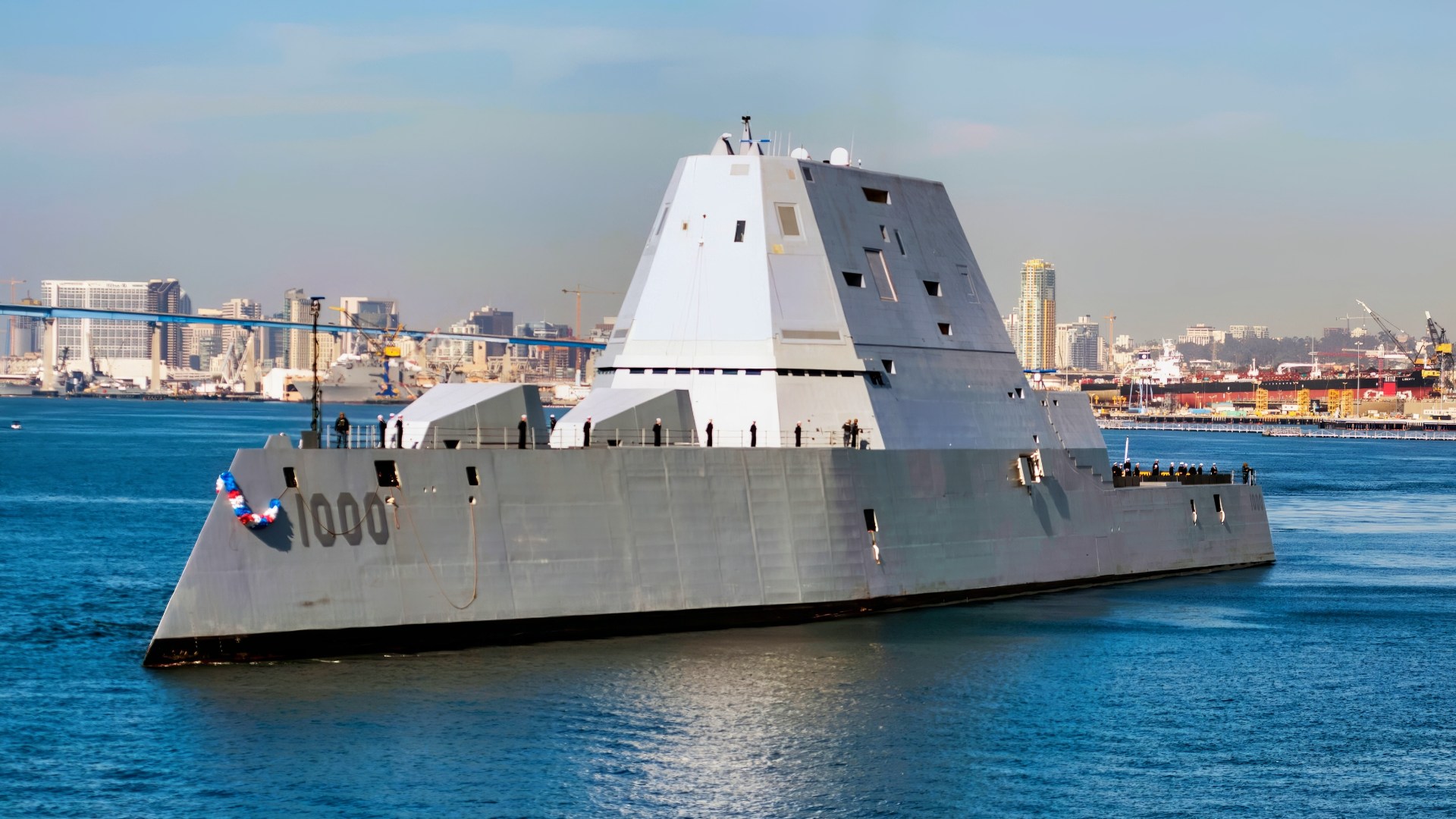
(Dec. 8, 2016) The guided-missile destroyer USS Zumwalt (DDG 1000) arrives at its new homeport in San Diego. Zumwalt, the Navy’s most technologically advanced surface ship, will now begin installation of combat systems, testing and evaluation and operation integration with the fleet. (U.S. Navy photo by Petty Officer 3rd Class Emiline L. M. Senn/Released)
“Representative Tokuda explained that she is formally requesting additional information on the planned arrival of hypersonics and the destroyers carrying them, emphasizing the need to inform residents about what such basing means for communities and servicemembers,” according to Army Recognition.
Tokuda is rightfully concerned about effects on the population, but this should be explainable by the Navy in a hearing. Tokuda sits on the House Armed Services Committee. More concerning for the Navy is that Tokuda is aware that China has taken the lead in hypersonic weapons development.
She wants to know why CPS is taking so long to develop after Beijing leapt ahead. These will be uncomfortable discussions for admirals and civilian leaders of the Navy.
How Does CPS Work?
Tactically, the Zumwalt-CPS pairing is a valuable concept. The missile has an aerodynamic projectile that launches up to the earth’s atmosphere with a booster; then the vehicle glides down at Mach 5-plus speed to destroy a target. It will be able to change its flight path for better survivability.
The Zumwalt-class needs some good news. A concerned member of Congress is maybe a positive development, because, if the stealth destroyers find a new home in Hawaii, Tokuda may become a champion of the Zumwalt and the CPS.
This often happens when a representative feels like they “own” a weapon system stationed in their district.
The Navy should answer Tokuda’s questions quickly for this very reason.
This should not be a heavy lift. What will be difficult is the pairing of a new weapon with the hard-luck Zumwalt-class. Difficult as the path may be to get there, it could save a troubled, expensive program that has yet to live up to its potential.
Let’s hope the Navy can answer the congresswoman’s concerns and transform her into an advocate for the program. The Zumwalt-class had endured congressional scrutiny before, given its high price tag and difficulties with the main armament onboard.
The CPS could be what makes it relevant for the 2030s.
About the Author: Brent M. Eastwood
Author of now over 3,000 articles on defense issues, Brent M. Eastwood, PhD is the author of Don’t Turn Your Back On the World: a Conservative Foreign Policy and Humans, Machines, and Data: Future Trends in Warfare plus two other books. Brent was the founder and CEO of a tech firm that predicted world events using artificial intelligence. He served as a legislative fellow for US Senator Tim Scott and advised the senator on defense and foreign policy issues. He has taught at American University, George Washington University, and George Mason University. Brent is a former US Army Infantry officer. He can be followed on X @BMEastwood.


