

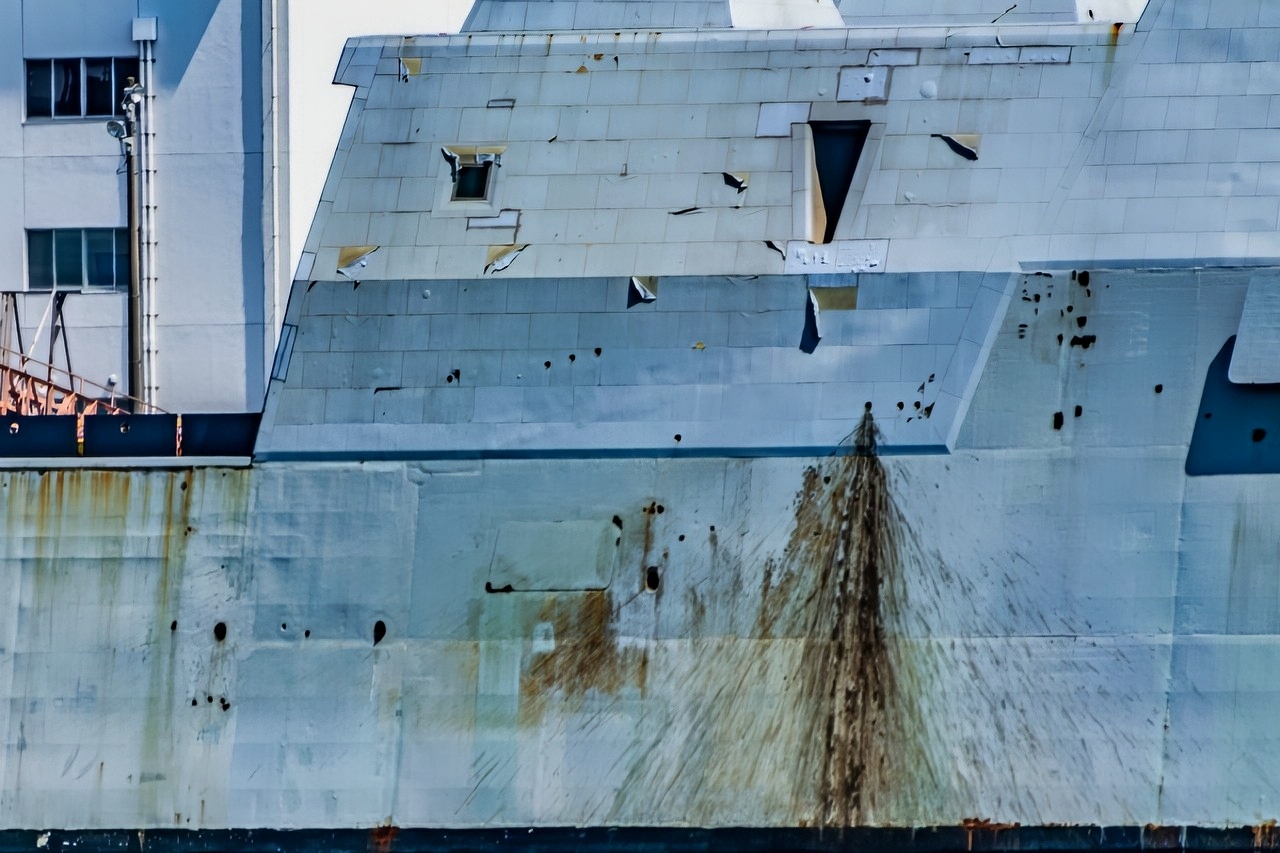
Key Points and Summary – The USS Michael Monsoor, a $9 billion Zumwalt-class stealth destroyer, recently arrived in Yokosuka, Japan, with its appearance sparking online mockery and concern.
-Photos show the futuristic warship covered in streaks of corrosion and discoloration. While the U.S. Navy has dismissed the decay as simple “cosmetic wear” that doesn’t affect performance, the poor optics are notable for such an expensive vessel.

Zumwalt-class Guided Missile Destroyer USS Michael Monsoor (DDG 1001) transits the Pacific Ocean, June 25, 2022. Twenty-six nations, 38 ships, four submarines, more than 170 aircraft and 25,000 personnel are participating in RIMPAC from June 29 to Aug 4 in and around Hawaiian Islands and Southern California. The world’s largest international maritime exercise, RIMPAC provides a unique training opportunity while fostering and sustaining cooperative relationships among participants critical to ensuring the safety of sea lanes and security on the world’s oceans. RIMPAC 2022 is the 28th exercise in the series that began in 1971.
-This visible disrepair is symbolic of the entire troubled Zumwalt program, which has been plagued by drastically scaled-down production and functionally useless main guns, raising questions about its overall effectiveness.
Zumwalt-Class: America’s $9 Billion Warship Has Seen Better Days
Last week, the USS Michael Monsoor arrived in Yokosuka.
But it wasn’t the humongous ship itself turning heads, but the state of disrepair it seems to be in.
New photos of the Zumwalt-class guided-missile destroyer show the Navy’s most futuristic surface combatant looking, well, a little worse for wear.
Streaks of corrosion, patches of discoloration, and what looks like surface damage have sparked a flurry of sarcastic comments and concern online.
X Users Mock Ageing Ship
One Japanese social media user joked that you’d need “courage to go into battle with this.”
Another wrote, “Better to just shout loudly to drown out the sound,” in a dig at the ship’s supposed stealth. More seriously, some questioned whether this visible decay might compromise the ship’s radar-deflecting design.
Officially, the Navy is keen to act like it is nothing to be concerned about.
One U.S. spokesperson told the press that corrosion and visible staining are standard for a vessel of this size and length of time at sea.“Cosmetic wear,” via sunlight, saltwater, and its work, they insisted, “doesn’t affect performance.”
But the optics are hard to ignore, especially for a ship that cost more than $9 billion. Oh, and the Zumwalt-class is supposed to be stealthy.
Zumwalt-Class Destroyer Fleet Was Meant to be Bigger
The U.S. Navy only ever built a trio of Zumwalt-class destroyers, and the Michael Monsoor is one of them.
The fleet was initially supposed to be 32-strong, but evolving priorities and budgets scaled down the mammoth project.

(July 28, 2022) U.S. Navy Zumwalt-class guided-missile destroyer USS Michael Monsoor (DDG 1001) sails in formation during Rim of the Pacific (RIMPAC) 2022, July 28. Twenty-six nations, 38 ships, three submarines, more than 30 unmanned systems, approximately 170 aircraft and 25,000 personnel are participating in RIMPAC from June 29 to Aug. 4 in and around the Hawaiian Islands and Southern California. The world’s largest international maritime exercise, RIMPAC provides a unique training opportunity while fostering and sustaining cooperative relationships among participants critical to ensuring the safety of sea lanes and security on the world’s oceans. RIMPAC 2022 is the 28th exercise in the series that began in 1971. (U.S. Navy photo by Mass Communication Specialist 3rd Class Aleksandr Freutel)
The ship’s advanced 155mm guns, once central to its role supporting amphibious landings, have been rendered functionally useless because the Navy never bought ammunition for them.
Now, the Navy is attempting to retrofit the Zumwalt-class ships for hypersonic weapons under its Conventional Prompt Strike program. Whether that salvages the class’s relevance remains to be seen.
Big Spending, Small Results?
Critics argue that the images from Yokosuka reinforce what has long been suspected: the Zumwalt program is a cautionary tale of military overreach, grand promises, substantial spending, and underwhelming delivery.
And when your $9 billion stealth destroyer looks like it’s been left out in the rain too long, it’s not just embarrassing, it’s symbolic.
The Zumwalt obviously has many plus points. These boats are equipped with advanced sensors and their ultra-low radar profile makes them among the best warships in operation.
But for all the high-tech engineering, the takeaway from Yokosuka is simple: the Navy’s most expensive destroyer may be operational, but it sure doesn’t look the part.
And in an era of growing maritime competition, appearances matter more than the Pentagon might like to admit.
About the Author:
Georgia Gilholy is a journalist based in the United Kingdom who has been published in Newsweek, The Times of Israel, and the Spectator. Gilholy writes about international politics, culture, and education.
Fighter Jet Fails
Russia’s Su-57 Felon Stealth Fighter Is a Waste of Rubles


David
August 5, 2025 at 3:51 am
I’ll never understand the people who expect tools to look like they aren’t used. Having spent 20 years working on Air Force aircraft I can say that the only thing this article proves is that the author is either completely clueless about anything military related or is actively trying to spread anti American propaganda. Having read more than a few articles from this site it’s not just this author doing this. It’s a trend and it’s really obvious. The days of actual reporting are long over, now we have this garbage to look forward to in our news feeds.
Capt Curmudgen
August 6, 2025 at 10:55 pm
Yeah stupid article. Ship is huge, minimally manned and no safe way to work over the side at sea and paint the rusting areas.
Pingback: Yet Another US Navy Surface Ship Fiasco | The Libertarian Institute