


Key Points and Summary – The Sturgeon-class (SSN-637) submarines were the U.S. Navy’s Cold War backbone: more than three dozen nuclear attack boats that shifted undersea warfare from diesel limits to endurance, quieting, and sensors.
-Born from lessons after Thresher’s loss and early SSN experiments, they carried better sonars, towed arrays, and weapons like SUBROC, Harpoon, and later Mk 48/ADCAP and Tomahawk.
-They stalked Soviet subs, worked the Arctic, and supported clandestine intelligence missions, while surviving collisions and hard operating environments that demanded changes in training and design.
-Replaced by Los Angeles-class boats in the 1980s–90s, the Sturgeons left a legacy of SUBSAFE rigor, acoustic discipline, and tactics that still shape the force.
Sturgeon-Class Submarines: The Quiet Backbone Of America’s Cold War Undersea War
By the early 1960s, diesel-electric submarines had hit a wall. They could be stealthy in short doses, but batteries ran down fast at speed, snorkels betrayed their presence, and the rhythm of surfacing to breathe made their movements predictable to radar, patrol aircraft, and destroyers.
Nuclear power erased those constraints. A pressurized-water reactor gave a submarine air-independent endurance and sustained underwater speed—the ability to stay submerged for weeks and choose when to be found. In a world where the Soviet Union was deploying faster attack boats and missile-carrying submarines, the U.S. needed hunters that could range, sprint, and persist in the open ocean.
Early nuclear boats proved the concept but not yet the operating model. The loss of USS Thresher (SSN-593) in 1963 was the tragic inflection point. The Navy responded with SUBSAFE, a cradle-to-grave safety and quality program covering material, processes, testing, and certification for seawater-boundary systems. The next major class to fully embody that rigor—and to embed nuclear power as the Navy’s default for attack submarines—was the Sturgeon-class.
Building A Fleet At Scale
The Navy didn’t buy a handful of Sturgeons; it built a fleet’s worth. From the late 1960s into the mid-1970s, the service commissioned more than three dozen SSN-637s, enough to populate every numbered fleet with reliable nuclear hunters, while keeping rotations healthy for training, maintenance, and deployments. This scale mattered. It meant carrier groups could count on an SSN screen, SOSUS cueing could be exploited quickly, and strategic chokepoints—from the GIUK gap to the Kurils—could be covered consistently. The Sturgeons became the baseline: when planners said “SSN available,” they usually meant a 637-class boat.
Design: Lessons Learned, Lessons Applied
The Sturgeons were evolutionary, not flashy—and that was the point. They took what worked on earlier boats, fixed what didn’t, and wrapped it all in SUBSAFE discipline.
Reactor And Machinery. A single pressurized-water reactor drove steam turbines on one shaft, with machinery mounted on isolation rafts and careful piping runs to cut transmitted noise. The plant was built for reliability and ease of inspection, reflecting SUBSAFE’s insistence on quality and access.
Hydrodynamics And Control. The hull was a refined “Albacore-inspired” shape optimized for submerged performance, with sail-mounted fairwater planes (rotatable for surfacing through thin ice) and a single quiet propeller. They weren’t the fastest fish in the sea, but they were quiet and controllable across a wide envelope.
Sensors. Big bow-mounted sonars and evolving fire-control suites gave better long-range passive detection, while many boats later gained towed arrays that let them listen “behind” the flow noise—crucial for tracking quiet contacts. Over time, sonar processing and displays improved dramatically, turning ocean noise into usable information.
Weapons. Four 21-inch tubes could launch torpedoes (ending with Mk 48/ADCAP), SUBROC (a rocket-boosted nuclear depth weapon), encapsulated Harpoon anti-ship missiles, and eventually Tomahawk land-attack missiles from torpedo tubes. The result was a boat that could kill submarines, threaten surface ships, and—when required—strike ashore.
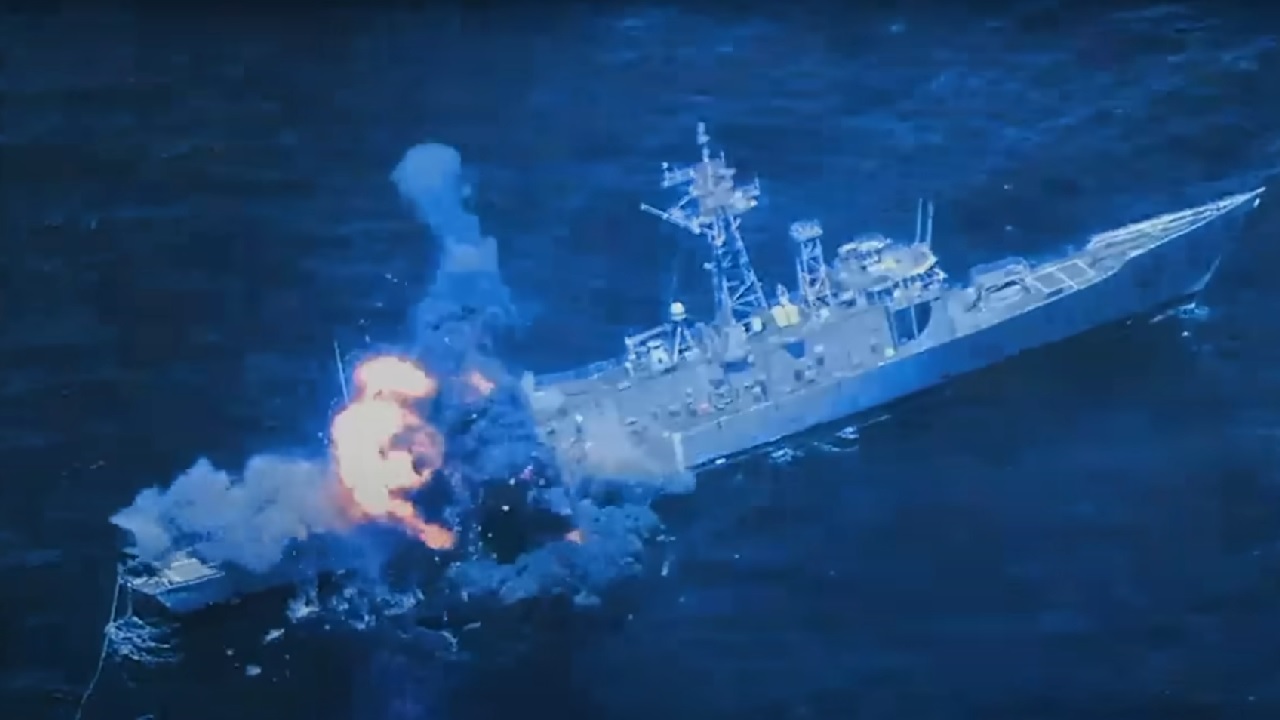
the USS Rodney M. Davis (FFG-60), an Oliver Hazard Perry-class guided missile frigate, was hit and sunk by anti-ship missiles.
Habitability And Endurance. Nuclear power meant abundant electricity for climate control, fresh water, and electronics; smart stowage and better crew spaces made the long patrols survivable. Morale matters when the ocean is your world.
The class also internalized post-Thresher design habits: systematic weld inspection, materials traceability, sea-water boundary controls, and a testing culture that tolerated schedule pain to buy safety.
How The Sturgeons Built On Successes—And Failures—Of Earlier Boats
The 637s were a direct answer to real experience:
From Skipjack and Thresher/Permit, they kept the fast, teardrop-derived underwater form but de-risked systems—fewer single points of failure, better valves and joints, and more thoughtful access for inspection and repair.
From the first round of quieting efforts, they learned that structure-borne noise travels. The Sturgeons improved mount isolation, machinery alignment, and fluid dynamics around openings to keep the ocean from “hearing” the boat’s heartbeats.
From early sonar operations, they absorbed the value of long-aperture listening. As towed arrays matured, the 637s became stable, quiet sensor platforms—a mobile extension of fixed SOSUS lines that could turn a cue into a covert trail.
From collision and ice-ops scrapes, they iterated procedures, reinforced certain fittings, and updated training. The class’s service life became a running laboratory for better ways to do hard things.
Operational History: The Unseen Campaign
A Sturgeon’s “battle record” was largely a stack of classified patrol reports—by design. The jobs were relentless and varied:
Open-Ocean Hunting. Working with long-range acoustic cueing, crews would localize and trail Soviet nuclear and diesel boats, measuring signatures, tactics, and weapons behavior. Patience mattered: a savvy captain could sit undetected on a Soviet sub’s baffles for hours, adjusting to every turn.
Barrier Operations. At chokepoints—GIUK gap, Aleutians, Kurils—637s acted as tripwires, catching submarines moving to or from the Atlantic and Pacific patrol areas. Sometimes they passed tracks to patrol aircraft or surface escorts; often they simply collected.
Arctic And Under-Ice. Several boats refined under-ice navigation, surfacing through thin leads and learning to live with strange acoustics. The work paid off: the Arctic stopped being a wall and became a route.
Special Missions. A few Sturgeons were configured for clandestine intelligence tasks—tapping undersea cables, recovering hardware from the seabed, or standing close enough to hostile coasts to listen. One late-class boat was lengthened to carry more gear for such missions and became one of the most decorated submarines in U.S. history.
Strike And Presence. With Tomahawk added in the 1980s, some 637s gained a strategic nibble: the ability to fire land-attack cruise missiles from a stealthy platform, complicating any adversary’s defense plans.
All of this happened with no headlines—a measure of success in a business where quiet is the mission.
Top Successes—And The Hard Lessons
Successes
Quieting Culture. The class institutionalized acoustic discipline—from maintenance practices to how crews ran pumps and valves. Quiet boats got better contacts, earlier and safer.
Towed-Array Tactics. Sturgeons turned passive, long-range sensing into an art form, proving that a patient SSN with a good array could dominate the chessboard.
Arctic Competence. They made under-ice a normal evolution, not a stunt, expanding American maneuver space and complicating Soviet routes.
Clandestine Intelligence. Specialized 637s delivered enormous intelligence value, informing everything from cryptology to force development.
Hard Lessons
Collisions Happen At The Edge. Several 637s suffered bumps with Soviet submarines or surface ships—occupational hazards in shadow work. These incidents drove procedural and equipment changes and reminded everyone that “close aboard” can turn kinetic fast.
Aging Systems, Rising Threat. As the 1980s progressed, newer Soviet boats—Victor III, Sierra, Akula—closed the acoustic gap. Sturgeons could still win, but the margin narrowed, and the force needed faster, quieter successors.
Speed Isn’t Everything—But It Helps. The class had solid sprint speed, yet Los Angeles-class boats brought more of it, along with better quieting at high speed—a big deal when the job is to get from a cue to a contact before the ocean rearranges the board.
How The Soviet Union Tried To Emulate—And Why It Struggled
Moscow charted a parallel course: the Victor-series SSNs (Project 671) and later Sierra and Akula families were Russia’s answers to the hunter-killer problem. They adopted streamlined hulls, invested in sonars, and steadily improved quieting. But emulation collided with industry.

Sierra-Class-Submarine. Image Credit: Creative Commons.
Quieting is metallurgy, precision machining, pump and valve design, blade quality, and the thousands of small tolerances that prevent rattles and hum. The Soviet Union made big strides—particularly with Akula—but lagged for years in the consistency and QA discipline that SUBSAFE and U.S. industry had been drilling since the 1960s. Where American yards normalized raft-mounted machinery, fine-tolerance shafts, and low-signature pumps across dozens of boats, Soviet results were uneven.
By the late 1980s, the gap had narrowed significantly, yet across the Sturgeons’ prime decades, the U.S. usually owned the acoustic first move.
Why The Sturgeon-Class Was Retired
Three forces converged to sunset the 637s:
Better Boats Arrived. The Los Angeles-class (SSN-688) and later Improved 688Is delivered higher quieting at speed, better sensors, and, eventually, vertical-launch Tomahawks. They were simply more capable for the late-Cold War and post-Cold War environments.

The Los Angeles class submarine USS San Francisco (SSN 711) shown in dry dock is having repairs made on its damaged bow. A new large steel dome about 20 feet high and 20 feet in diameter was put in the place of the damaged bow. San Francisco ran aground 350 miles south of Guam Jan. 8, killing one crew member and injuring 23. U.S. Navy photo (RELEASED)
Age And Cost. Even with SUBSAFE rigor, decades of pressure-cycle fatigue, corrosion, and dated electronics add up. Modernizing every Sturgeon to late-game standards made less sense than moving funds to newer hulls with more life ahead.
Strategic Reset. After 1991, the Navy reduced force structure. Older SSNs retired to keep shipbuilding and maintenance accounts aligned with a smaller fleet, while a handful of long-hull special-mission Sturgeons stayed on a bit longer to finish sensitive work.
Most 637s decommissioned through the 1990s, many processed through the Ship-Submarine Recycling Program in Bremerton. A few components lived on as training assets; the rest left a paper trail and a line of sailors who’d made their bones in boats without name recognition—and didn’t mind.
Overall Legacy: The Standard Everyone Worked From
The Sturgeon-class didn’t dazzle; it endured—and in undersea warfare, that matters more. Their legacy threads through the fleet today:
SUBSAFE As Culture. The class proved that rigorous standards are compatible with operational tempo; they made safety the price of admission, not a trade against readiness.
Acoustic Discipline. From how gear is mounted to how a watchstander spins a valve, the 637s taught generations that quiet is a tactic, not just a specification.
Towed Arrays And Passive Mastery. They turned long-range sensing into daily practice, setting up the doctrine that would carry into Los Angeles, Seawolf, and Virginia classes.
Arctic Normalization. Under-ice routes and tactics moved from experiment to fleet playbook, expanding the Navy’s geometry and options.
Special Missions. Their clandestine successes showed how a “plain” attack boat can be a strategic instrument, not just a tactical killer. The later emphasis on multi-mission SSNs owes much to what a few modified Sturgeons quietly pulled off.
If the question is whether the Sturgeon-class changed what the Navy could do, the answer is yes—quietly, continuously, and with a professionalism that left few headlines and many better habits.
They were the boats that made nuclear attack submarines routine—and in making them routine, made them decisive.
About the Author: Harry J. Kazianis
Harry J. Kazianis (@Grecianformula) is Editor-In-Chief and President of National Security Journal. He was the former Senior Director of National Security Affairs at the Center for the National Interest (CFTNI), a foreign policy think tank founded by Richard Nixon based in Washington, DC. Harry has over a decade of experience in think tanks and national security publishing. His ideas have been published in the NY Times, The Washington Post, The Wall Street Journal, CNN, and many other outlets worldwide. He has held positions at CSIS, the Heritage Foundation, the University of Nottingham, and several other institutions related to national security research and studies. He is the former Executive Editor of the National Interest and the Diplomat. He holds a Master’s degree focusing on international affairs from Harvard University.
More Military
The USS Nautilus Nuclear Attack Submarine Has a Message for the U.S. Navy
The Forrestal-Class Aircraft Carriers Have a Message for the U.S. Navy
The Canada-F-35 Divorce Could Have Consequences
The B-58 Hustler Mach 2 Bomber: The Air Force’s Big Blunder?


