

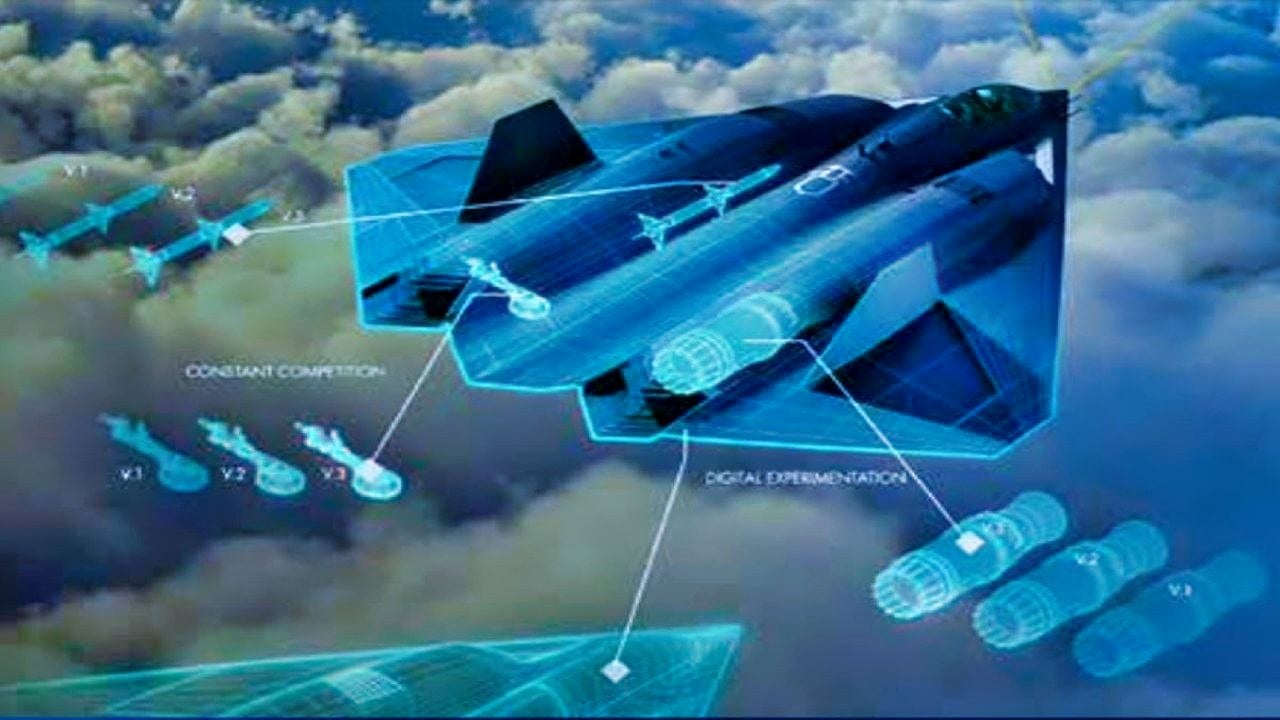
Key Points and Summary – In the late 1990s, the U.S. Air Force, NASA, and Lockheed Martin studied the X-44 MANTA—a tailless, delta-winged concept that utilized multi-axis thrust vectoring instead of conventional control surfaces.
-Derived from the F-22’s propulsion and systems, it aimed to reduce drag and radar signature, add fuel volume, and prove that thrust alone could handle pitch, roll, and yaw.

X-44 MANTA concept art.
-Funding dried up by 2000, and an X-44 MANTA prototype was never built, but the work intersected with thrust-vectoring research and tailless control studies.
-Those ideas—tight integration of engines, controls, and stealth shaping—now echo across sixth-generation “NGAD” fighter thinking.
X-44 MANTA: The Tailless Fighter Concept That Tried To Leapfrog The Future
By the end of the 1990s, stealth technology had been proven and digital flight control was mature—yet fighters still carried large radar-reflective tails and draggy moving surfaces.
The Air Force and NASA asked a radical question: if thrust vectoring could provide full control authority, could you delete the tail—shrinking radar signature, trimming drag, freeing volume for fuel, and simplifying the airframe?
The answer was explored in a joint study called X-44 MANTA—short for Multi-Axis No-Tail Aircraft—envisioned as a flying proof that engines and software could replace rudders, elevators, and ailerons.
Origins: From Raptor DNA To A Delta With No Tail
Lockheed Martin’s concept borrowed the F-22’s core (engines, systems, some structure) but replaced the entire aft end with a tailless delta and 3-D thrust-vectoring.
Where the Raptor employs 2-D pitch-vectoring nozzles and still uses tails, X-44 MANTA’s vision was bolder: all three axes—pitch, roll, and yaw—handled by vectored thrust and sophisticated control laws.
The broader wing promised more internal fuel; the absence of verticals promised lower signature and less interference drag; and removing large moving surfaces reduced mechanical complexity on paper. Early planning even contemplated flight-validating the idea with a modified F-22 or F-15 testbed before a dedicated X-plane.

F-22 Raptor National Security Journal Image

F-22 Raptor at US Air Force Museum. Image taken by National Security Journal.
What It Could Do—On Paper
In theory, X-44 MANTA offered four compelling gains:
Lower Observables: No vertical tails can reduce radar cross-section from many aspects, complementing stealth shaping elsewhere on the jet.
Range And Efficiency: A large delta wing provides added fuel volume and can reduce trim drag if you’re not constantly deflecting tailplanes.
Agility Without Penalties: 3-D vectoring can generate control moments at high angle of attack where conventional surfaces lose bite—potentially enabling aggressive post-stall maneuvers while keeping the jet on-command.
Reliability Through Integration: With propulsion and flight controls tightly fused, you can reassign authority (e.g., one nozzle compensates for another) and keep flying even with damage or failures—if the software is robust enough.
Those “ifs” were large. The control system would need extraordinary fidelity to handle everything from formation refueling to weapons separation with no aerodynamic backup. Still, decades of research on integrated flight-propulsion control and thrust vectoring suggested the physics—and the algorithms—were within reach.
Development: A Bold Study That Stopped Short
The Air Force and NASA green-lit early studies in 1999, with public descriptions framing X-44 as a way to leapfrog state-of-the-art. By 2002, trade coverage described MANTA as a dormant proposal to modify an F-22 prototype—delete the tails, fit a delta wing, and fly with multi-axis vectoring only.
Funding ended around 2000, and a dedicated X-44 MANTA demonstrator never materialized. The designation later surfaced on an X-44A, a small tailless UAV Lockheed revealed in 2018—interesting, but a different animal.

YF-118G Bird of Prey and F-22 Raptor. Image Taken at U.S. Air Force Museum on 7/20/2025.
Why It Was Never Built
Three forces, more than anything, kept the X-44 on paper:
Program Risk Versus Payoff. Demonstrating full three-axis control with thrust alone—across airspeeds, altitudes, and failure modes—demanded a complex, safety-critical control system and exhaustive test campaign. The cost-to-benefit ratio was hard to defend while the F-22 and F-35 already consumed budgets and political oxygen.
Shifting Priorities. After 2001, the Pentagon prioritized ISR, precision strike, and persistent wars over boutique air-dominance experiments. The Air Force focused on fielding fifth-gen fleets and sensors rather than pioneering a no-tail control architecture at full scale.
Good Enough, For Now. The F-22 already brought stealth, supercruise, and extreme agility. The marginal advantage of a tailless, thrust-only variant—set against integration risk—wasn’t compelling enough to win funding in a tight environment.

U.S. Air Force Maj. Josh Gunderson, F-22 Demo Team commander, enters into the Raptor Slide during the Millville Airshow, Sept. 3, 2021, at Millville Army Airfield, Millville, New Jersey. During the Raptor Slide the aircraft actually slides down and backwards under control before Gunderson adjusts the aircrafts position and powers out of the maneuver. (U.S. Air Force photo by Staff Sgt. Don Hudson)
What The Control System Needed To Prove
X-44’s heart wasn’t the airframe; it was the control allocation between engines and airframe with no tails to bail you out. It would have had to:
Maintain precise yaw control on approach and in crosswinds without a rudder.
Ensure weapons separation with high exhaust-flow interaction near the bays.
Handle engine asymmetry gracefully (startup, flameout, damage).
Avoid departure at the edges of the envelope where thrust plumes and vortices interact.
Much of this echoes earlier testbeds—where vectoring nozzles and integrated flight-propulsion control showed big gains, but with tails still attached. MANTA would have removed that safety net.
The X-44A Side Note: Tailless Tech, Different Mission
When Lockheed unveiled the once-secret X-44A UAV in 2018, it confirmed another vector of the story: compact, tailless platforms were maturing on the unmanned side—useful for refining aerodynamics, flight controls, composites, and command-and-control at lower cost and risk.
The X-44A wasn’t MANTA, but it kept the thread alive inside the industry.
Could Thrust Alone Have Flown The Jet?
Technically, yes—with enough authority, bandwidth, and software. Extensive work on mechanical and fluidic thrust vectoring demonstrated large, controllable nozzle-deflection effects with manageable thrust penalties. In practice, though, integrating 3-D vectoring as the only control effector on a high-performance manned fighter, then certifying it for everyday reliability, would be a long, expensive gauntlet. The most plausible path always looked like a stepping-stone testbed before a clean-sheet airplane.
What MANTA Might Have Changed If It Flew
Had X-44 flown and proved itself, three shifts were likely:
Shaping Freedom: Designers could optimize stealth without worrying about tail interference or hinge lines—especially valuable against wider-band sensors.
Range And Payload Trades: Less trim drag and more fuel volume mean larger radii or more time on station for a given thrust class.
Maintenance Mix: Fewer moving surfaces and actuators—but more exotic nozzles and software—would shift the maintenance burden from hydraulics to engines and code.
Even without MANTA, these are precisely the trades now being revisited in sixth-generation programs.
The Influence: From A Study To A Zeitgeist
Look at recent sixth-gen concepts and official renderings, and you’ll see a theme in some of the artist photos and renders: tailless or semi-tailless platforms with deep integration of propulsion and controls.
The logic is familiar—signature, range, efficiency, and cooperative control with unmanned teammates.
While no program office has credited X-44 directly, the questions it asked are now mainstream in design trades for next-generation air-dominance aircraft.
Why The Fighter Was Never Built—And Why Its Ideas Endure
MANTA was a concept ahead of its time and behind its budget. It appeared during a period when the Pentagon was already paying for two fifth-generation fighters and bracing for long land wars.
But the technical current it swam in—propulsion-driven control, tailless shaping, digital integration—never stopped flowing. It went to testbeds, UAVs, and now, to sixth-gen.
What X-44 Still Teaches Designers Today
Delete To Win. Every surface you remove is a win for stealth and drag—provided your software picks up the slack.
Integrate Early. Engines, inlets, nozzles, sensors, and flight controls must be designed as one system from day one.
Test The Corners. Full-authority thrust control must work in the ugly corners—crosswinds, tanker joins, asymmetric stores—before it earns trust.
Evolve In Public And In Shadow. If you can’t buy risk down in a manned X-plane, do it in unmanned demonstrators and digital twins—then scale.
The Bottom Line on X-44 Manta
The X-44 MANTA never became the tailless Raptor-derivative that headlines love to imagine. But it codified a provocation that is now central to fighter design: if stealth, range, and agility are paramount, maybe the best tail is no tail at all—provided your engines and algorithms are good enough.
Whether tomorrow’s front-line fighters fully commit to that philosophy, the X-44’s big idea has already done its work: it moved the Overton window of what a fighter can be.
About the Author: Harry J. Kazianis
Harry J. Kazianis (@Grecianformula) is Editor-In-Chief and President of National Security Journal. He was the former Senior Director of National Security Affairs at the Center for the National Interest (CFTNI), a foreign policy think tank founded by Richard Nixon based in Washington, DC. Harry has over a decade of experience in think tanks and national security publishing. His ideas have been published in the NY Times, The Washington Post, The Wall Street Journal, CNN, and many other outlets worldwide. He has held positions at CSIS, the Heritage Foundation, the University of Nottingham, and several other institutions related to national security research and studies. He is the former Executive Editor of the National Interest and the Diplomat. He holds a Master’s degree focusing on international affairs from Harvard University.
More Military
B-1B Lancer: The Bomber The Air Force Needs to Keep Flying
Su-37 ‘Terminator’: The Thrust-Vectoring Super Flanker Fighter That Never Was
Russia or China Would Love to Have the Aircraft Carrier USS Harry S. Truman
NATO’s Big Fear: Putin Drops a Tactical Nuclear Weapon on Ukraine
The U.S. Military’s Big F-22 Raptor Stealth Fighter Mistake Cuts Deep


John Williams
September 25, 2025 at 12:14 am
They have a tail less plane in the B2 Bomber. It does have control surfaces. They would save money using a combination of control surfaces and thrust vectoring. Nozzles could be made out less exotic materials. Computer software would be simpler.
The seventh generation would be able to replace the control surfaces. And, there is no telling what material sciences will bring to the table. As well as computer sciences.