

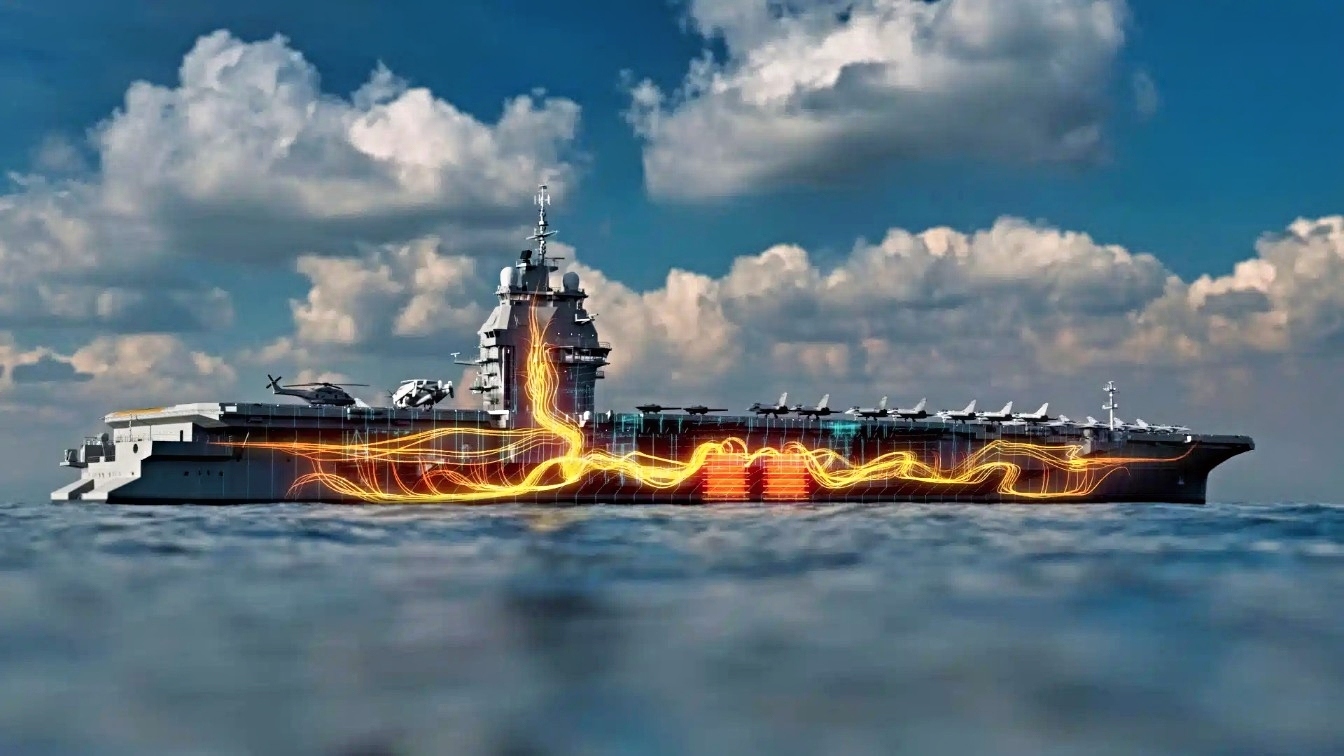
France is building an 80,000-ton nuclear supercarrier, the FS France Libre — twice the displacement of the Charles de Gaulle and the largest warship ever built in Europe. Announced by President Macron, it will carry up to 30 Rafale-M fighters launched by three American-made EMALS catapults, the same system on the U.S. Navy’s Ford-class. Due in 2038 at a cost of €10.25 billion, the carrier is built for global power projection — and to operate alongside U.S. forces against China.
Libre: France’s New 80,000-ton Aircraft Carrier Dream
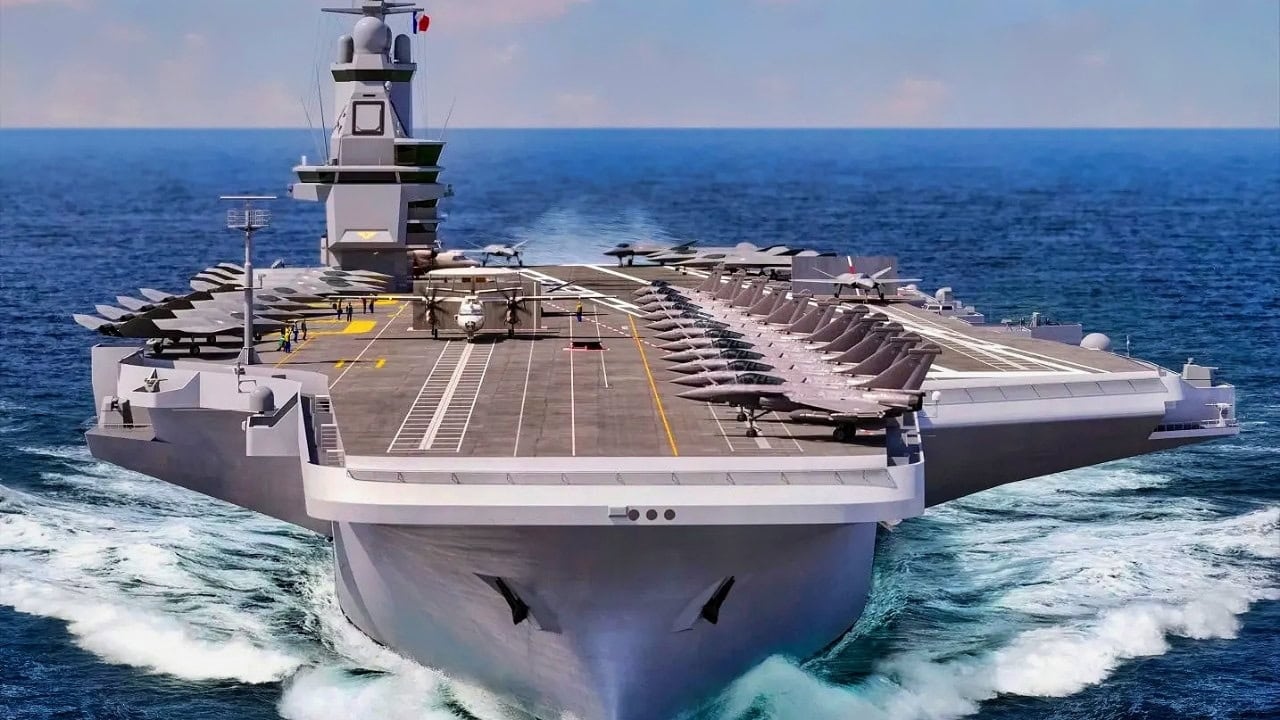
PANG France Aircraft Carrier. Image Credit: Creative Commons.

PANG Aircraft Carrier from France. Image Credit: Creative Commons.
France is embarking on an extremely ambitious project to build a 78,000-80,000-ton supercarrier, named the FS France Libre, which French President Macron announced in March and dedicated to the Free French Forces of World War II.
The future French flagship will be a nuclear supercarrier with catapult-assisted take-off but arrested recovery (CATOBAR) capabilities. Only France, the United States, and China have CATOBAR-capable carriers.
President Macron’s Comments On The Carrier
“I wished to place our future aircraft carrier in the lineage of General de Gaulle. His life, his destiny, and the choices made as early as June 1940, following the collapse—these speak to a certain idea of France. For him, and for us. The French spirit. It is a spirit of resistance. It is a will that nothing can stop.
“A will to resist in order to remain free. An irreducible, invincible will on national territory or elsewhere in the face of occupation. A will which, like our aircraft carrier, can take to the seas if necessary until victory is achieved. The will to remain free—yes, that is it. The great project that is ours. The one that binds us.
“The project of our armed forces, but also of our research, of our national industries. This will to remain free is the will for independence at all costs; for total, unconstrained autonomy of action; for the projection of our forces wherever the defense of France’s interests demands it, anywhere in the world.
“That is why our new aircraft carrier will bear the name ‘France Libre’. Within this name lives the memory of the women and men who stood up against barbarism. United to save the fatherland.

190424-M-BP588-1005 U.S. 5TH FLEET AREA OF OPERATIONS (April 24, 2019) A U.S. Marine MV-22 Osprey assigned to the 22nd Marine Expeditionary Unit sits on the flight deck of France’s Marine Nationale aircraft carrier FS Charles De Gaulle (R 91). This was the second time that Ospreys have landed aboard the French vessel. Marines and Sailors assigned to the 22nd MEU and Kearsarge Amphibious Ready Group are currently deployed to the U.S. 5th Fleet area of operations in support of naval operations to ensure maritime stability and security in the Central region, connecting the Mediterranean and the Pacific through the western Indian Ocean and three strategic choke points. (U.S. Marine Corps photo by Maj. Joshua Smith/Released)
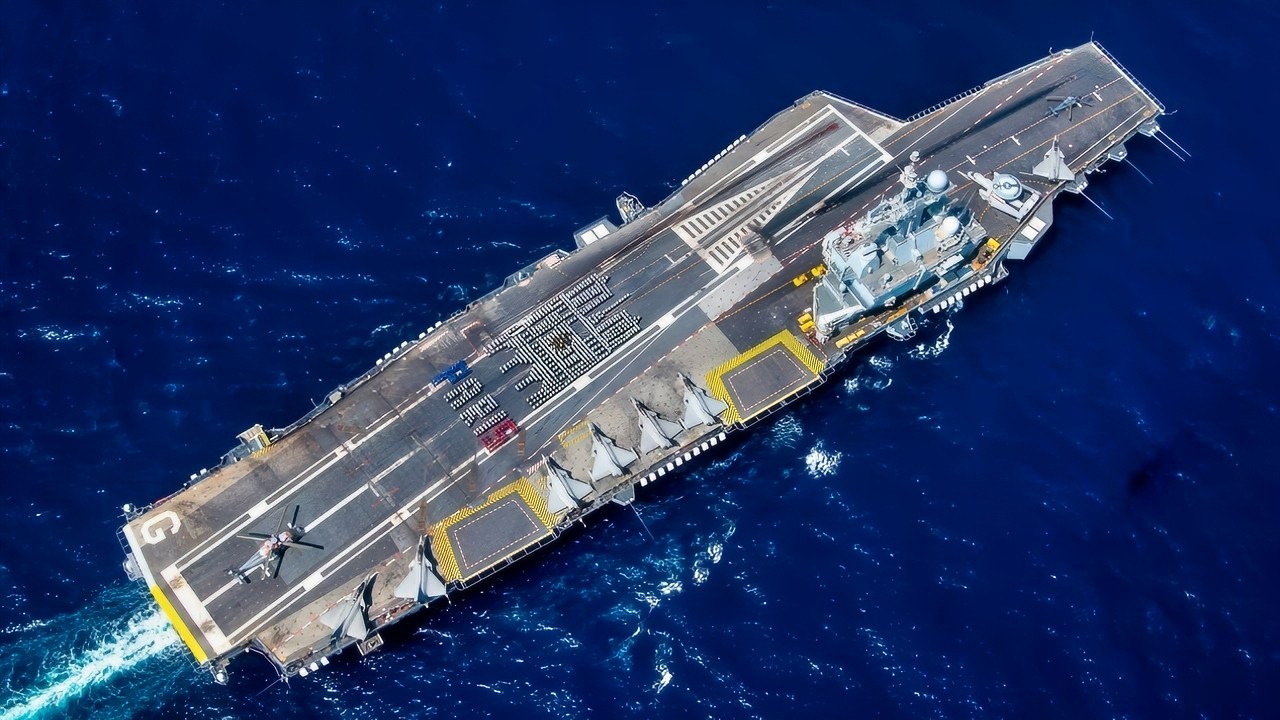
Charles de Gaulle Aircraft Carrier France. Image Credit: Creative Commons.
“Determined to defend a certain idea of our nation. To the Companions of the Liberation, this name seals a vow for the future: To remain free, we must be feared. To be feared, we must be powerful. And to be powerful, we must be ready to put in the effort.
“In these efforts, let us be irreducible. United. And relentless. Power. Independence. Resistance. Yes. It is by serving the fatherland that we shall achieve victory.”
Meet The FS France Libre
Construction on the massive supercarrier is set to begin in 2031, with the ship finished and commissioned into the French Navy by 2038.
The carrier will be 310 meters (1,020 feet) long with a beam of 85 meters (279 feet and a displacement of between 78,000 and 80,000 tons, double that of the FS Charles de Gaulle.
The propulsion will be provided by 2 x K22 pressurized water reactors (PWRs), 220 MW (300,000 hp) each, 2 x steam turbines, and 2 shafts/2 propellers.
The super carrier’s air wing is envisioned to include up to 30 Rafale-M fighters, three E-2D Hawkeye airborne early warning aircraft, European-designed combat drones, and six NH90 helicopters.
The supercarrier will feature three Electromagnetic Aircraft Launch Systems (EMALS) and three Advanced Arresting Gears (AAGs). The equipment will be supplied by General Atomics.
EMALS can precisely adjust its launch energy. This allows the carrier to launch heavy combat jets—like the future Rafale-M F5—alongside very light, fragile stealth drones and unmanned aerial vehicles (UCAVs).
Using EMALS Makes For Interoperability With The US A Snap
EMALS technology, paired with the ship’s 17,200-square-meter angled deck, enables simultaneous launch and recovery operations, greatly accelerating the daily flight tempo.
Sourcing the same system used on the U.S. Navy’s USS Gerald R. Ford-class allows French aircraft to conduct exercises and operations seamlessly using American hardware.
France’s Landing Signal Officers (LSOs) train for two years in the U.S., becoming familiar with directing U.S. naval aircraft for landing, enabling French and U.S. carriers to land on each other’s decks seamlessly.
Why France Needs The New Supercarrier
France needs the France Libre aircraft carrier to replace its aging flagship, the Charles de Gaulle, ensure uninterrupted global power projection, and maintain European strategic autonomy.
Set for commissioning by 2038, the supercarrier will be the largest warship ever built in Europe.
As the only nuclear power in the European Union, France is investing in capabilities that allow it to operate independently. The carrier serves as a central asset for European defense initiatives and international diplomacy.
The Macron administration knows the strategic world situation will look very different in 2038. But France’s desire to possess sovereign power projection capabilities has been a constant since World War II.
However, there have been plenty of criticisms leveled at the building of the Libre due to its cost (€10.25 billion), which critics claim could have been spent on submarines.
Also, the rise of hypersonic missiles and area-denial (A2/AD) strategies has led some experts to argue that the era of massive, floating airbases is coming to an end. Despite this, China is aggressively building new carriers and expects to have nine by 2035.
Critics also point to the paradox of using American technology while simultaneously claiming sovereign power projection; however, if a future shooting war does occur, especially in the Indo-Pacific, US and French carriers will be working together against the Chinese.
About the Author: Steve Balestrieri
Steve Balestrieri is a National Security Columnist. He served as a US Army Special Forces NCO and Warrant Officer. In addition to writing on defense, he covers the NFL for PatsFans.com and is a member of the Pro Football Writers of America (PFWA). His work was regularly featured in many military publications.


