

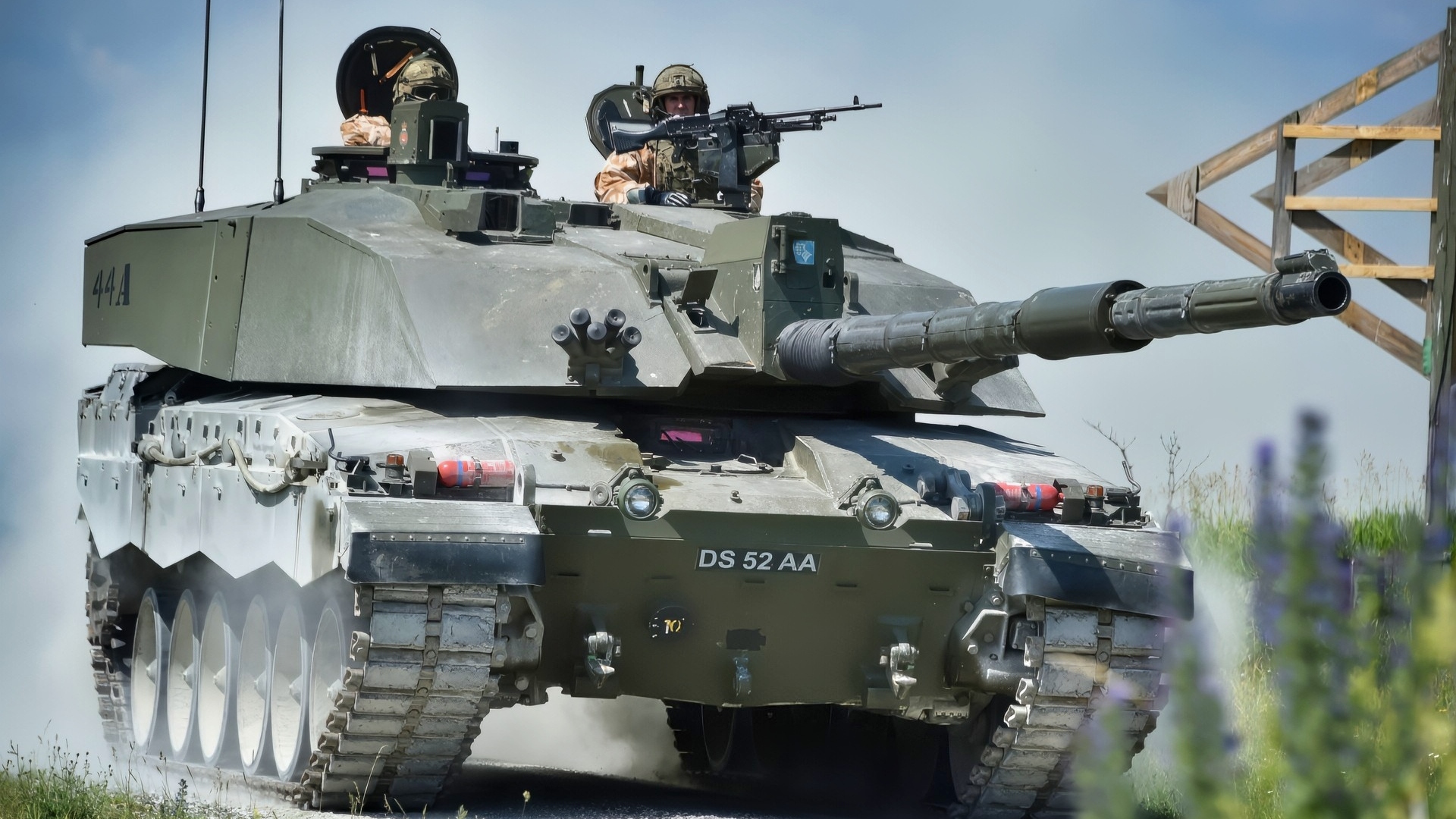
The first Challenger 2 main battle tank destroyed in combat was hit by another Challenger 2 tank. The British Army Queens Royal Lancers Challenger 2 was destroyed by friendly fire on March 25, 2003 during the invasion of Iraq. A British tank crew mistakenly identified the Challenger 2 as an Iraqi armored vehicle. The British crew fired 2 HESH rounds. The second round struck the other Challenger 2 around the commander’s hatch. 2 tankers were killed. The Challenger 2 had previously enjoyed a “nearly mythical reputation for survivability.”
Challenger 2 vs. Challenger 2: The Tank Battle No One Saw Coming

Challenger 2 Tank. Image Credit: Creative Commons.

Challenger 2 Tank. Image Credit: Creative Commons.
The first Challenger 2 main battle tank destroyed during combat was not knocked out by an enemy tank or even an anti-tank missile. It was, in fact, destroyed by another Challenger 2 — a case of friendly fire.
The incident happened on March 25, 2003, during the invasion of Iraq. A Challenger 2 from the Queen’s Royal Lancers was mistakenly identified as a hostile vehicle by another British tank from the battlegroup. Through thermal sights and amid the confusion of combat, the crew thought they were seeing an Iraqi armored threat maneuvering in the area. One Challenger fired two HESH rounds. The second struck the other tank around the commander’s hatch area. The impact of the round caused fragmentation inside the turret and a fire, which eventually led to the ammunition igniting. Two tankers were sunk, and the Challenger 2 was destroyed.
The incident would become infamous thanks in part to the nearly mythical reputation the Challenger 2 had previously enjoyed for survivability. During the Iraq War, British Challenger 2s absorbed RPG strikes as well as other damage that would have been likely to disable other main battle tanks.
For many years, Challenger 2 proponents had maintained that the tank had never been destroyed by enemy fire — a claim that became more difficult to maintain after Challenger 2 in Ukraine, operated by Ukrainian tanker crews, was lost while engaged with Russian forces in 2023. But even before the war in Ukraine, the incident in Iraq showed that no tank, no matter how well protected, is invulnerable when hit in a vulnerable area under the right circumstances.
The Development
The tank’s development was particularly long and problematic. Developed in the late 1980s and early 1990s by Vickers Defense Systems as a successor to the Challenger 1, the two tanks look rather similar externally, though the Challenger 2 differs significantly from its predecessor, featuring a new turret, upgraded armor, and improved fire-control systems.
One of the Challenger 2’s defining features was its continued use of the 120mm rifled main gun, an outlier in the NATO alliance, where most members favored a more modern 120 smoothbore main gun.
The British Army argued that the rifled main gun provided advantages in long-range accuracy, particularly with HESH-type ammunition, though the choice of main gun meant that NATO-standard 120mm tank ammunition was incompatible with British Army tanks.
By the late 2010s, however, the British Army faced a tough choice. Whether to replace the Challenger 2 with a from-scratch new design, subject the platform to another modernization round, or divest main battle tanks altogether.
Though there was some speculation that the British Army would be without tanks for the first time since the First World War, the Challenger 3 program was eventually approved in 2021.
Challenger 3
Despite the Challenger 3’s name, it is not a clean-sheet design, but rather a rebuild of the Challenger 2 already in service with the British Army.
One of the most obvious and consequential changes to the Challenger 3 is its adoption of a 120mm smoothbore main gun, which brings the tank in line with virtually the rest of the NATO alliance. The Challenger 3 also features a new turret, improved sights, enhanced networking capabilities, and enhanced armor protection.
But the Challenger 3 program is not without its detractors.

Challenger 3 On the March. Image Credit: Creative Commons.

Challenger 3 Tank British Army Image.

Challenger 3 Tank Image from the British Army.
By far and away the largest criticism of the Challenger 3 program relates to scale. Britain originally operated hundreds of Challenger 1s and Challenger 2s when those programs came online — but seemingly inexplicably, it will procure just 148 Challenger 3 main battle tanks.
For a country that considers itself one of NATO’s leading military powers, that decision is remarkable. Critics have argued that attrition in a high-intensity conflict cannot be absorbed by such a small fleet, which would quickly be worn down and turned combat-ineffective.
The ongoing war in Ukraine has bolstered those fears, as the Ukrainian experience has shown that armored vehicle losses can quickly stack up while under modern drone and artillery fire.
The Challenger 3 is a balance of sorts between continuity and deep contraction.
While the British Army keeps tanks in service, their numbers are significantly lower than during the Cold War or even more recently, during the Iraq War. Though Challenger 3 proponents have argued that the smaller Challenger 3 fleet is justified by its greater capabilities compared to the older Challenger 2, that debate is far from settled.
About the Author: Caleb Larson
Caleb Larson is an American multiformat journalist based in Berlin, Germany. His work covers the intersection of conflict and society, focusing on American foreign policy and European security. He has reported from Germany, Russia, and the United States. Most recently, he covered the war in Ukraine, reporting extensively on the shifting battle lines in Donbas and writing about the war’s civilian and humanitarian toll. Previously, he worked as a Defense Reporter for POLITICO Europe. You can follow his latest work on X.


