


Summary and Key Points: There’s a single island in the Persian Gulf through which Iran ships 90 percent of its oil — and planners call it the Achilles’ heel of the Iranian economy. Take Kharg out of the equation, the thinking goes, and Tehran would have to sue for peace. It’s one of several ways Washington could force the Strait of Hormuz open — from mining Iran’s waters to choking off the oil it sends to China. But each carries a cost in dollars and blood, and the war’s price has already climbed toward $100 billion. The hardest question isn’t whether America can do it — it’s whether it still wants to.
The Iran Invasion Option Trump Might Consider

Troopers with 3rd Armored Brigade Combat Team, 1st Cavalry Division firing the 25mm canon on a Bradley fighting vehicle in order to zero the vehicles weapons systems at a range in Poland. Ranges such as these familiarize troopers with the vehicles systems in order to ensure combat readiness.
President Donald Trump promised us no new Middle East “forever wars,” but the current conflict against Iran, a tenuous ceasefire, and a faltering peace process could result in a permanent U.S. Navy and Army presence in the region. This may mean that naval ships could continue to patrol the Persian Gulf and the Strait of Hormuz indefinitely, and American marines and soldiers will be on standby for months.
There could be a deployment of ground troops to Iran, forcing the Islamic Revolutionary Guard Corps (IRGC) to react strongly and create a bloody campaign that would roil oil prices and financial markets, which could lead to a global recession or depression.
A Majority of Citizens in the United States Do Not Support the War
Are the American people ready for another long Middle East conflict? The Pew Research Center in polling conducted in March revealed that 61 percent disapprove of Trump’s handling of the war in Iran. Pollster Nate Silver conducts a daily survey about the conflict and the level of American support. As of May 31, 58 percent oppose it.
That means U.S. boots on the ground would be a deal breaker for many Americans who even support it now. The main problem with a ground troop deployment would be a longer war and the possibility of more casualties. The American people just do not have the appetite for a prolonged and bloody conflict against Iran.

Aerial drone image of Bradley Fighting Vehicle crews from the 1st Armor Brigade Combat Team, 3rd Infantry Division, conducting Table XII gunnery at Fort Stewart, Ga. December 7, 2016.

Troopers with 3rd Armored Brigade Combat Team, 1st Cavalry Division firing the 25mm canon on a Bradley fighting vehicle in order to zero the vehicles weapons systems at a range in Poland. Ranges such as these familiarize troopers with the vehicles systems in order to ensure combat readiness.
High Monetary Costs of the Conflict
Plus, the war is expensive. A website called “Iran War Cost Tracker” estimates that the conflict required $6 billion over the first six days of bombing. The total cost of the war has reached nearly $100 billion over 95 days as of June 3.
Remove Kharg Island From the Chess Board
One way the United States could open the Strait is to blockade Kharg Island and create a situation that would force the Iranians to seek peace in an action that would destroy their economy.
“Tehran exports 90 percent of its oil through the loading terminals on Kharg, making it the Achilles’ heel of the Iranian economy. Some have hinted that marine forces might be tasked with seizing the island, but any U.S. ground elements involved would be vulnerable to prolonged bombardment from the mainland. Alternatively, some might argue that a sounder [and less politically fraught] plan would be to mine Iranian territorial waters in the approaches to Kharg and threaten any Iranian vessels attempting to clear them, so that Iranian tankers cannot take on petroleum products there,” according to the Washington Institute.
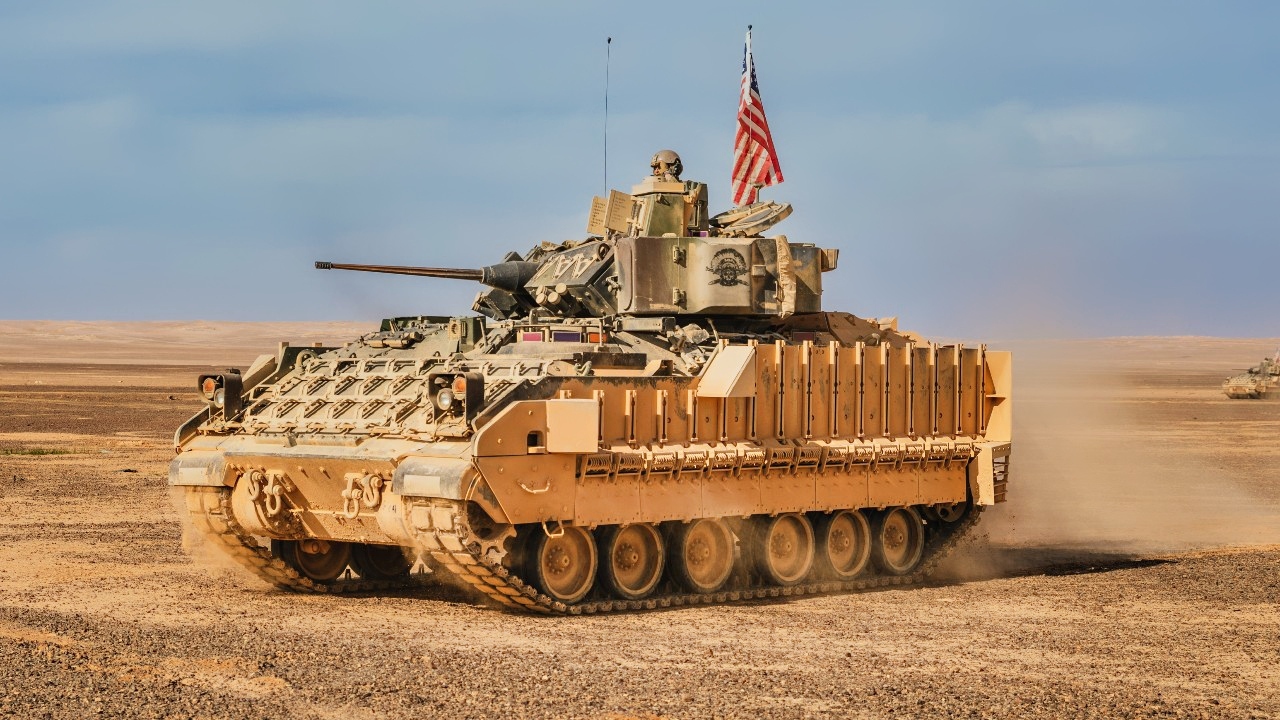
U.S. Army Soldiers assigned to 2nd Squadron, 278th Armored Cavalry Regiment, Task Force Reaper, conduct movement procedures with M2 Bradley Fighting Vehicles during the Jade Cobra VI exercise in the U.S. Central Command’s area of responsibility, Feb. 19, 2025. Jade Cobra VI strengthens military-to-military partnerships, increases readiness, and facilitates security cooperation between the United States and Jordan. (U.S. Army photo by Staff Sgt. Hector Tinoco)
Blockading Iranian Imports
The United States could continue its blockade of Iranian oil tankers by also blocking ships carrying imports to Tehran. Eighty percent of Iran’s imports come through the strait, the Washington Institute estimated. The Americans could quarantine everything, but food, and that would crimp the Iranian economy further until the regime comes to the negotiation table and allows the Americans to get the best terms for a complete peace agreement.
‘Distant Blockade’ – Keep Iranian Oil From Reaching China
The Americans could also do what the Washington Institute calls a “Distant Blockade.” This gambit would stop any oil transiting East Asian waterways bound for China. The distant blockade could be accomplished by quarantining the strategic Strait of Malacca in the western portion of the South China Sea and preventing Iranian tankers from delivering their oil to China. The downside of this is that Beijing would be hopping mad and declare that it could take active measures to thwart this contingency.
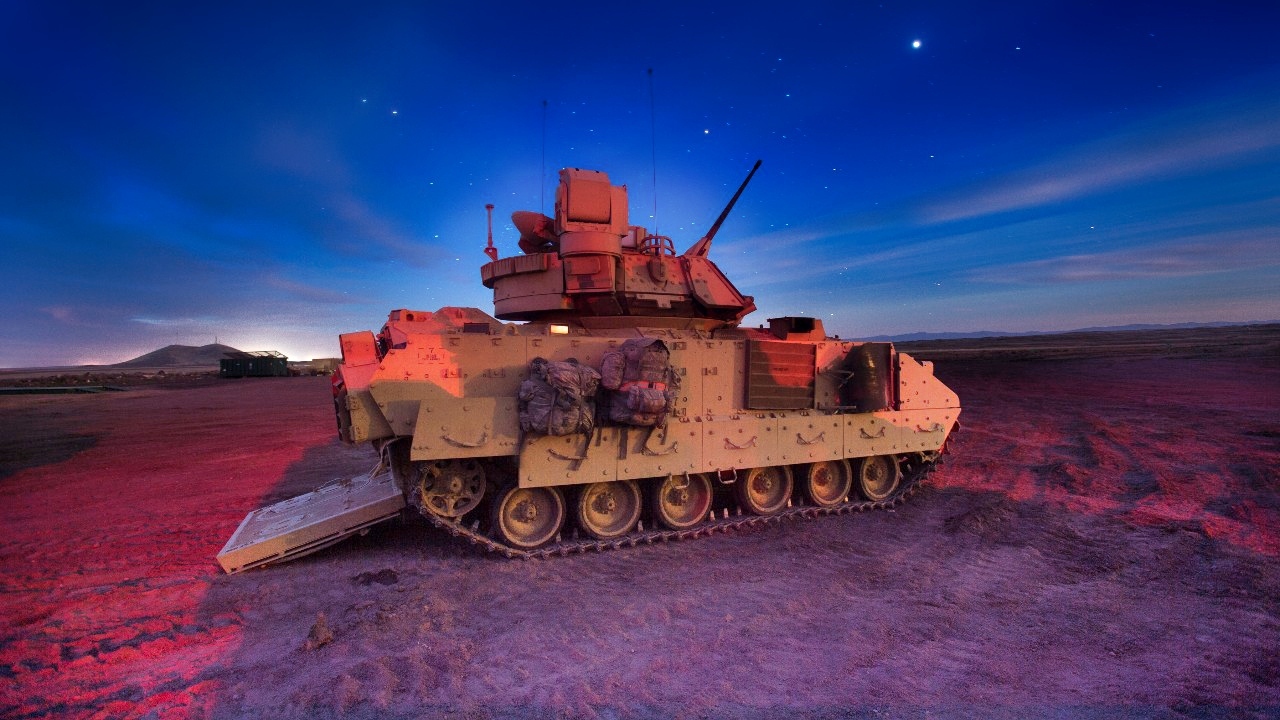
Engineers with the 116th Brigade Engineer Battalion conduct M2A3 Bradley fighting vehicle gunnery qualification on March 27, 2018, Orchard Combat Training Center, south of Boise, Idaho. Combat engineers with the 116th BEB trained through gunnery table XII, evaluating their ability to execute collective platoon-level tasks in a tactical live-fire environment; including integrating dismounted soldiers with their assigned BFV. (U.S. Army National Guard photo by 1LT Robert Barney)
Dynamic Air and Ground Military Attack
The next method is to conduct what I call the Kinetic Missile Fight against Iran in its entirety. The Kinetic Missile Fight comprises modern, high-intensity warfare dominated by large-scale standoff missile exchanges, particularly involving cruise missiles, ballistic missiles, hypersonics, and other precision-guided munitions. This would be massive barrages of long-range missiles against Iranian military targets once again. There would also be attacks on Iranian fast-attack boats to destroy the Iranian “Mosquito Fleet” once and for all. The Kinetic Missile Fight would be followed by an amphibious landing of Marines and an airborne operation by U.S. paratroopers.
No Guarantee Total War Would Work
This would become all-out warfare, and while it might reopen the strait, it would exact a heavy toll in blood and treasure. The attacking force would have trouble being resupplied without the ability for heavy armored forces to control the ground. The initial territorial gains would be impressive, but the IRGC could mount an insurgency and terror campaign against the Americans, and it would be a repeat of the Second Gulf War that was so costly for the United States, particularly in the years from 2003 until 2006.
Thus, the United States has few good military options. Blockades would be difficult to expand upon and fraught with risk. A ground assault would be unpopular and could fail even after initial success. The war is expensive, and costs are mounting daily. The only recourse is a diplomatic agreement that would allow the strait to be opened peacefully. The United States would still need to maintain military assets, but at least the American people who do not have the stomach for a shooting war would be more supportive.
About the Author: Brent M. Eastwood, PhD
Author of now over 3,500 articles on defense issues, Brent M. Eastwood, PhD, is the author of Don’t Turn Your Back On the World: A Conservative Foreign Policy and Humans, Machines, and Data: Future Trends in Warfare, plus two other books. Brent was the founder and CEO of a tech firm that predicted world events using artificial intelligence. He served as a legislative fellow for US Senator Tim Scott and advised the senator on defense and foreign policy issues. He has taught at American University, George Washington University, and George Mason University. Brent is a former US Army Infantry officer. He can be followed on X @BMEastwood.


