


The U.S. Navy truncated the Constellation-class FFG-62 frigate program from 20 ships to 2 ships in November 2025. The Constellation-class frigate’s cost climbed to approximately $1.4 billion per ship. The Constellation-class frigate costs approximately 80% of a U.S. Navy destroyer while delivering approximately 60% of the destroyer’s capability.
The Constellation-Class Frigate Fiasco

An artist rendering of the U.S. Navy guided-missile frigate FFG(X). The new small surface combatant will have multi-mission capability to conduct air warfare, anti-submarine warfare, surface warfare, electronic warfare, and information operations. The design is based on the FREMM multipurpose frigate. A contract for ten ships was awarded to Marinette Marine Corporation, Wisconsin (USA), on 30 April 2020.
The Constellation-class guided-missile frigate was intended to be a new class of smaller naval vessels that could provide better firepower than the Littoral Combat Ship (LCS) but at a lower cost.
Based on a proven European design, the project was intended to avoid many of the pitfalls of the LCS program by choosing a pre-existing platform and reducing development costs.
However, the Constellation-class soon ran into many of the same issues as its predecessor. The requirements changed frequently, resulting in numerous redesigns even after the first ship was already in production.
Ultimately, the Navy pulled the plug on the program before it could spiral further out of control.
Program Origins
The Constellation-class program, designated FFG‑62, was originally conceived as a crucial pillar of the U.S. Navy’s effort to rebuild its small surface combatant fleet. It emerged in the late 2010s after the Navy recognized a widening gap in its force structure.
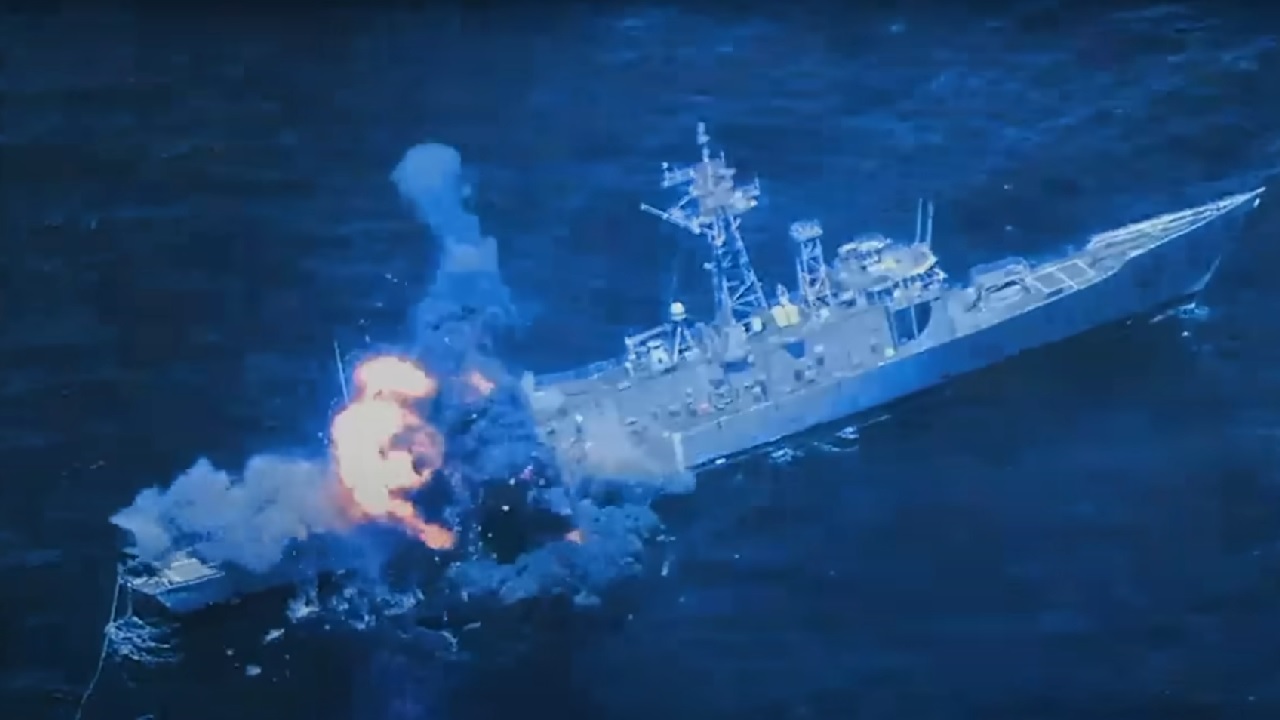
The USS Rodney M. Davis (FFG-60), an Oliver Hazard Perry-class guided missile frigate, was hit and sunk by anti-ship missiles.

Oliver Hazard Perry-Class Frigates. Image Credit: Creative Commons.
The aging Oliver Hazard Perry-class frigates had long since been retired, and the LCS program had failed to deliver a vessel capable of surviving and operating effectively in high-end combat environments. The Navy needed a ship that could operate alongside destroyers and cruisers but at a lower cost, allowing it to increase fleet size without overwhelming its budget.
To meet this need, the Navy launched the FFG(X) program and selected a design derived from the Franco-Italian FREMM frigate, a proven and widely used European warship.
The expectation was that using an existing design would reduce risk, accelerate production, and avoid the costly pitfalls associated with entirely new ship classes. The Constellation-class was therefore envisioned as a relatively quick, cost-effective solution, with early estimates placing the price of each follow-on vessel between roughly $850 million and $950 million.
The Constellation-class was intended to carry advanced systems such as the Aegis Baseline 10 combat system, the Enterprise Air Surveillance Radar, and a 32-cell Mk 41 Vertical Launch System capable of firing a wide array of missiles.
In addition to anti-air warfare, the ship would conduct anti-submarine and surface warfare missions, making it a multi-role combatant that could integrate seamlessly into carrier strike groups.
In concept, the Constellation-class would provide a balance between capability and affordability, offering meaningful combat power without approaching the cost of an Arleigh Burke-class destroyer.
Too Many Requirements
However, almost from the beginning, the program drifted away from its original premise of simplicity and low risk. The central problem lay in the extent to which the Navy modified the FREMM baseline design. Instead of adopting the ship largely as-is, the Navy imposed a host of additional requirements.
These included stricter survivability standards, the integration of American-made sensors and weapons systems, and compliance with U.S. cybersecurity and operational doctrines. Some of the requirements were practical and made sense. However, as the project continued, things got out of hand.
These changes gradually transformed the Constellation-class from a modified foreign design into something closer to an entirely new warship.
This shift had serious consequences. The initial assumption that the program would avoid the typical risks of new ship development proved incorrect. Instead, the project became mired in the same inertia that had plagued previous Navy programs.
Building a Ship Before it’s Ready
Compounding the problem was the Navy’s decision to begin construction before the design was finalized. According to a Government Accountability Office (GAO) report, this approach contradicted best shipbuilding practices and led to significant instability.
As construction progressed, ongoing design changes disrupted the process, leading to rework, schedule delays, and increased costs. The program thus entered a cycle in which incomplete design work led to construction delays, which, in turn, necessitated further adjustments.
One visible symptom of this instability was significant weight growth. As additional systems and requirements were added, the ship became several hundred tons heavier than originally planned. This increase threatened the ship’s performance and required additional engineering changes to ensure structural integrity and stability. The effort to fix these issues only deepened the program’s complexity.
Program Delays and Cost Overruns
Meanwhile, the schedule slipped dramatically.
The lead ship, USS Constellation, was originally expected to be delivered in 2026. Over time, this date was pushed back to around 2029, resulting in a roughly three-year delay.
Construction progress lagged significantly as well; years into the program, the ship was still only a small fraction complete. These delays undermined confidence that the Navy would receive the ships quickly enough to meet its operational needs.
At the same time, costs escalated sharply. The price of each ship climbed to around $1.4 billion, far exceeding initial expectations. This increase placed the frigate in an uncomfortable position within the Navy’s budget.
As officials noted, the ship cost roughly 80 percent as much as a destroyer while delivering only about 60 percent of its capability. This imbalance made it difficult to justify continued investment, particularly given competing priorities such as submarines, destroyers, and emerging technologies.
The Navy Pulls the Plug
In November 2025, the Navy announced a major restructuring of the program.
Rather than continuing with the planned fleet of around 20 frigates, the Navy decided to truncate the Constellation-class to just two ships that were already under construction.
The remaining planned vessels were canceled before construction began. This effectively ended the program as a cornerstone of the Navy’s future fleet.
The decision was driven by the conclusion that the program no longer made strategic or financial sense.
The Navy needed ships that could be built faster, at lower cost, and with less technical risk.
Continuing with the Constellation-class would have required committing billions of dollars to a program that was behind schedule, over budget, and struggling to deliver its promised capabilities.
Now the Navy has pivoted to a new approach, initiating the FF(X) program as a replacement. This new program is based on the Coast Guard’s Legend-class National Security Cutter.
About the Author: Isaac Seitz
Isaac Seitz, a Defense Columnist, graduated from Patrick Henry College’s Strategic Intelligence and National Security program. He has also studied Russian at Middlebury Language Schools and has worked as an intelligence Analyst in the private sector.


