


Key Points and Summary – The U.S. Navy has officially killed the Constellation-class frigate program, terminating four future ships and leaving only two half-built hulls in limbo.
-Billed in 2020 as a “low-risk” adaptation of Italy’s FREMM design, the frigate quickly became another cautionary tale: major redesigns, incomplete drawings at the start of construction, exploding costs, and a three-year slip in delivery.

An artist rendering of the U.S. Navy guided-missile frigate FFG(X). The new small surface combatant will have multi-mission capability to conduct air warfare, anti-submarine warfare, surface warfare, electronic warfare, and information operations. The design is based on the FREMM multipurpose frigate. A contract for ten ships was awarded to Marinette Marine Corporation, Wisconsin (USA), on 30 April 2020.
-With China racing toward a 400-ship fleet, Navy leaders now say “speed to delivery” is the new organizing principle and are pivoting to simpler, faster-built surface combatants.
-GAO’s verdict is brutal: doubled shipbuilding budgets, but no real fleet growth in 20 years.
Constellation-Class Disaster: How the Navy Blew Its “Easy Win” Warship
The Navy made it official on Wednesday: It is killing the Constellation-class frigate program and pivoting to new classes of warships that can be built faster.
The move was announced on social media by the Secretary of the Navy, John Phelan.
“From day one, I made it clear: I won’t spend a dollar if it doesn’t strengthen readiness or our ability to win,” Phelan said in the caption of a video message posted to X. “To keep that promise, we’re reshaping how we build and field the Fleet—working with industry to deliver warfighting advantage, beginning with a strategic shift away from the Constellation-class frigate program.”
The secretary then went into more detail.
“We are reshaping how the Navy builds its fleet. Today, I can announce the first public action is a strategic shift away from the Constellation-class frigate program,” Phelan’s statement said. “The Navy and our industry partners have reached a comprehensive framework that terminates, for the Navy’s convenience, the last four ships of the class, which have not begun construction.”
“Speed to Delivery”
An unnamed senior defense official explained more about the decision.
“A key factor in this decision is the need to grow the fleet faster to meet tomorrow’s threats. This framework seeks to put the Navy on a path to more rapidly construct new classes of ships and deliver capabilities our war fighters need in greater numbers and faster,” the official said, USNI News reported.
According to Defense News, two ships in the program are “half-built.”
“We greatly value the shipbuilders of Michigan and Wisconsin. While work continues on the first two ships, those ships remain under review as we work through this strategic shift. Keeping this critical workforce employed and the yard viable for future Navy shipbuilding is of foremost concern,” Secretary Phelan said in his announcement. The statement lines up with remarks earlier this month from Defense Secretary Pete Hegseth, who declared that “speed to delivery is now our organizing principle.”
In April 2020, during the first Trump presidency, the Navy announced that the FFG-62 contract had been awarded to Fincantieri/Marinette Marine (F/MM), an Italian shipbuilding concern that would build the ships in Marinette, Wisconsin.
That builder won a bid against Austal USA, General Dynamics/Bath Iron Works, and Huntington Ingalls Industries/Ingalls Shipbuilding (HII/Ingalls).
“F/MM was awarded a fixed-price incentive (firm target) contract for Detail Design and Construction (DD&C) for up to 10 ships in the program—the lead ship plus nine option ships,” USNI News reported in 2021. According to CNN, the ships were to cost about $1.1 billion each. Had the program gone forward, it would have represented the U.S. Navy’s first frigate since the USS Simpson was decommissioned a decade ago.
However, the program soon proved more expensive than expected.
“At inception, the Constellation class was envisioned as a faster way to build US Navy warships. It was based on an in-service Italian design, which would be modified to meet US requirements,” CNN said of the frigate program. “But those modifications proved to be more extensive than planned. Costs ballooned, and construction soon fell behind schedule. Plans for the USS Constellation to be delivered in 2026 have already been pushed back to 2029, according to a report from the Congressional Research Service.”
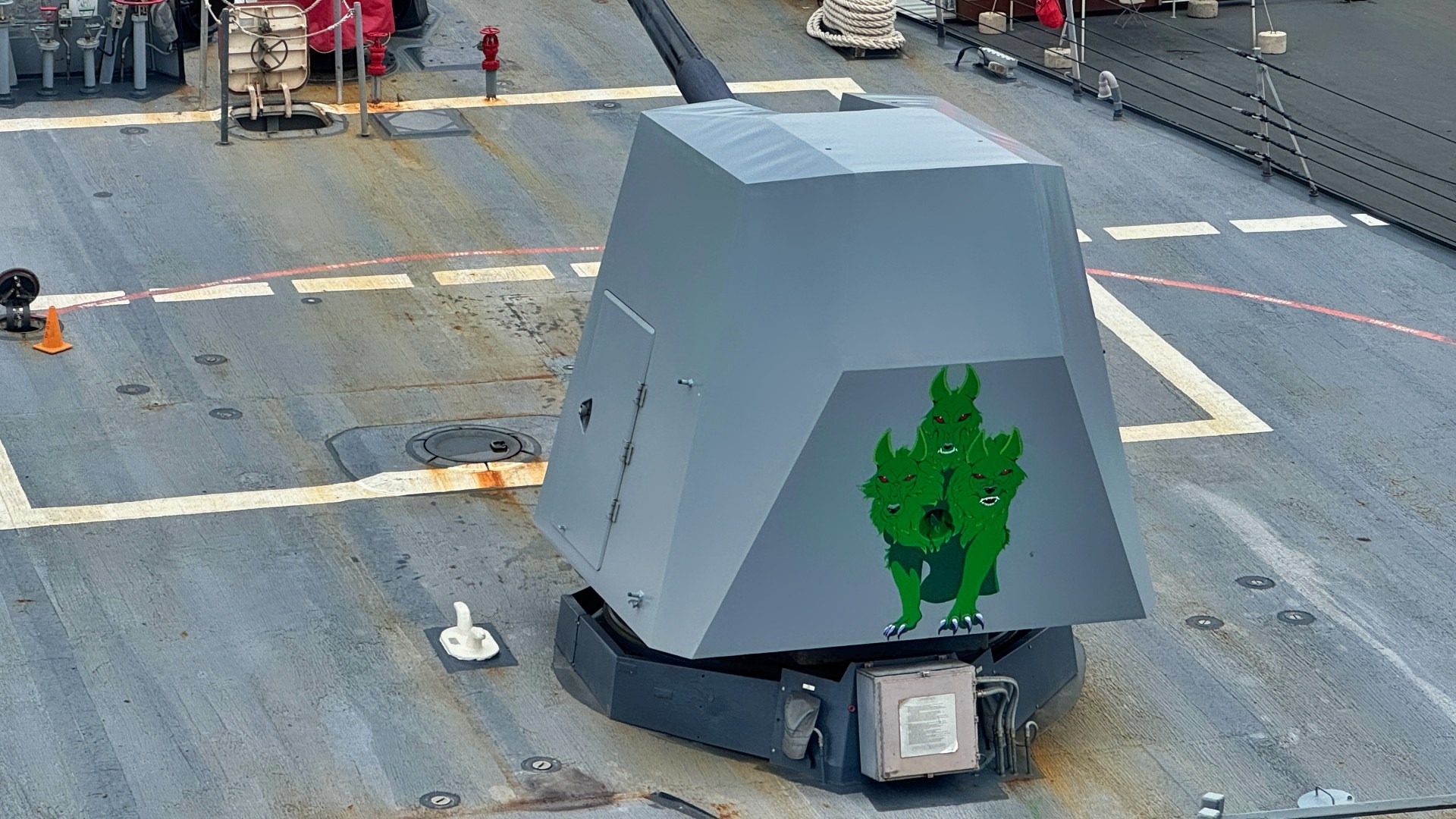
USS Lassen Deck Gun U.S. Navy. Image Credit: Stephen Silver/National Security Journal.
Fincantieri’s CEO, George Moutafis, reacted to the cancellation.
“Fincantieri has been a committed partner, and the Navy values this partnership, our investment and together we want to rapidly deliver capabilities to warfighters, so we believe that the Navy will honor the agreed framework and channel work in sectors such as amphibious, icebreaking, and special missions into our system of shipyards, while they determine how we can support with new types of small surface combatants, both manned and unmanned, that they want to rapidly field,” the chief executive said in a statement Wednesday.
The China Question
Per CNN, the U.S. is placing itself in position to respond to the rapid growth of China’s Navy.
“According to a Pentagon estimate, the People’s Liberation Army Navy is expected to have about 400 hulls in the water by the end of this year. Some 50 of those ships are frigates, according to the International Institute for Strategic Studies,” CNN reported. The U.S. fleet, ships and submarines included, now comprises 240.
Carl Schuster, a former U.S. Navy captain and military analyst, told CNN that cancelling the program was the right decision.
“The Constellation was a great waste of money,” he said. “It would not survive long in an action against a Houthi-level threat.”
An Ominous Report
A Government Accountability Office (GAO) reported in March shed light on the Navy’s slowgoing shipbuilding efforts.

ATLANTIC OCEAN (June 14, 2011) The Nimitz-class aircraft carrier USS Dwight
D. Eisenhower (CVN 69) conducts rudder turns during sea trials. Dwight
D. Eisenhower completed a nine-month planned incremental availability at Norfolk Naval Ship Yard on June 10 and is scheduled to resume underway operations this summer. (U.S. Navy photo by Mass Communication Specialist 1st Class Christopher Stoltz/Released)
The report, titled “Navy Shipbuilding: Enduring Challenges Call for Systemic Change,” noted that rising expenses in the sector haven’t led to positive results.
“We testified that the Navy hasn’t increased the number of ships in its fleet over the past 20 years—despite nearly doubling its shipbuilding budget,” the GAO report said. “Its acquisition practices consistently result in growing costs and delivery delays. For example, the Navy’s frigate program began construction before completing ship design and expects the first ship to deliver at least 3 years late.”
The report went into more detail about the now-cancelled frigate program.
“ For example, GAO identified schedule risks in 2024 for the Constellation-class frigate program. Counter to leading ship design practices, construction for the lead ship started before the ship design work was complete, and delivery is expected to be delayed by at least 3 years,” the report said. “GAO has previously identified leading ship design practices used by commercial ship buyers and builders that the Navy can use to achieve more timely, predictable outcomes for its shipbuilding programs.”
About the Author: Stephen Silver
Stephen Silver is an award-winning journalist, essayist, and film critic, and contributor to the Philadelphia Inquirer, the Jewish Telegraphic Agency, Broad Street Review, and Splice Today. The co-founder of the Philadelphia Film Critics Circle, Stephen lives in suburban Philadelphia with his wife and two sons. For over a decade, Stephen has authored thousands of articles that focus on politics, national security, technology, and the economy. Follow him on X (formerly Twitter) at @StephenSilver, and subscribe to his Substack newsletter.
More Military
The Army’s AH-64E Apache Helicopter Can Destroy Drones with Missiles
U.S. Navy Iowa-Class Battleship USS New Jersey’s ‘Comeback’ Is Now Complete
Blaze of Glory: The SR-71 Blackbird Retired Hitting Mach 3.21


