

Summary and Key Points: Israel is moving to extend the range of its F-35I Adir stealth fighters after long-range strike operations against Iran exposed the limits of tanker-dependent airpower. A new $34 million agreement with Elbit Systems will develop external fuel tanks intended to increase endurance, reduce reliance on aging Boeing 707-based tankers, and give Israeli planners more flexibility for future deep-strike missions. The tanks appear likely to function as drop tanks rather than conformal tanks, allowing the aircraft to trade stealth for range when needed. For Israel, the F-35I is becoming more than a stealth fighter: it is a flexible strike platform.
The F-35I Adir Gets Even Better
With operations in Iran exposing the operational burden of long-range strike missions and limited aerial refueling capacity, Israel is officially moving to extend the range of its F-35I Adir stealth fighters.
The Israeli Ministry of Defense confirmed on May 14 that it had signed a $34 million agreement with Elbit Systems to develop external fuel tanks for the F-35.
The work will be carried out by Cyclone, an Elbit subsidiary, and is intended to increase the aircraft’s range and endurance while reducing its dependence on tanker support.
“The new capability is expected to extend the aircraft’s operational range, reduce reliance on aerial refueling, and enhance operational flexibility across long-range missions,” Elbit said about the deal.
Iran Strikes Exposed the Range Problem

F-35I Adir Fighter from Israel. Image Credit: Creative Commons.
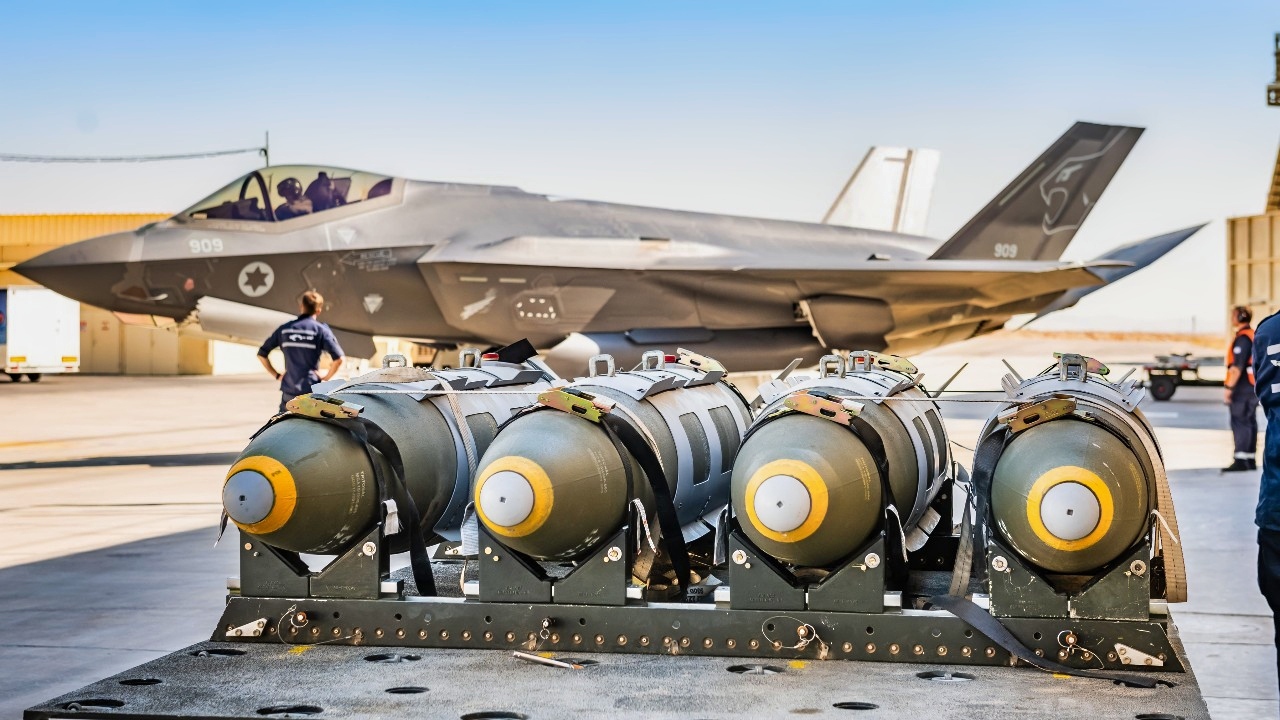
Israel F-35I Adir Stealth Fighter. Image Credit: IAF.

An Israeli Air Force pilot walks to an F-35I Adir prior to a Red Flag-Nellis 23-2 mission at Nellis Air Force Base, Nevada, March 15, 2023. Red Flag is an opportunity to build on the success of JUNIPER OAK 23-2, JUNIPER FALCON, and additional combined exercises to enhance interoperability with Israel, strengthen bilateral cooperation, and improve capabilities in ways that enhance and promote regional stability and reinforce the United States’ enduring commitment to Israel’s security. (U.S. Air Force photo by Airman 1st Class Trevor Bell)

An Israeli Air Force pilot climbs into an F-35I Adir prior to a Red Flag-Nellis 23-2 mission at Nellis Air Force Base, Nevada, March 16, 2023. Red Flag is an opportunity to build on the success of JUNIPER OAK 23-2, JUNIPER FALCON, and additional combined exercises to enhance interoperability with Israel, strengthen bilateral cooperation, and improve capabilities in ways that enhance and promote regional stability and reinforce the United States’ enduring commitment to Israel’s security. (U.S. Air Force photo by Airman 1st Class Trevor Bell)
While the Iran War likely didn’t trigger the decision, it certainly reinforced the need for it. Israel’s F-35I fleet has been heavily involved in strikes against Iran, including long-range missions against nuclear, military, and air defense targets throughout the country.
The aircraft gives Israel a stealthy strike platform, but the basic problem remains: Iran is far away, and even the F-35’s internal fuel capacity does not eliminate the need for careful tanker planning for repeated deep-strike operations.
Israeli aircraft in Iran have been operating at the very edge of their capabilities, with reports of fighters returning with very low fuel margins. External drop tanks were also reportedly found in eastern Iraq, indicating that Israeli aircraft have already been using additional fuel carriage to help sustain long-range strike sorties.
And there lies the problem for Israel. Its aerial refueling fleet has long relied on a small number of aging Boeing 707-based tankers – potentially as few as seven. That limits the number of long-range strike packages Israel can support at any given time, especially during sustained campaigns.
What the New Tanks Will Do
The new announcement indicates that Israel is looking to equip the F-35I with greater independent range, allowing it to fly longer missions and reduce tanker dependence, providing Israeli planners with greater flexibility if any future strike campaigns become necessary.
And if recent history is anything to go by, they probably will.
Elbit has said the work is based on an existing Cyclone fuel tank design originally developed for the F-16I, strongly suggesting it will be a drop tank rather than a fully conformal tank.

F-16I Sufa. Image Credit: Creative Commons.

F-16I Fighter from Israel. Image Credit: Creative Commons.

Israel F-16I Fighters IDF. Image Credit: IDF.
Unlike conformal tanks, which are blended closely into the aircraft’s fuselage to reduce aerodynamic and radar penalties, traditional drop tanks simply hang externally beneath the aircraft and can usually be jettisoned if the aircraft needs to return to a fully stealth state in defended airspace.
The aim, then, is to provide reach when it’s needed, while allowing the F-35I to operate as a stealthy aircraft when necessary.
A conformal tank would be far more complex to develop and integrate, and also arguably unnecessary.
Israel already uses conformal fuel tanks on aircraft such as the F-16I, but applying that concept to the F-35 would be far more difficult because the aircraft’s stealth depends on its carefully shaped outer lines.
Any major external change can affect the radar signature and aerodynamics.
“Beast Mode”
Israel has shown that it is willing to sacrifice some of the F-35I’s stealth advantages when operational requirements demand it.
The clearest example is perhaps the aircraft’s so-called “beast mode” – a configuration in which the F-35 carries weapons externally on underwing pylons instead of relying solely on internal weapons bays.
While the F-35 was originally designed around stealth and internal carriage, beast mode allows the aircraft to dramatically increase its payload once air superiority has been established or when stealth is considered less critical. An F-35 configured in this way can carry as much as 22,000 pounds of ordnance.
Israel became the first known operator to use the F-35 operationally in beast mode, with the Israeli Air Force releasing imagery showing F-35Is carrying external 2,000-pound GBU-31 JDAMs during combat operations.
The Adir, therefore, is not seen solely by the Israelis as a stealth aircraft, but as a flexible strike platform that can trade survivability for range or firepower depending on the mission.
The new fuel tank program reflects exactly the same logic, whereby external tanks increase radar visibility but allow Israeli fighters to reach Iran more effectively and reduce dependence on vulnerable tanker aircraft.
That’s valuable, but it’s even more useful against adversaries with limited ability to intercept even visible aircraft.
A Long Time Coming
There are indications that Israel may have been working toward this capability for years.
Back in 2021, Lockheed Martin disclosed that it was carrying out tens of millions of dollars in engineering support work for an unnamed foreign F-35 customer, widely believed to involve range-extension modifications.
Then, in 2022, reports appeared claiming Israel had already developed an unspecified method of extending the F-35I range far enough to strike Iran without aerial refueling.
More recently, Israeli Ambassador to the United States Yechiel Leiter appeared to publicly confirm the existence of the tanks in February, stating that Israel had developed fuel tanks that extended the aircraft’s range “without compromising stealth.”
About the Author: Jack Buckby
Jack Buckby is a British researcher and analyst specializing in defense and national security, based in New York. His work focuses on military capability, procurement, and strategic competition, producing and editing analysis for policy and defense audiences. He brings extensive editorial experience, with a career output spanning over 1,000 articles at 19FortyFive and National Security Journal, and has previously authored books and papers on extremism and deradicalization.


