

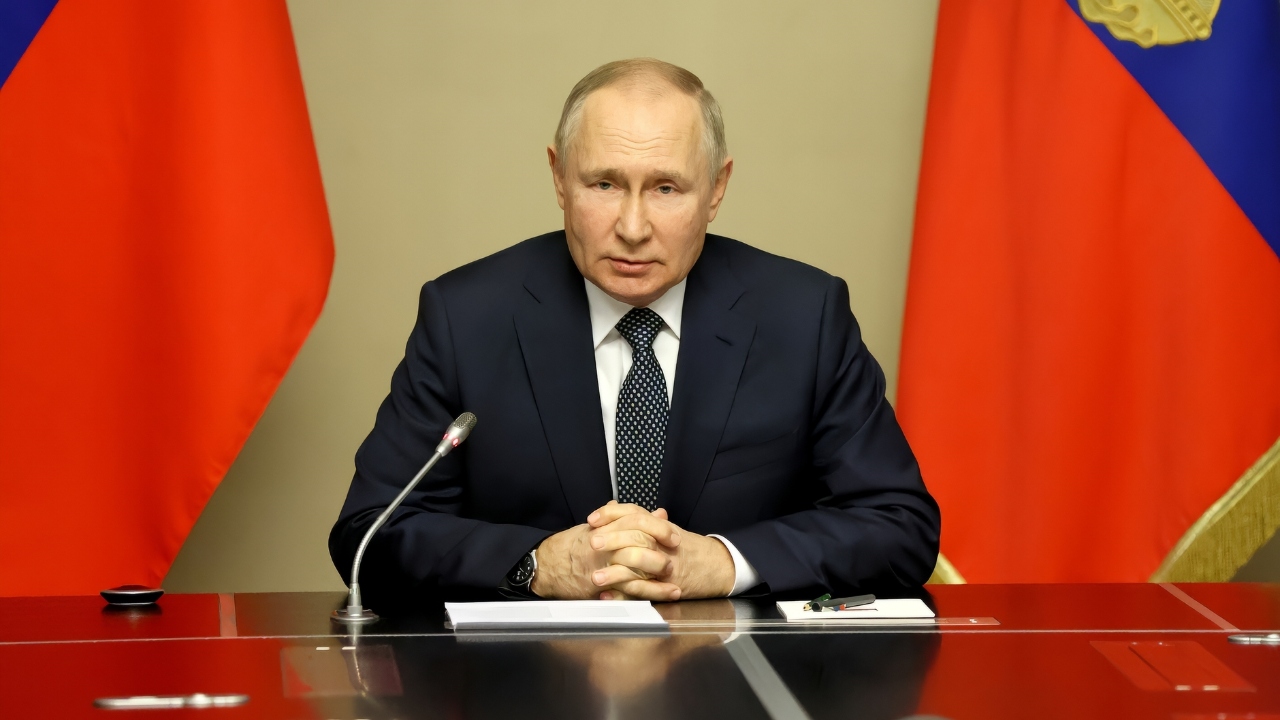
Russia is heading toward a crippling shortage of working-age men to fill both military ranks and defense factory lines, according to Alexander Kolyandr of the Center for European Policy Analysis. The natural Russian population has declined every year since 1992, resulting in a cumulative decline of 16.8 million people. The workforce aged 25 to 29 fell by more than 720,000 in 2022 alone. Russia’s economically active population could shrink by as many as 23 million — roughly a quarter — by 2050. The late American demographer Dr. Murray Feshbach predicted the trajectory in 1983. Vladimir Putin’s war in Ukraine, Kolyandr writes, simply poured fuel on a fire that was already burning.
Russia’s Demographic Crisis and the Ukraine War are Double Trouble for Putin

Putin with a Rifle. Image Credit: Russian State Media.

President of Russia Vladimir Putin at the at the BRICS+ meeting (via videoconference). Image Credit: Creative Commons.

Putin in 2022. Image Credit: Creative Commons.
Russia is careening towards a crippling shortage of able-bodied, working-age males to fill the rapidly depleted ranks of frontline military units and man the production lines of the country’s defense industrial enterprises.
Moreover, the profile of the current population in Russia, writes Alexander Kolyandr from the Center for European Policy Analysis (CEPA) in this month’s Spectator, is one in which these trends only become more dire over time.
What is worse, he points out, is if you are Russian President Vladimir Putin, you are maniacally obsessed with continuing the war in Ukraine regardless of the cost that you compound your own troubles.
Your increasingly ineffective use of both military manpower and hardware only exacerbates all the trends that put the country’s labor pool in this position in the first place.
The demographic situation in Russia has been going in the wrong direction for decades.
Multiple societal and economic ills contributed to declining birth rates and falling life expectancy – especially for males – throughout the Soviet period. At the same time, infant mortality was rising, and many Soviet females had undergone more than one abortion.
These were often crudely administered, and many women then became incapable of carrying a child through to live birth.
The person who understood the disaster that Russia was headed for far better than anyone in history was the late political scientist, historian, and demographer Dr. Murray Feshbach.
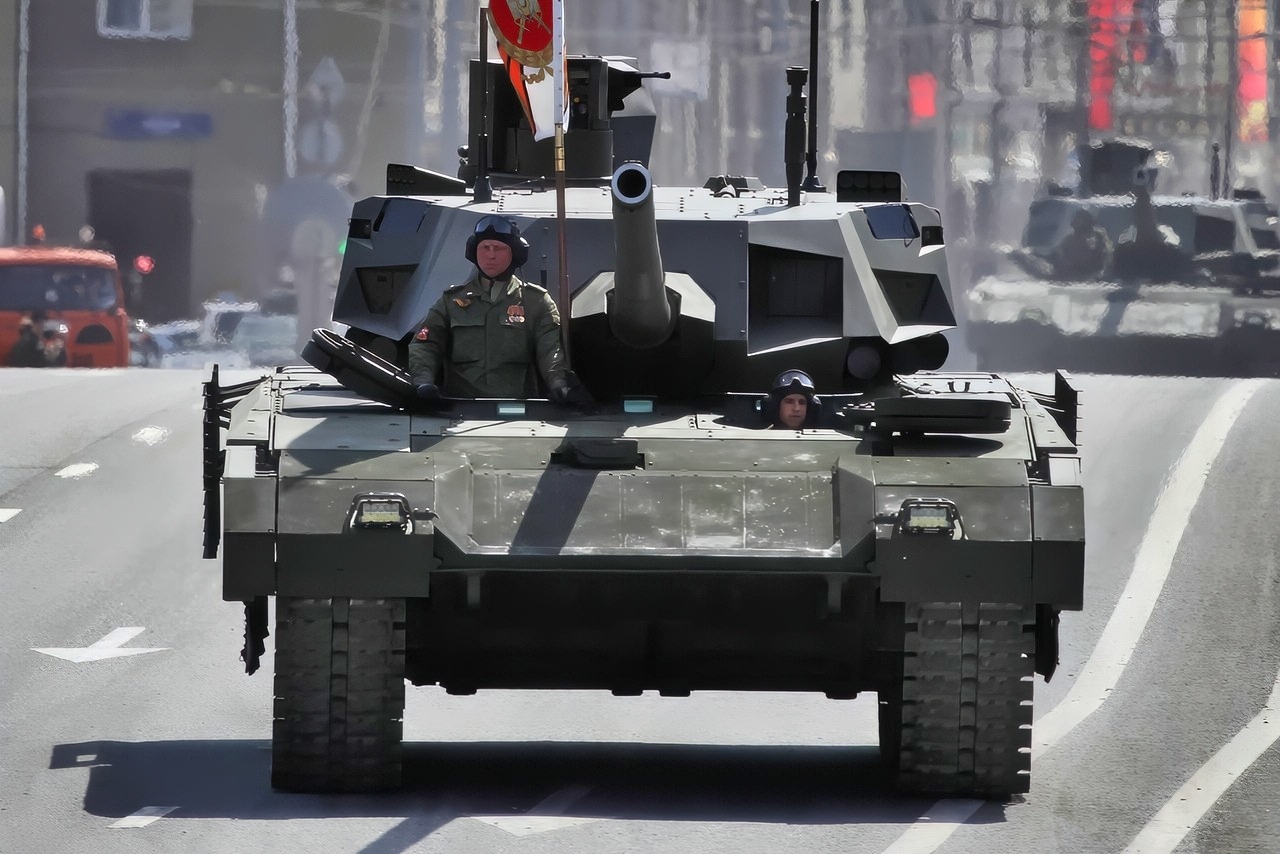
T-14 Armata Tank from Russia. Image Credit: Creative Commons.

T-14 Armata Tank. Image Credit: Creative Commons.
A brilliant and detailed profile of him in The Atlantic more than 30 years ago shows how, almost a decade before it fell apart, the USSR was already in trouble if it was going to still exist when the calendar clicked over to the 21st century.
How the Defense Industrial Base Suffers
As we now know, Moscow’s Brave New World never made it that far. Feshbach had already explained in 1983 that the country’s population trends did not support sustained growth or the maintenance of a superpower status.
People still called it that, but this superpower was running on an increasingly unstable foundation. In that time, which is often thought of as the last years of the heyday of the Soviet Union, the “worker’s paradise” was turning out to be a place where many lived under less than heavenly circumstances.
“At least one out of every five urban families shares living space with another family. Usually that means sharing a corridor, kitchen, and bathroom, but there are still large numbers of working youths living in communal dormitories or substandard baraki,” he explained to the magazine’s Cullen Murphy.
“The Soviets are extremely reticent about discussing sanitation; almost no data are available,” he continued. “It’s bad in hospitals, let alone restaurants,” Feshbach said. In 1972, he pointed out, only 60 percent of the families within the Novosibirsk district had indoor plumbing. Novosibirsk is the largest city in Siberia.
For those who do not know, Novosibirsk was – and still is – home to a number of scientific organizations and enterprises central to the development of advanced weapon systems. These include the Siberian Aeronautical Research Institute (SibNIA) and the Novosibirsk Aviation Production Association (NAPO) im. Chkalov, which produces the Sukhoi Su-34 bomber/attack aircraft.
Conditions in the Russian economy today, under pressure from multiple quarters, have not improved much, if at all.
Putin’s Improbable Statistical Analysis
As Kolyandr points out, “Vladimir Putin likes good statistics.” But he likes them most when he can interpret them to make it appear as though his clever, effective, and judicious leadership of Russia has produced miraculous results.
At a government meeting on 15 April, Putin conceded that the nation’s economic growth was slowing. But he then patted himself on the back by quoting the current unemployment rate: 2.1 percent, a record low.
His claim is that this number proves that the Russian economy is still as strong as a horse despite sanctions, embargoes, and the Ukrainians bombing his petroleum industry into the Stone Age. What the number really shows, however, is the extent to which the labor pool in Russia has contracted, a contraction that has also reached a post-Soviet low point.
The shortage of able-bodied men who can carry a rifle in the field or operate a factory machine press is so pronounced that the survival of the former Lt. Col.’s regime increasingly depends on an army of foreign soldiers and workers from North Korea and other nations.
Russia’s natural population, Kloyandr points out, has been declining since 1992. The total drop over the past three decades is 16.8 million people.
Looking at the statistics impartially, he points out that those born between 1992 and 2002 – the decade of the lowest birth rates – are now of working age. But in 2022 alone, the number of workers aged 25 to 29 had already dropped by more than 720,000.
Feshbach saw this coming for years. In 2017, it was predicted that the “economically active population could shrink by 6 to 7 million by 2030, and by as many as 23 million – roughly a quarter – by 2050,” says Kolyandr.
In the end, the Ukraine war, with its mounting casualties, did not create Russia’s demographic disaster. More than a quarter-century of increasingly incompetent rule by Putin is what did. The war, as the CEPA researcher concludes, “simply poured fuel on it.”
MORE – ‘She Can Shoot Down an F-22’: China’s J-20 Stealth Fighter Has Arrived
MORE – China’s J-35A Stealth Fighter Has a Message for the U.S. Air Force
About the Author: Reuben F. Johnson
Reuben F. Johnson has thirty-six years of experience analyzing and reporting on foreign weapons systems, defense technologies, and international arms export policy. Johnson is the Director of Research at the Casimir Pulaski Foundation. He is also a survivor of the Russian invasion of Ukraine in February 2022. He worked for years in the American defense industry as a foreign technology analyst and later as a consultant for the U.S. Department of Defense, the Departments of the Navy and Air Force, and the governments of the United Kingdom and Australia. In 2022-2023, he won two consecutive awards for his defense reporting. He holds a bachelor’s degree from DePauw University and a master’s degree from Miami University in Ohio, specializing in Soviet and Russian studies. He lives in Warsaw.


Swamplaw Yankee
May 20, 2026 at 12:25 pm
Wrong. The question is more accurately, Why was the USA so very interested in NAZI Hitler + not at all in the NAZI marriage partner, the Kremlin Muscovy?
Why was the USA hunting NAZI members + never the marriage partner members?
So in 2026 How many former Members of the Putin regime Kremlin Muscovy have entered the USA? Particularly, to reside in the USA? What are the complete statistics? Where do most reside inside the USA? NYC or where?
Until, the USA determines it is serious about the immediate prosecution of perpetrators of mass atrocities such as the Kremlin Muscovy ethnic tribe, the USA has and is disqualifying itself from any role in cuddling up with Kremlin Muscovy Putin.
MAGA POTUS Trump allows the highest figures of mass atrocity Kremlin Muscovy to enter the USA at will. None are even hinted at as perpetrators of international Genocide crime. The cycle of mass atrocities is encouraged by MAGA POTUS Trump + all his elite in blatant international view.
Some international Genocide figures even cavort with Trump personally as in Anchorage, where USA forces rolled out red carpets at US tax payer expense. Did Trump personally make secret deals with international Criminal Genocide figures on US spoil? Is Trump now tainted the USA with cuddling formally with a perpetual mass atrocity, Genocide Muscovy regime?
The demographic change is completely of USA origin. International War criminals can easily take off their Kremlin Muscovy Halloween costumes + obtain US legal papers. As the USA distracts with NAZI Hitler blather, the real NAZI marriage partners, the Kremlin Muscovy, have the legal right to be white washed by the US legal system.