

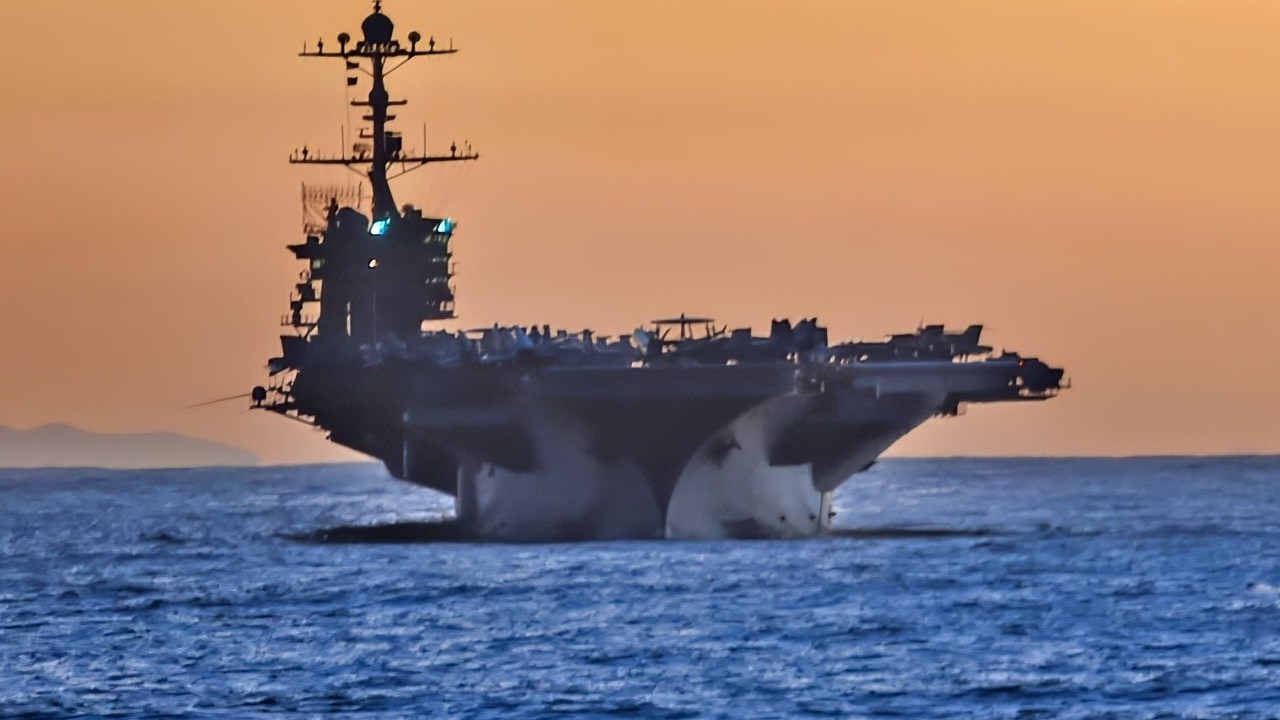
Sometimes, when I am lucky enough to give a lecture or speak to a group of folks interested in national security, I get the question: what got me interested in this field? Since I was a child, I have dragged history books (A World At Arms is my favorite) with me everywhere I went, and I have always been obsessed with military history. But the one thing that literally pushed me to change careers from the telecommunications industry in Rhode Island to a professional defense geek in a Washington, DC think tank back over a decade ago was one missile. Specifically, China’s DF-21D ‘carrier-killer’ missile. I literally wrote my graduate school thesis at Harvard University, mostly on the DF-21D and Beijing’s A2/AD military doctrine, breaking down this missile, the overall strategy it entailed, and how it would affect the U.S. Navy.
The DF-21D: The One Word Threat to the U.S. Navy Takes Seriously

DF-17 Missile from China. Image Credit: PLA.

DF-17 Missile from China. Image Credit: Creative Commons.
However, I must be frank, times have changed, and the threat has only grown. China now fields better anti-ship missiles than the DF-21D.
The DF-26B reaches twice as far. The DF-17 flies a hypersonic glide profile that is substantially harder to intercept. The DF-27 can range from Guam, Wake Island, and the approaches to Hawaii.
By raw capability, the missile that started the entire carrier-killer worry is no longer the most dangerous weapon in the Chinese arsenal.
It may, however, still be the one the U.S. Navy should worry about most in an actual crisis.
The DF-21D is the most mature anti-ship ballistic missile China has ever built. It has been in service longer than any of its successors, it exists in the largest numbers, and it is the weapon Chinese rocket forces have practiced with most extensively. If a Taiwan crisis turned hot tomorrow and Chinese commanders needed to put American carriers at risk within roughly 1,000 miles of the Chinese coast, the DF-21D is the missile they might reach for first — not because it is the best, but because it is the one that is ready, proven, and available in volume.
DF-21D: A Weapon Born In a Time of Crisis
The DF-21D’s origin traces to a moment of Chinese strategic humiliation.
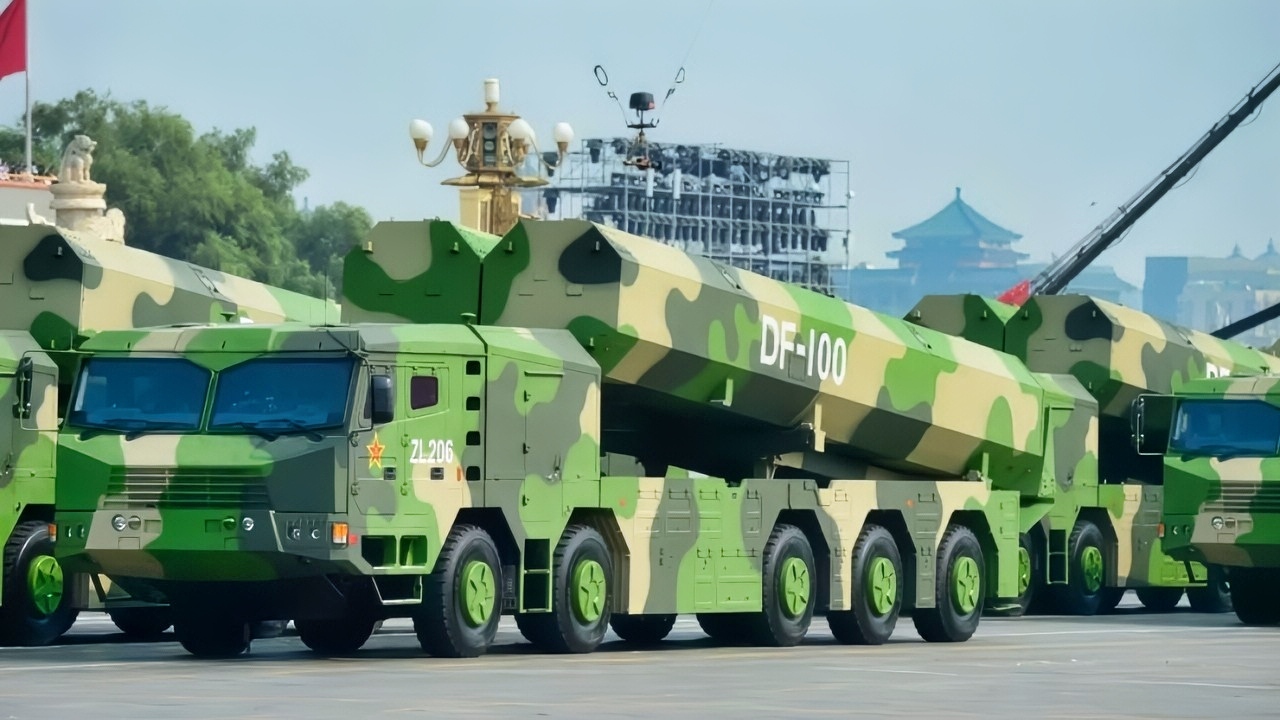
DF-100 Missiles: X Screengrab.
The 1995-1996 Taiwan Strait Crisis, when the Clinton administration sailed two carrier strike groups into the waters off Taiwan, and China had no way to threaten them, convinced Beijing it needed a weapon that could hold American carriers at risk from land.
But the technical inspiration came from a different conflict.
According to the most comprehensive open-source study of the weapon, written by U.S. Naval War College professor Andrew Erickson, the Kosovo War shaped the program’s development.
Chinese analysts studying the 1999 NATO air campaign over Yugoslavia drew lessons about precision strike, targeting, and the vulnerability of fixed and moving targets to guided ballistic weapons that fed directly into the anti-ship ballistic missile concept. Erickson’s bottom-line assessment, published as the missile reached maturity, was blunt: the era of treating the Chinese anti-ship ballistic missile as a bluff was over, and the DF-21D was neither science fiction nor a smoke-and-mirrors deception.
The missile itself is a variant of the DF-21 medium-range ballistic missile family, which entered Chinese service in 1991 as the country’s first solid-fuel, road-mobile ballistic missile. The road-mobile basing is central to the threat. The launchers cannot be reliably located and destroyed before launch, which means the DF-21D cannot be neutralized the way a fixed missile silo could be.
What The Missile Can Do
The DF-21D is a conventionally armed ballistic missile designed specifically to strike ships at sea. U.S. reports place its range at roughly 1,450 to 1,550 kilometers, with a maneuverable reentry vehicle that allows the warhead to adjust course during its terminal descent toward a moving target. Deployment estimates range from as few as 50 to as many as 200 missiles, and the warhead is assessed to have an accuracy measured in tens of meters — close enough to strike a carrier-sized target.
The terminal velocity is what makes interception so difficult. The warhead reentering the atmosphere approaches its target at speeds reported as high as Mach 10, compressing the time available to any defensive system to a handful of seconds.
A Chinese state aerospace official, Wang Genbin of the China Aerospace Science and Industry Corporation’s 4th Department, stated the missile could strike slow-moving targets with an accuracy of dozens of meters — a public Chinese claim that, while not independently verified against a real carrier, signaled the confidence Chinese engineers had in the system.
The Tests That Made It Real
The DF-21D progressed from concept to operational reality through a series of tests spanning more than a decade.
Reaching what Western analysts judged to be the equivalent of initial operational capability, the missile was assessed to have been deployed in small numbers even as additional challenges and tests remained — particularly the complex problem of identifying and tracking a U.S. carrier in the open ocean and fusing that targeting data fast enough to guide the missile to a moving ship.
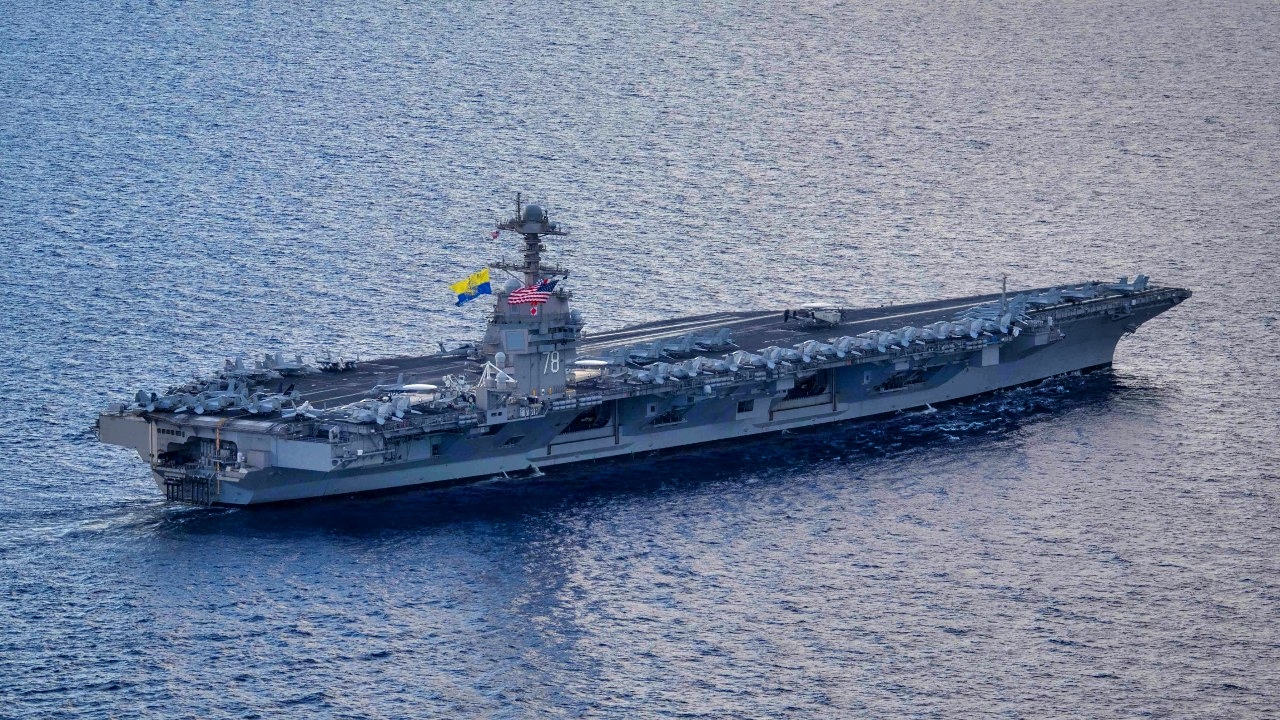
The world’s largest aircraft carrier USS Gerald R. Ford (CVN 78) sails in the Mediterranean Sea, Dec. 31, 2023. The U.S. maintains forward deployed, ready, and postured forces to deter aggression and support security and stability around the world. (U.S. Navy photo by Mass Communication Specialist 2nd Class Jacob Mattingly)
In 2013, the missile was reported to have been tested successfully against targets resembling U.S. naval vessels. The most significant demonstration came in August 2020, when Chinese rocket forces fired DF-26B and DF-21D missiles into the South China Sea. Chinese sources subsequently confirmed that the missiles struck a moving target — the closest thing to public proof that the anti-ship ballistic missile concept actually worked against a vessel underway rather than a fixed point on the ocean floor.
The Pentagon called the launches destabilizing and counterproductive, noting that the reported ranges of the DF-21D and DF-26 weapons extended as far as 1,000 nautical miles or more, introducing new risks for carriers seeking to project power off enemy coasts.
The Swarm Problem
The single missile is dangerous. The salvo is decisive. The DF-21D was never designed to be fired one at a time, and the U.S. Navy’s defensive architecture is the reason why.
American carrier strike groups defend against ballistic missile threats using the Aegis combat system paired with the Standard Missile family — the SM-6 for terminal engagement and the SM-3 for midcourse interception — supplemented by electronic warfare systems that attempt to confuse incoming missiles with false targets. Erickson noted that these American defensive measures, including Aegis ballistic missile defense and electronic warfare systems capable of generating false targets, represent a serious and evolving countermeasure to the anti-ship ballistic missile threat.
The Chinese answer is volume. A carrier strike group’s escorts carry a finite number of interceptor missiles in their vertical launch cells, and those cells must be divided among air defense, ballistic missile defense, and offensive strike weapons. A coordinated salvo of DF-21Ds fired simultaneously — particularly when combined with DF-26B ballistic missiles, DF-17 hypersonic glide vehicles, and air- and sea-launched cruise missiles arriving from multiple vectors at once — is designed to present more inbound threats than the defending warships have interceptors to engage.
The math does not need to favor any single missile getting through. It only needs enough missiles in the air for the defensive system to run out of shots before the attack runs out of weapons. And as I have said before in many articles over the years, in the missile defense game, math is all that matters.
The Lessons The Successors Learned
The DF-21D’s most lasting impact is visible in the missiles that followed it.
The DF-26B doubled the range to roughly 4,000 kilometers, extending the anti-ship threat from the first island chain out to Guam, while keeping the road-mobile basing and the maneuverable terminal warhead that made the DF-21D survivable and accurate.
The DF-17 took the basic anti-ship ballistic missile concept and replaced the conventional reentry vehicle with a hypersonic glide vehicle that skims the upper atmosphere on an unpredictable flight path, specifically to defeat the midcourse interception the Aegis system relies on.
Each successor inherited the core architecture the DF-21D pioneered: a road-mobile launcher that cannot be reliably found, a maneuverable warhead that can adjust course toward a moving ship, a reconnaissance-strike kill chain that fuses satellite, radar, and over-the-horizon targeting data, and a terminal velocity that compresses the defender’s reaction time to near zero.
Current Western analysis notes the DF-21D remains in service and that an air-launched derivative may have been tested as recently as 2025 — meaning the weapon that started the carrier-killer crisis is still evolving even as its successors carry the concept farther.
About the Author: Harry J. Kazianis
Harry J. Kazianis (@Grecianformula) was the former Senior Director of National Security Affairs at the Center for the National Interest (CFTNI), a foreign policy think tank founded by Richard Nixon based in Washington, DC. Harry has over a decade of experience in think tanks and national security publishing. His ideas have been published in the NY Times, The Washington Post, The Wall Street Journal, CNN, and many other outlets worldwide. He has held positions at CSIS, the Heritage Foundation, the University of Nottingham, and several other institutions related to national security research and studies. He is the former Executive Editor of the National Interest and the Diplomat. He holds a Master’s degree focusing on international affairs from Harvard University.


Htos1av
May 29, 2026 at 8:33 am
Ummmm, so?
If you know all this, you KNOW that JUST ONE, JUST ONE of the 105mm uranium shells IN ORBIT, will leave a 25 MILE WIDE “imprint” upon a nation’s land.
JUST ONE, incoming at 17,000mph, is a “bad day”, wherever it lands. JUST ONE, will “remove” an entire country’s navy with JUST a “splash” nearby.
Thank you, president Reagan.
Hope you’re feelin’ better, now.
Brad Boyd
May 30, 2026 at 8:21 pm
American carriers are practically strategic assets and should be treated and defended as such. If irbms are used to destroy a carrier the world needs to be made aware that the response will be a tactical nuclear weapon dropped on a naval base or their carriers. No way to know until ignition if the warhead on the enemy missile is nuclear. Let prospective enemies know we will not be ambiguous in our response nor wait for impact.
Steven F
May 31, 2026 at 5:52 pm
Which is exactly why we need the Defiant class battle cruisers. Bleeding edge, high power EW systems, working in concert with a 32 megajoule primary rail gun (20 pound projectile + 100 mile range + hypersonic velocity + 500 rounds in a ready magazine with 2X reserve magazines, each with 250 rounds), with both systems working in concert with dual ~1 mW Directed Energy Weapons, all tied together with AI Target Optimization and multiplied by 2 (two BBGN’s per fleet), topped off with hordes of MUSV’s loaded to bear with Mk 70 PDS and the next generation of Standard Missiles, will give our CSG’s the volume and magazine capacity to absorb almost any saturation attack Xi can muster.