


Summary and Key Points: Millennium Challenge 2002 was supposed to prove the future of U.S. network-centric warfare. Instead, it became a warning about overconfidence. Retired Marine Lt. Gen. Paul Van Riper, leading the Red Force (most likely Iran), used low-tech communications, small boats, and missile barrages to overwhelm a U.S. naval task force, “sinking” an aircraft carrier, cruisers, and amphibious ships early in the exercise. The decision to refloat the ships and restrict Red Force tactics fueled accusations that the war game had been scripted to protect favored Pentagon concepts. More than two decades later, its lessons still feel relevant in the Persian Gulf.
One Wargame Shook the U.S. Navy

The aircraft carrier USS Gerald R. Ford (CVN 78) completes the first scheduled explosive event of Full Ship Shock Trials while underway in the Atlantic Ocean, June 18, 2021. The U.S. Navy conducts shock trials of new ship designs using live explosives to confirm that our warships can continue to meet demanding mission requirements under harsh conditions they might encounter in battle. (U.S. Navy photo by Mass Communication Specialist 3rd Class Riley B. McDowell)
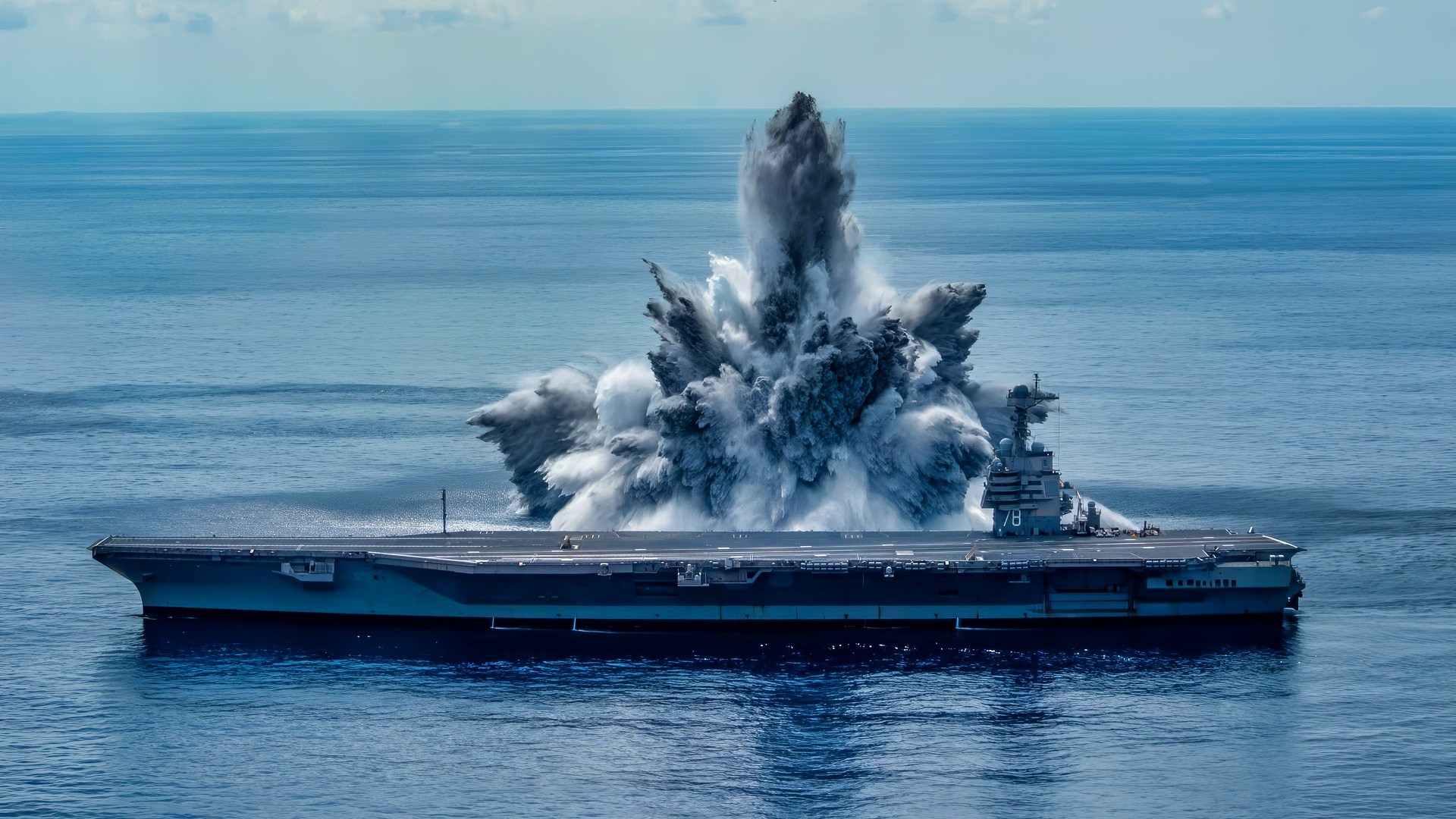
The aircraft carrier USS Gerald R. Ford (CVN 78) successfully completes the third and final scheduled explosive event of Full Ship Shock Trials while underway in the Atlantic Ocean, Aug. 8, 2021. The U.S. Navy conducts shock trials of new ship designs using live explosives to confirm that our warships can continue to meet demanding mission requirements under harsh conditions they might encounter in battle. (U.S. Navy photo by Mass Communication Specialist 3rd Class Novalee Manzella)
The Millennium Challenge 2002 was a massive, $250 million U.S. military war game conducted in July and August of 2002.
It was designed to test experimental, network-centric warfare against an unnamed Middle Eastern adversary, widely thought to be Iran.
The exercise famously ended in controversy when the opposing “Red” forces, led by retired Marine Lieutenant General Paul Van Riper, soundly defeated the U.S. “Blue” forces.
The bigger controversy was that after the catastrophic loss of US ships on the second day of the simulation, the exercise coordinators halted the game, “refloated” the sunken U.S. ships, and constrained Van Riper’s tactical choices to ensure the U.S. forces ultimately won.
But others argued that the Red Forces used impossible tactics to win.
Background On The MC 2002
The exercise was conducted by the former U.S. Joint Forces Command (USJFCOM), which was a functional Unified Combatant Command of the United States Armed Forces headquartered in Norfolk, Virginia.

MEDITERRANEAN SEA (Feb. 21, 2017) The aircraft carrier USS George H.W. Bush (CVN 77) transits the Mediterranean Sea in support of Operation Inherent Resolve. The George H.W. Bush Carrier Strike Group is conducting naval operations in the U.S. 6th Fleet area of operations in support of U.S. national security interests. (U.S. Navy photo by Mass Communication Specialist 3rd Class Daniel Gaither/Released)
It was officially disbanded on August 4, 2011, as part of a Department of Defense restructuring to cut costs and rebalance priorities.
Following its deactivation, its core responsibilities—such as joint concept development, training, and force management—were reassigned to other combatant commands and the Joint Chiefs of Staff.
When conducted, the exercise was the most ambitious and expensive military simulation in American history. Planning for the exercise took two years, with more than 13,000 troops involved, in a mixture of simulation and live exercises.
It pitted the U.S. military (Blue) against a nameless potential adversary (Red), widely thought to be Iran, with the outcome intended to inform future strategy and procurement decisions. Congress mandated the exercise to “explore critical war-fighting challenges at the operational level of war that will confront United States joint military forces after 2010.”
However, when the opposition force, or red team, learned that the results were scripted to ensure U.S. forces would win, it sparked a storm of controversy.
The Scenario Sounds Almost Similar To Today
The situation surrounding the wargame was very intriguing, especially today, since some of what is unfolding in the Gulf was planned 24 years ago.
After a devastating natural disaster (an earthquake), the Red Force country experienced civil unrest and a breakdown in governmental authority.
A nationalistic military commander of CJTF-South used the opportunity to take control over the Red Force country. He seized some islands in the Persian Gulf and began to levy fees on ships transiting international sea lanes, such as the Strait of Hormuz.
The Blue Force (the United States) dispatched a large naval task force to the region to enforce the Freedom of Navigation and a World Court ruling requiring the Red Force to evacuate the islands.
Marine LTG Ripper was chosen as he was a “devious sort of guy” and “a no-nonsense solid professional warfighter.”
The Blue Force Navy Was Nearly Wiped Out
Van Ripper’s Red Forces didn’t sit back and wait for the Blue Force to attack. Instead of normal radio communications, he used motorcycle-borne messengers and old-fashioned light signals to pass message traffic.
Using small, swift attack boats and ground-based launchers, he launched a pre-emptive strike using cruise missiles and overwhelmed the defenses of the Blue naval task force. By Day 2 of the exercise, an aircraft carrier, ten cruisers, and five amphibious landing craft were “sunk.”
The controversy began because the actual live portion of the exercise involved the Marine Corps conducting an amphibious assault, and the Army’s 82nd Airborne Division inserting troops via vertical envelopment was still slated to occur. So, the exercise controllers “refloated” the Navy’s ships for that purpose.
Van Ripper was told that he couldn’t fire against the Marine Corps’ V-22 Ospreys or the Air Force’s transports for the 82nd. He was livid. He stepped down as the commander of the Red Force and, for the next 17 days of the exercise, acted as an advisor. The Blue Force then accomplished its objectives.
But the story didn’t end there.
Van Ripper’s Report Ripped The Exercise
Van Ripper’s report pointed out several factors as to why the Blue Force was hit so hard. He believed that the Joint Force controllers scripted the exercise to show that the military had misplaced confidence in still-untested war-fighting concepts.
“War-gaming is not normally corrupted, but this whole thing was prostituted; it was a sham intended to prove what they wanted to prove,” he said.
In an interview later on NOVA, he stated, “War is about adapting. Any potential enemy, as well as we, the United States, if we didn’t adapt, learn, and evolve from our past experiences, we would be a species or a nation that would not survive. And any enemy that wants to survive against the United States can’t fight like some of our recent enemies have, or they won’t survive.
“But just because the United States has overwhelming forces (or at least we Americans perceive that it does) and will for the foreseeable future, shouldn’t make us believe that we’re always going to dominate on that future battlefield. Many enemies are not frightened by that overwhelming force. They put their minds to the problem and think through: how can I adapt and avoid that overwhelming force and yet do damage against the United States?”
The USJFCOM’s report didn’t come to light for nearly ten years, but it eventually admitted that the exercise was scripted to limit the Red Force’s ability to resist.
The exercise sparked an intense debate within the Pentagon regarding whether the military was relying too heavily on technology while ignoring the unpredictable, adaptable nature of human adversaries.
About the Author: Steve Balestrieri
Steve Balestrieri is a National Security Columnist. He served as a US Army Special Forces NCO and Warrant Officer. In addition to writing on defense, he covers the NFL for PatsFans.com and is a member of the Pro Football Writers of America (PFWA). His work was regularly featured in many military publications.


