


Summary and Key Points: The Avro Vulcan was designed as a bomber, but it was never defined so tightly in practice. Britain’s great delta-winged V-bomber handled like a fighter, and at 45,000 feet it humbled them — Mirages, Phantoms, Starfighters, Lightnings all climbed up to take it on, and its pilots swear not one ever beat a Vulcan in a turning fight. It had a low radar signature and countermeasures that let it slip past defenses decades before anyone used the word “stealth.” But its defining moment came at the very end of its life, in 1982, when an aircraft already three decades old flew a mission so long and improbable it’s still studied today. And in a stranger footnote, the Vulcan had a Hollywood career too — one that ended with a movie prop on the ocean floor, where divers still visit it.
Meet The Avro Vulcan Bomber
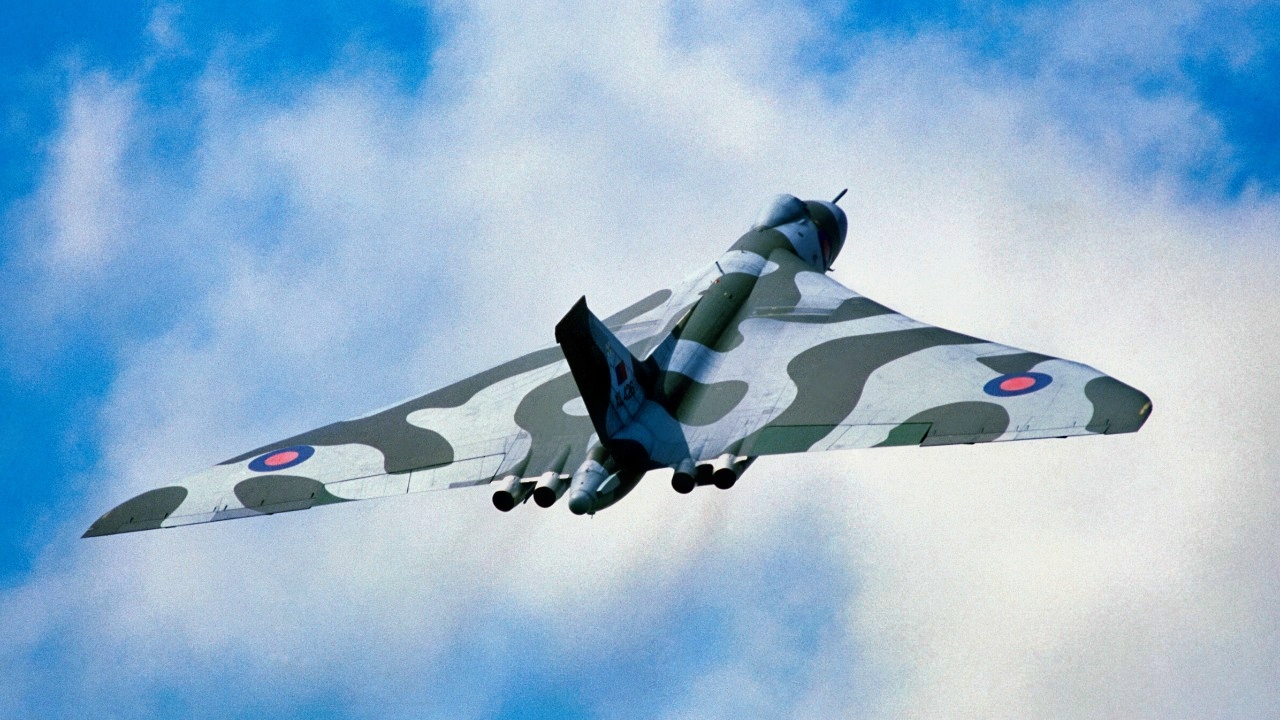
A Royal Air Force Vulcan Display Team Vulcan B. Mk 2 aircraft performs during Air Fete ’85. Image Credit: Creative Commons.
The Avro Vulcan was an outstanding, revolutionary, jet-powered delta-wing strategic bomber operated by the Royal Air Force (RAF) from 1956 until 1984.
Praised by its pilots for handling like a fighter aircraft, the Vulcan boasted incredible high-altitude performance, near-Mach-1 speed, and innovative stealth characteristics.
As the most technically advanced of Britain’s famous “V bombers,” it served as the backbone of the UK’s nuclear deterrent during the Cold War before transitioning to conventional bombing, where it conducted raids in the Falkland Islands.
The History
The Avro Vulcan was designed in the early days of the Cold War as a high-altitude nuclear bomber. Famous for its thunderous roar, it developed a cult following likely to last for a very long time.
The Avro Vulcan’s delta-wing design enabled excellent aerodynamics, ample fuel capacity, and flapless take-off and landing.
The bomber possessed a massive internal bomb bay capable of carrying up to 21,000 lbs of conventional bombs, a single large nuclear gravity bomb, or a semi-recessed Blue Steel nuclear stand-off missile.
Due to its low radar cross-section and highly effective electronic countermeasures (ECM), the Vulcan frequently evaded sophisticated air defenses during wargames. While it wasn’t a stealth aircraft, it had stealthy characteristics.
The aircraft was renowned for making it easier for pilots to handle at high speeds due to its advanced electrical system. The reliable Rolls-Royce Olympus engines gave the Avro Vulcan impressive altitude and maneuverability.
They produced 17,000 pounds of thrust each, delivering sufficient thrust to reach 45,000 feet. Former Vulcan pilot Bill Ramsey said, “In operation, we flew up to 45,000 feet and fighters would come up to have a go at us – Mirages, Phantoms, Voodoos, Starfighters, Lightnings – and none of them could get up and fight a Vulcan at that altitude!

An Australian Mirage III, from the 75th Squadron, Royal New Zealand Air Force, is inspected. The Mirages were to be used during PITCH BLACK 84, but were grounded due to problems with the landing gear. PITCH BLACK is a joint US, Australian and New Zealand exercise.

Mirage 2000 Fighter. Image Credit: Creative Commons.
“We would sit there at low speed and 2g out-turning them. The high wing loading fast-jets didn’t stand a chance – we were never defeated by a solo fighter at 45,000ft!”
The Avro Vulcan was the pinnacle of achievement for Avro; it was developed just 10 years after the iconic World War II heavy bomber, the Lancaster.
Operation Black Buck And A Nearly 8,000 Mile Mission
Operation Black Buck was a series of seven daring, ultra-long-range bombing raids conducted by the Royal Air Force during the 1982 Falklands War. Although the Vulcan was nearing the end of a nearly 30-year career in the RAF, this would be her baptism of fire. And the aircraft didn’t disappoint.
Flying Vulcan bombers, the RAF launched attacks from Ascension Island on Argentine positions at Port Stanley. The flights were long and arduous, involving several in-flight refuelings; the mission spanned nearly 8,000 miles (12,200 km).
The mission was to take out the runway at Port Stanley, and the first Vulcan to achieve this was piloted by Martin Withers in Vulcan XM607; the bomber dropped twenty-one 1,000lb bombs from 10,000 feet, successfully cratering the runway.
Flight Lieutenant Martin was awarded the Distinguished Flying Cross (DFC) for his part in the mission. Squadron Leader Bob Tuxford, who piloted Victor XL189 – the last Victor tanker to refuel the Vulcan prior to the raid, was awarded the Air Force Cross.
The United States covertly supplied a number of AGM-45A Shrike anti-radar missiles at the beginning of the conflict. Black Buck 6 took place on June 3, 1982.
It was a mission tasked with destroying Argentine radar sites using Shrike anti-radiation missiles.
After dropping their ordnance, a problem arose with the Vulcan’s refueling probe. This forced the bomber to divert to Rio de Janeiro, Brazil. The crew was eventually released, and the aircraft was interned.
The Avro Vulcan bombers were retired in 1984.
“Bond…James Bond” And The Vulcan
The Avro Vulcan B.1A is a Cold War-era British strategic jet bomber that famously served as the central plot device in the 1965 James Bond film Thunderball.
In the film, SPECTRE operatives hijack the Vulcan—which is carrying two nuclear warheads—and crash-land it in the shallow waters of the Bahamas to steal the bombs.
Today, the remains of the full-size Thunderball Vulcan movie prop serve as a popular artificial reef and dive site off Clifton Pier in Nassau, Bahamas. After decades in the water, the fiberglass skin has eroded, but the structural framework and landing gear rods remain easily accessible for recreational divers.
The Avro Vulcan was an outstanding Cold War-era bomber that was beloved by its pilots and flew in combat just before it was retired.
About the Author: Steve Balestrieri
Steve Balestrieri is a National Security Columnist. He served as a US Army Special Forces NCO and Warrant Officer. In addition to writing on defense, he covers the NFL for PatsFans.com and is a member of the Pro Football Writers of America (PFWA). His work was regularly featured in many military publications.


