

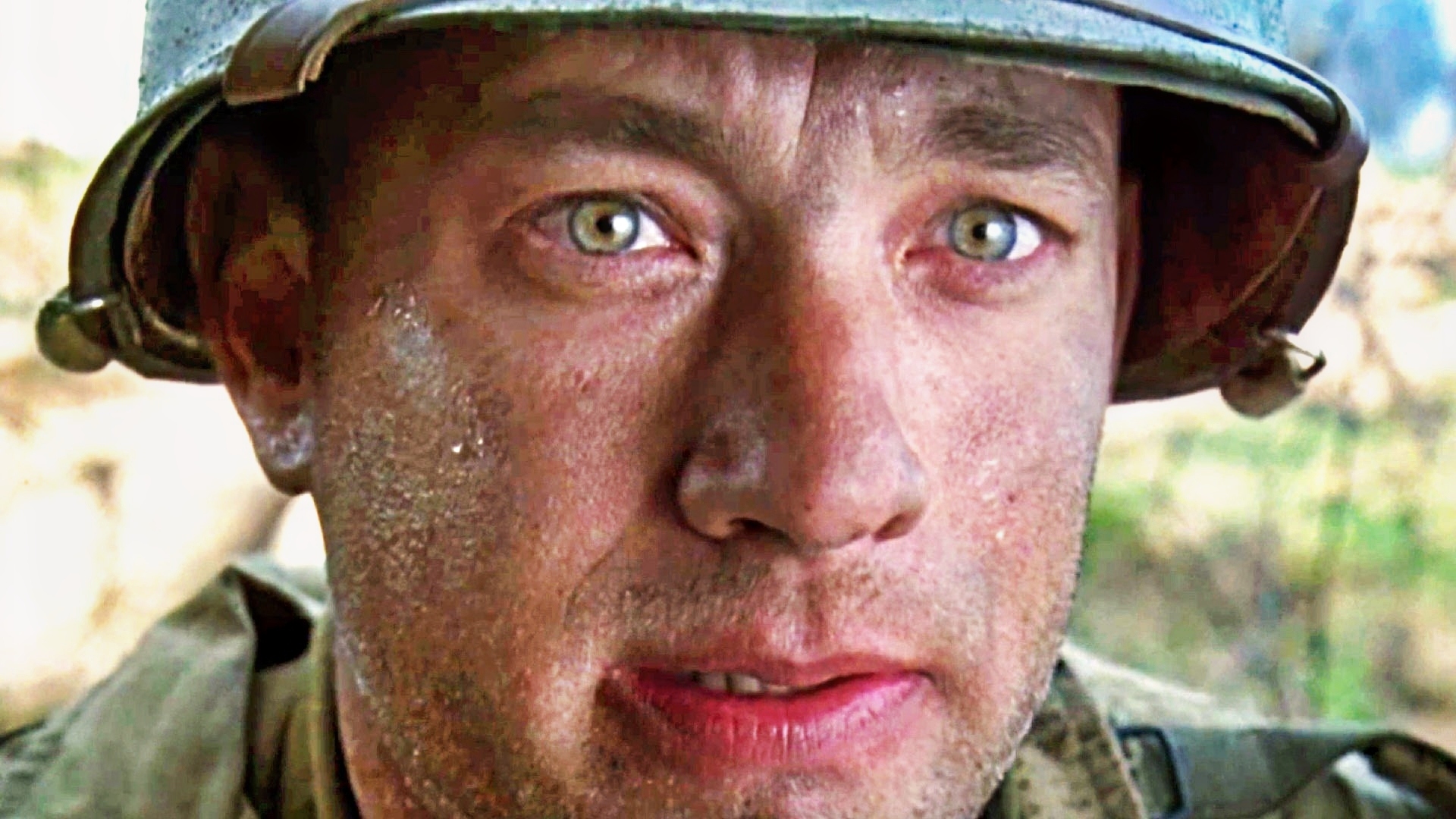
Saving Private Ryan, Steven Spielberg’s story of a group of World War II soldiers venturing behind enemy lines in Nazi-occupied France to rescue a single soldier, has been named to various lists of the best war movies ever produced.
Hollywood has been churning out movies about World War II since the war was still underway in the 1940s, and it hasn’t really stopped since. Made near the end of the 20th century, Private Ryan was one of the best of them.
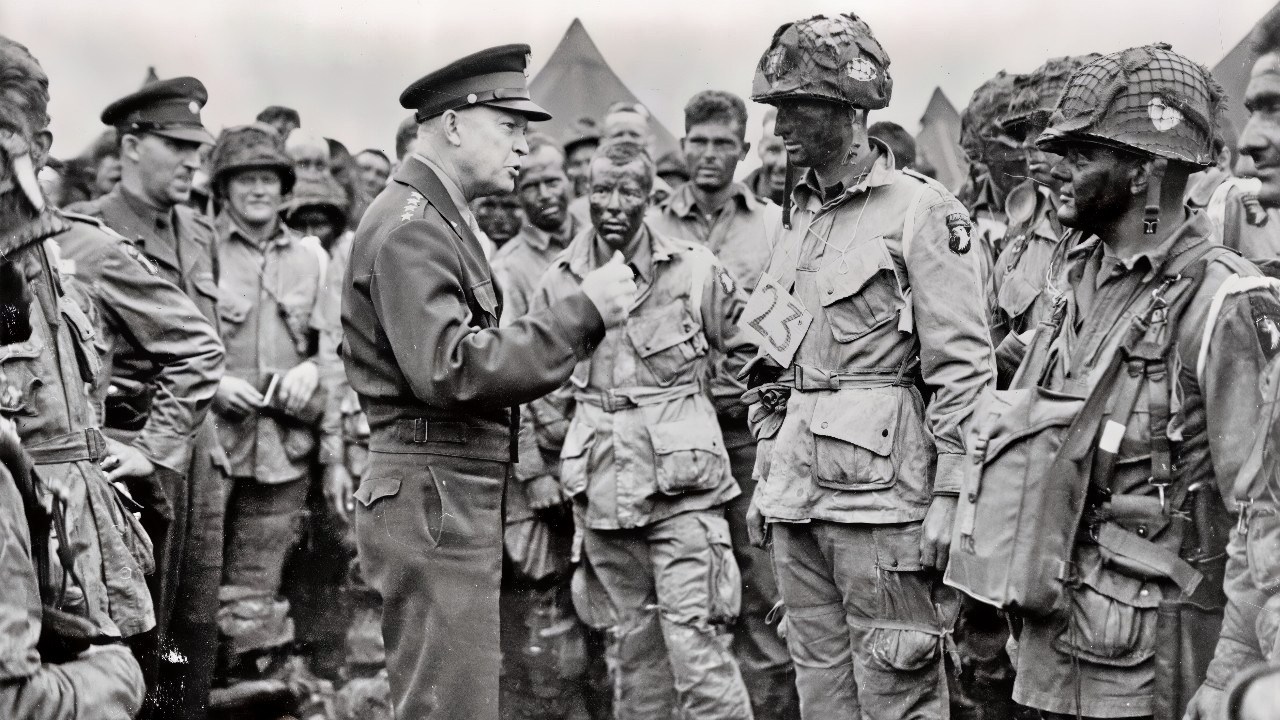
General Dwight D. Eisenhower addresses American paratroopers prior to D-Day. “Gen. Dwight D. Eisenhower gives the order of the Day. ‘Full victory-nothing less’ to paratroopers in England, just before they board their airplanes to participate in the first assault in the invasion of the continent of Europe.” Eisenhower is meeting with US Co. E, 502nd Parachute Infantry Regiment (Strike) of the 101st Airborne Division, photo taken at Greenham Common Airfield in England about 8:30 p.m. on June 5, 1944. The General was talking about fly fishing with his men as he always did before a stressful operation (Eisenhower speaks with Hartsock).
Starting with a harrowing, graphic depiction of the D-Day invasion on June 6, 1944, the film soon settles into its main plot: The Department of War has become aware that three brothers from a single family, the Ryans, have been killed in action, and a fourth brother, James, is missing. The orders have come straight from Gen. George Marshall: A dangerous mission to find Ryan, rescue him, and bring him home to his family.
The mission is led by Captain John Miller (Tom Hanks), and the unit includes Edward Burns, Adam Goldberg, Tom Sizemore, Jeremy Davies, Barry Pepper, and Vin Diesel. Matt Damon, still at the very beginning of his career, plays the titular Private Ryan. (In 2023, I interviewed Adam Goldberg about his work on the film.)
The film makes it very clear that this type of mission isn’t what the soldiers signed up for, and they aren’t especially thrilled about risking their lives in enemy territory for what amounts to a PR exercise.
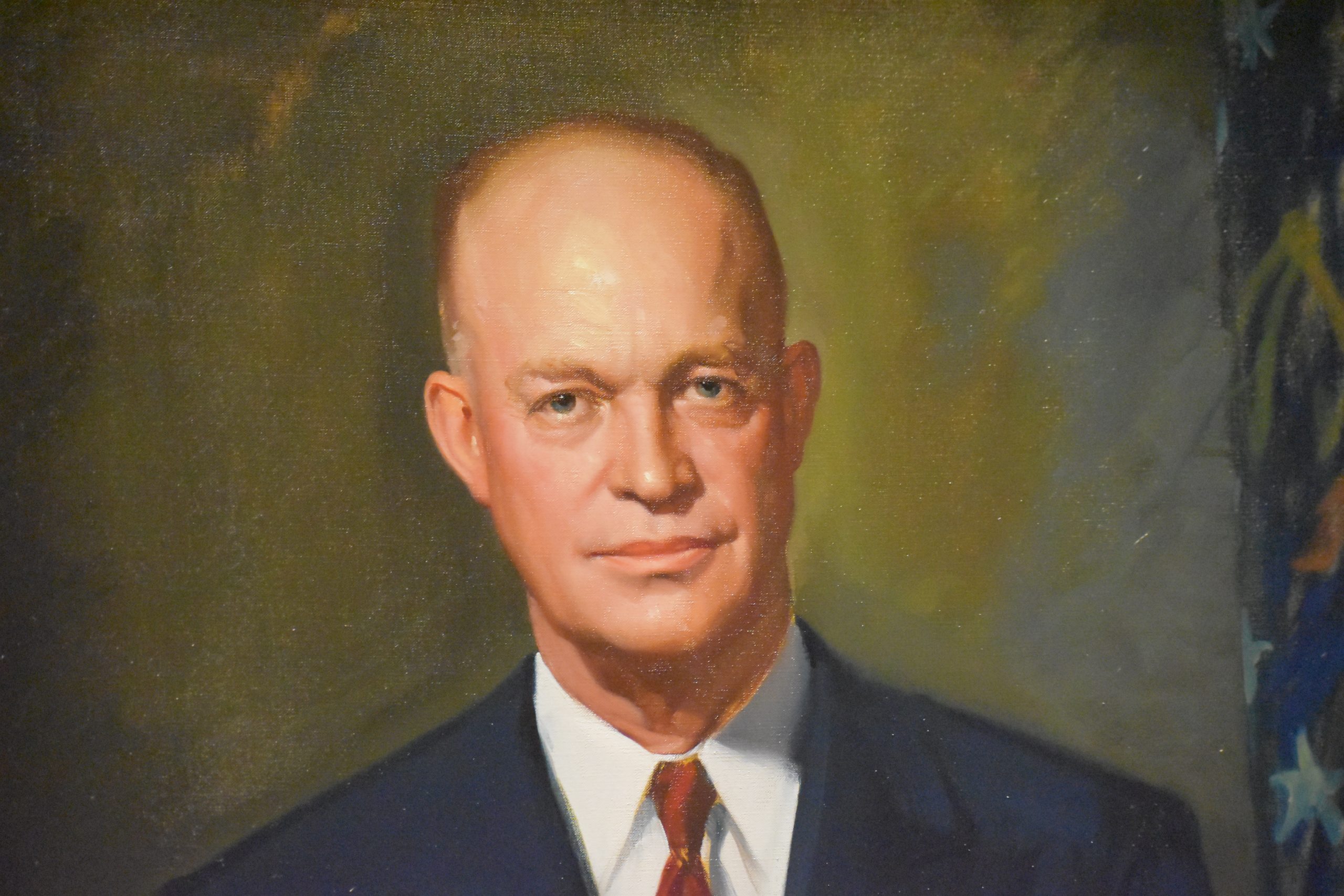
Dwight D. Eisenhower. Image taken at the National Portrait Gallery for National Security Journal.
Saving Private Ryan uses a framing device in which an elderly man visits the Normandy Cemetery with his large extended family before coming across a specific grave. At the end of the film, it’s revealed that the old man is Ryan, that the grave he’s visiting is Miller’s, and that Miller’s dying words to him were to “earn this.”
Saving Private Ryan was not based on any particular true story, but was inspired by much of the work of historian Stephen Ambrose, as well as by multiple stories from that war of families in which multiple brothers lost their lives. It was written by Robert Rodat and directed by Spielberg, who had swept the Oscars with Schindler’s List five years earlier. Spielberg and Hanks would go on to collaborate on other acclaimed World War II projects, including Band of Brothers, The Pacific, and Masters of the Air.
What’s Great About It: D-Day and More
There are several reasons Saving Private Ryan is well respected and highly regarded.
That D-Day sequence is not only uncompromising and brilliantly put together, but it also went on to greatly influence later World War II movies. Spielberg’s usual collaborators, cinematographer Janusz Kaminski and composer John Williams, do some of their best work on this film.
Also, the film features a strong performance from Tom Hanks, along with fine work from a group of well-cast up-and-coming actors, many of whom would go on to greater stardom in the years that followed. Sizemore, in particular, would become a staple of other war movies, like Black Hawk Down and Pearl Harbor.
Saving Private Ryan arrived at a time of renewed interest in World War II and appreciation for the sacrifices of its veterans, as Tom Brokaw’s book The Greatest Generation was also published in 1998, and another World War film from a major filmmaker, Terrence Malick’s The Thin Red Line, came out a few months later.

M4 Sherman. Image Credit: Creative Commons.
Spielberg and Rodat, Roger Ebert wrote in his 1998 review of the film, have “made a philosophical film about war almost entirely in terms of action… ‘Saving Private Ryan’ says things about war that are as complex and difficult as any essayist could possibly express, and does it with broad, strong images, with violence, with profanity, with action, with camaraderie. It is possible to express even the most thoughtful ideas in the simplest words and actions, and that’s what Spielberg does.”
The film’s historical accuracy, especially in its depiction of D-Day, has been widely praised by historians.
Taking Exception
Most other critics agreed, as the film has a 94 percent critics score and 95 percent audience score on Rotten Tomatoes (a site to which I am a contributing critic, although I have not reviewed Saving Private Ryan). Rotten Tomatoes’ list of the 100 best war movies of all time has Saving Private Ryan at #26.
The Internet Movie Database, on their even more questionable list of the Top 50 War Movies, has Saving Private Ryan #6, behind Nuremberg, Inglourious Basterds, The Hunger Games: Ballad of Songbirds and Snakes, Civil War, and Kingdom of Heaven.
Variety’s 2023 list of the 30 best war movies, which did not rank the films, included Saving Private Ryan.
“The brilliance of the film, apart from the bone-deep humanity of its U.S. Army platoon (led by the stubborn bedraggled decency of Tom Hanks), is the way that Spielberg depicts the very spirit of war as a snake that keeps slithering back, sucking the men under, with annihilation lurking around every corner,” critic Owen Gleiberman wrote of the film, praising both the opening battle sequence and the rest of the story.
Those who dislike the film tend to be those who aren’t big on war films, or are among the small but vocal group of film enthusiasts who dislike Steven Spielberg in principle.
There is, however, one asterisk to Saving Private Ryan’s reception: While it won five Academy Awards, including for Best Director, Best Cinematography, Best Film Editing, Best Sound, and Best Sound Effects Editing, it lost the Best Picture Oscar to Shakespeare in Love. It was one of the biggest upsets in the history of the Oscars, with the award going to a film that history has not looked nearly as kindly on as Private Ryan.
About the Author: Stephen Silver
Stephen Silver is an award-winning journalist, essayist, and film critic, and contributor to the Philadelphia Inquirer, the Jewish Telegraphic Agency, Broad Street Review, and Splice Today. The co-founder of the Philadelphia Film Critics Circle, Stephen lives in suburban Philadelphia with his wife and two sons. For over a decade, Stephen has authored thousands of articles that focus on politics, national security, technology, and the economy. Follow him on X (formerly Twitter) at @StephenSilver, and subscribe to his Substack newsletter.


