

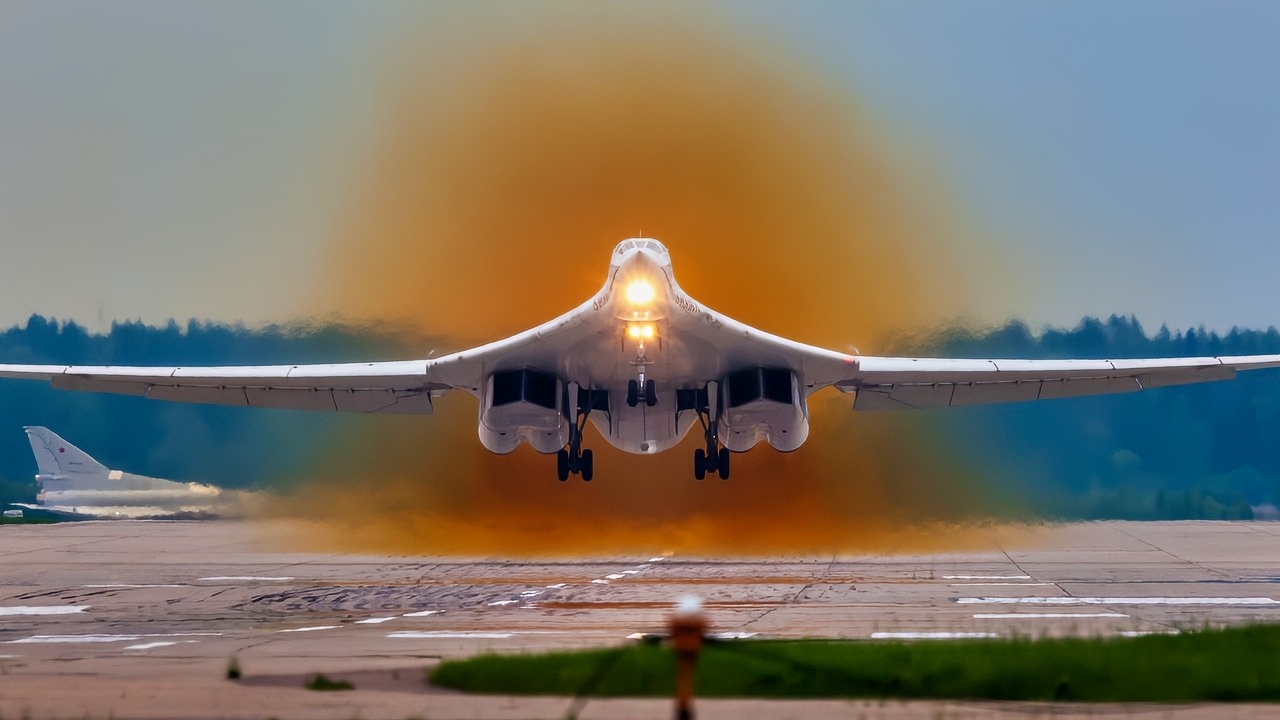
Russia retains one of the largest fleets of strategic bombers in the entire world, behind the U.S. and China. Despite its bombers dating back to the Cold War, its fleet remains world-class in range and overall payload capacity. They form the air wing of Russia’s nuclear triad and a central pillar of the country’s nuclear deterrence strategy.
The issue with Moscow’s strategic fleet is not that its bombers are incapable, but rather that its bombers are old Soviet designs, almost all of which have been out of production for several decades. This means that pretty much any loss to its fleet is irreplaceable, a harsh lesson that the Russian Air Force has been forced to learn after four years of fighting in Ukraine.

Tu-95 Bomber Russian Air Force. Image Credit: Creative Commons.

Tu-95 Bear Bomber. Image Credit: Creative Commons.
Russia’s Main Strategic Bombers
The Tupolev Tu-95 (NATO designation: “Bear”) currently forms the majority of Russia’s strategic bomber force. This Cold War relic is the Soviet equivalent of the B-52 Stratofortress and is just as irreplaceable as its American counterpart.
Powered by two Kuznetsov NK-12 turboprop engines, this aircraft has a range of 8,100 nautical miles (15,000 km) and a service ceiling of 13,716 meters (45,000 ft). Originally designed to drop free-falling nuclear bombs, the Tu-95 was later refitted to accommodate air-launched cruise missiles and quickly became the premier missile carrier of the Soviet Union.
Over time, the bomber has received numerous upgrades, keeping it relevant for more than 70 years since its inception.
Next to the Tu-95 is the Tu-22M (NATO designation: Backfire), the USSR’s first and most accident-prone supersonic bomber. The original Tu-22 underwent several design iterations before being developed into the Tu-22M. This bomber features a variable sweep wing design and is powered by two Kuznetsov NK-25 turbofan engines, which can propel the large aircraft to speeds of Mach 1.88.
With its internal weapons bay and external hardpoints, the Tu-22M can carry around 24,000 kg (53,000 lb) of munitions, which can vary from conventional bombs to air-launched nuclear cruise missiles. As noted earlier, this bomber is unusually accident-prone, with around 10 incidents recorded during its nearly 50-year service history.

Tu-22M3 Bomber Russian Air Force. Image Credit: Creative Commons.
The Air Component of Russian Nuclear Deterrence
Finally, the Tu-160 (NATO designation: Blackjack) is the largest and one of the most capable strategic bombers in the world. At full wingspan, this aircraft is the largest warplane ever built.
Built in response to the American B-1 Lancer, the Tu-160 features variable sweep wings and is powered by four Samara NK-321 afterburning turbofans, which enable it to reach Mach 2.05. The aircraft was built first and foremost as a missile carrier. Its two weapon bays can carry around 45,000 kg (99,208 lb) of ordnance, making it one of the heaviest bombers in the entire world. The Tu-160 is also the only strategic bomber in Russia still in production, although its sheer size and complexity mean production is slow.
Together, these three bombers form the air component of Russia’s nuclear triad. Each is capable of carrying nuclear and conventional cruise missiles, which make them an essential part of Russia’s strategic deterrence strategy.
At the start of the war in Ukraine, Russia’s fleet of strategic bombers numbered around 120, although some reports indicated that about a third were out of service for maintenance and modernization. Still, the Russians possessed and still possess the third-largest fleet of long-range bombers in the world behind the U.S. and China. Russia’s bombers have all seen extensive action in Ukraine, launching volleys of cruise missiles against Ukrainian energy infrastructure.
Why Soviet Bomber Production Halted and Cannot Resume
Russia’s fleet was inherited by the Soviet Union, and therein lies the main problem with its strategic forces. After the collapse of the USSR, production of all strategic bombers came to a screeching halt.
The Soviets produced Tu-95s and Tu-22Ms in steady numbers, but production ended in 1993, when the Cold War ended. The cash-strapped Russian Federation that emerged from the ashes of the USSR could not afford to continue production on its bombers, and even if it could, continuing production of its nuclear bombers would risk ruining relations with the Americans, which were comparatively positive in the 90s and early 2000s.
Today, resuming production of the Tu-95 and Tu-22M is practically impossible for Russia. Much of the infrastructure and expertise responsible for producing the Cold War giants disappeared with the USSR and is unlikely to ever resurface again.
The only bomber still in production is the Tu-160, which is the largest, most complex, and most expensive bomber in Russia’s inventory. Production officially resumed in 2019, with the first new production aircraft delivered in 2024. Production has since proceeded slowly. Only six aircraft have been delivered since production resumed, a small but not entirely insignificant addition to the fleet.
No Replacements in Sight
The lack of production has not been helped by the war in Ukraine, during which Ukraine has used asymmetric tactics to target and destroy numerous strategic bombers. The Tu-22M, being the accident-prone aircraft that it is, has also experienced numerous crashes in the past four years, with the most recent recorded on Monday, June 15th, when a bomber experienced an engine failure and crashed.
All of these losses, it should be repeated, are irreplaceable for Russia, and considering the progress on the PAK DA program (or lack thereof), it is unlikely that a replacement will be coming anytime soon. Until then, Russia will have to rely on the slow pace of Tu-160 production while its air losses slowly continue to mount.
About the Author: Isaac Seitz
Isaac Seitz, a Defense Columnist, graduated from Patrick Henry College’s Strategic Intelligence and National Security program. He has also studied Russian at Middlebury Language Schools and has worked as an intelligence Analyst in the private sector.


Doug Strelka
June 16, 2026 at 3:17 pm
Powered by two Kuznetsov NK-12 turboprop engines, this aircraft….
Really guys, the TU95 is a four engine turboprop