


In the 1980s, at the height of its economic power, Japan set out to build something it had not built since World War II: its own modern fighter jet, designed and made in Japan, a symbol of a country that had become a high-technology superpower. It never happened the way Tokyo wanted. Under heavy pressure from Washington, which feared an independent Japanese fighter industry and a worsening trade dispute, Japan agreed to abandon the fully indigenous design and instead build a version of the American F-16 Fighting Falcon. Then came the twist that still stings in Tokyo. The United States refused to release the F-16’s flight-control source code, the software that actually lets the unstable jet stay in the air, forcing Japanese engineers to write their own from scratch. Japan ended up with the worst of both worlds, pushed into an American design and then denied the American software that would have made building it simple. The resulting aircraft, the Mitsubishi F-2, was in many ways superb, and it cost roughly four times as much as the F-16 it was based on. More lasting than the price was the bitterness, and it shaped how Japan approaches building warplanes to this day.
F-2: Japan’s Bid To Build Its Own Fighter
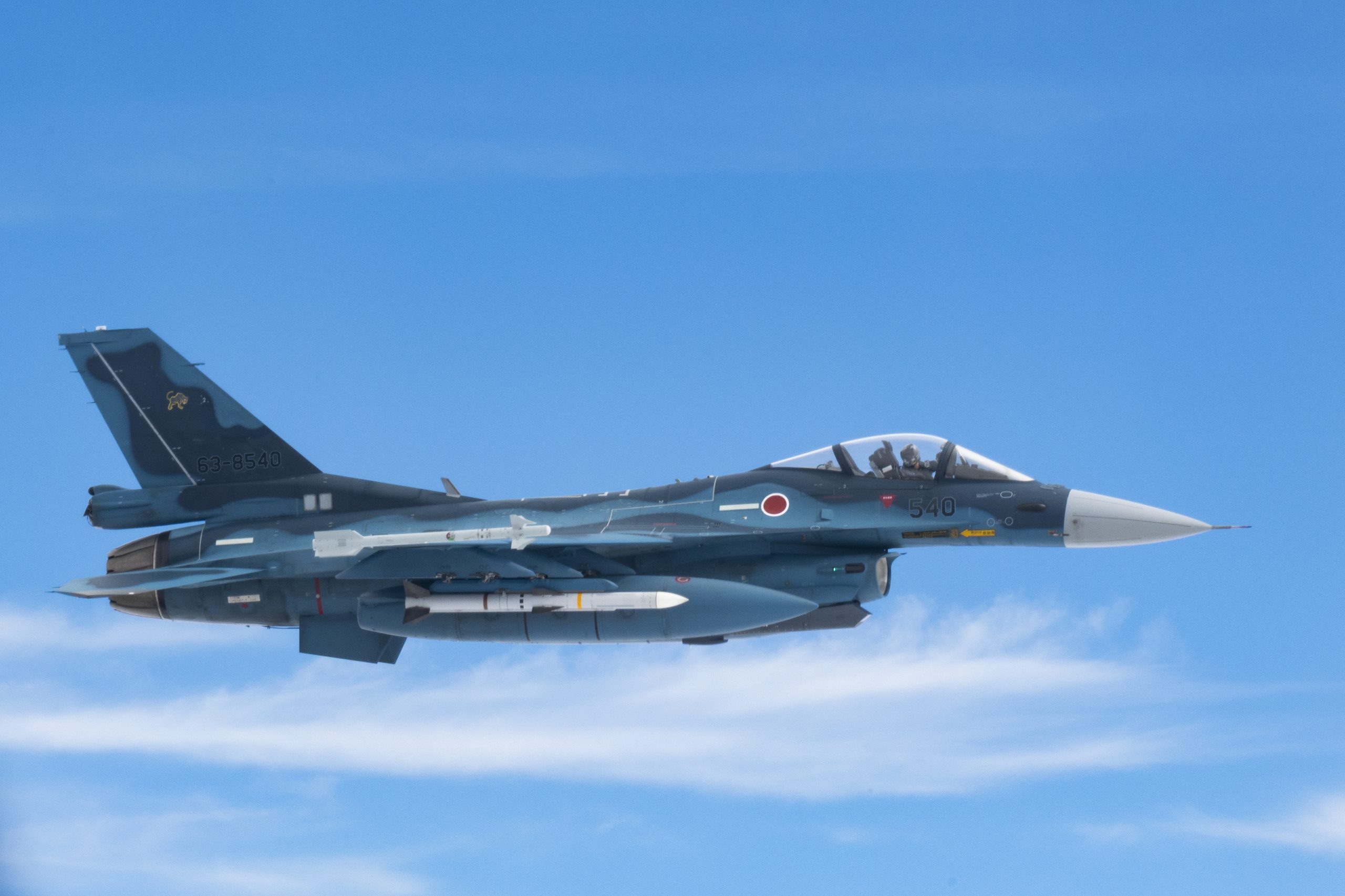
A Koku Jieitai (Japan Air Self-Defense Force) F-2 aircraft flies in formation with a U.S. Air Force B-52H Stratofortress, assigned to the 2nd Bomb Wing, Barksdale Air Force Base, Louisiana, during a Bomber Task Force mission over the Indo-Pacific region, September 21, 2021. Bomber missions provide opportunities to train and work with allies and partners in joint and coalition operations and exercises. (U.S. Air Force photo by Staff Sgt. Devin M. Rumbaugh)
The project began in the early 1980s, when Japan’s Air Self-Defense Force started looking for a successor to the Mitsubishi F-1, the first combat aircraft Japan had developed on its own after the war. Engineers at the secretive Laboratory Three division of Japan’s Technical Research and Development Institute studied options for a clean-sheet domestic design that could carry anti-ship missiles over long range, and Japanese industry, led by Mitsubishi Heavy Industries, pushed hard to build the aircraft entirely at home.
The ambition had a number attached to it. Japan’s defense researchers concluded that, with the exception of the engine, the country had the domestic capability to develop an advanced fighter for about $1 billion. For a nation then at its economic peak, an all-Japanese fighter was as much a point of national pride as a defense requirement.
Washington Pushes Back
The United States did not want Japan to go it alone. American officials worried that an independent Japanese fighter program would weaken the defense relationship, erode interoperability, and, against the backdrop of fierce 1980s trade friction, do nothing to close a large trade deficit.
The pressure was heavy enough to force Japan to set aside its indigenous plans, and by late 1986, Tokyo had agreed to consider building a derivative of an existing American jet instead. The politics inside Washington were not one-sided. Senior officials in the State and Defense departments backed the joint project as a way to gain access to Japanese technology and strengthen the alliance, while the Commerce Department and many in Congress opposed it, fearing it would hand a serious economic rival the means to compete with American aerospace firms.
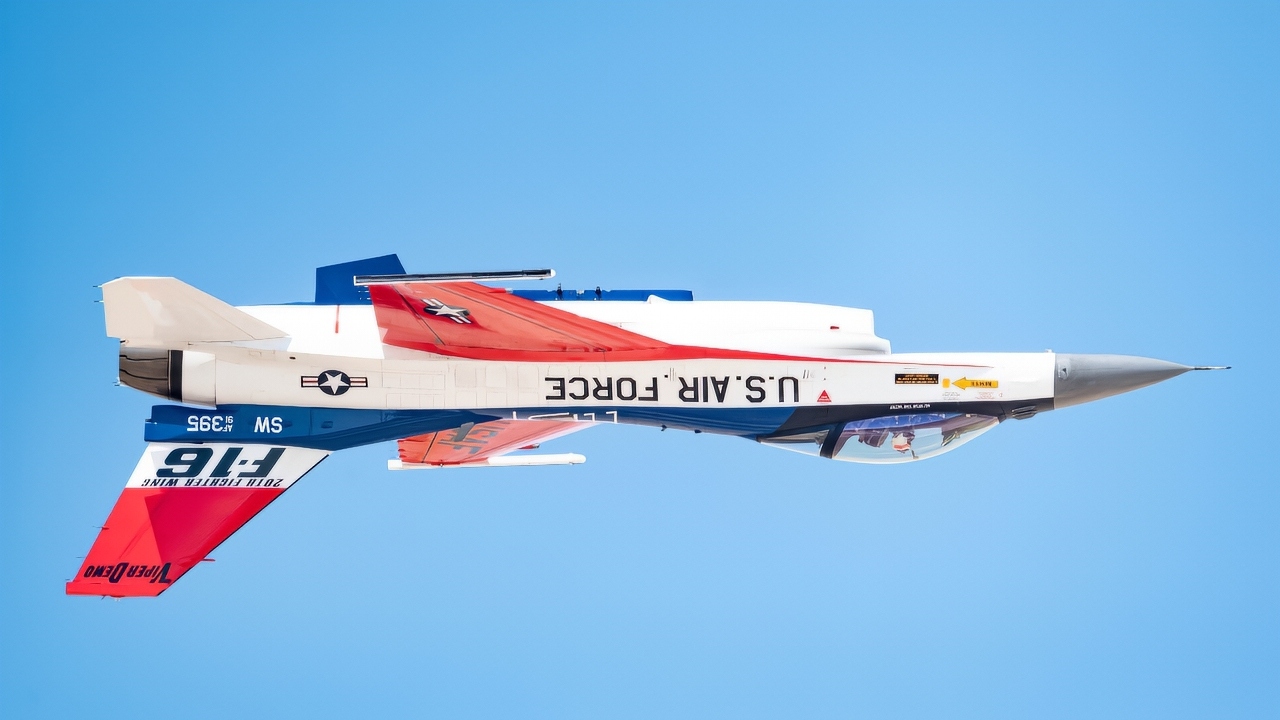
U.S. Air Force Maj. Taylor “FEMA” Hiester, F-16 Viper Demonstration Team commander and pilot, performs aerial maneuvers in an F-16C Fighting Falcon during an air show at Marine Corps Air Station Yuma, Ariz., March 15, 2025. The flight demonstration highlights the versatility of the F-16, a multi-role fighter aircraft proficient in both air-to-air and air-to-ground combat. (U.S. Air Force photo by Senior Airman Steven Cardo)

A U.S. Air Force F-16 Fighting Falcon flies over the U.S. Central Command area of responsibility Oct. 14, 2020. The F-16 Fighting Falcon is a compact, multirole fighter aircraft that has proven itself in both air-to-air combat and air-to-surface attack. (U.S. Air Force photo by Senior Airman Duncan C. Bevan)
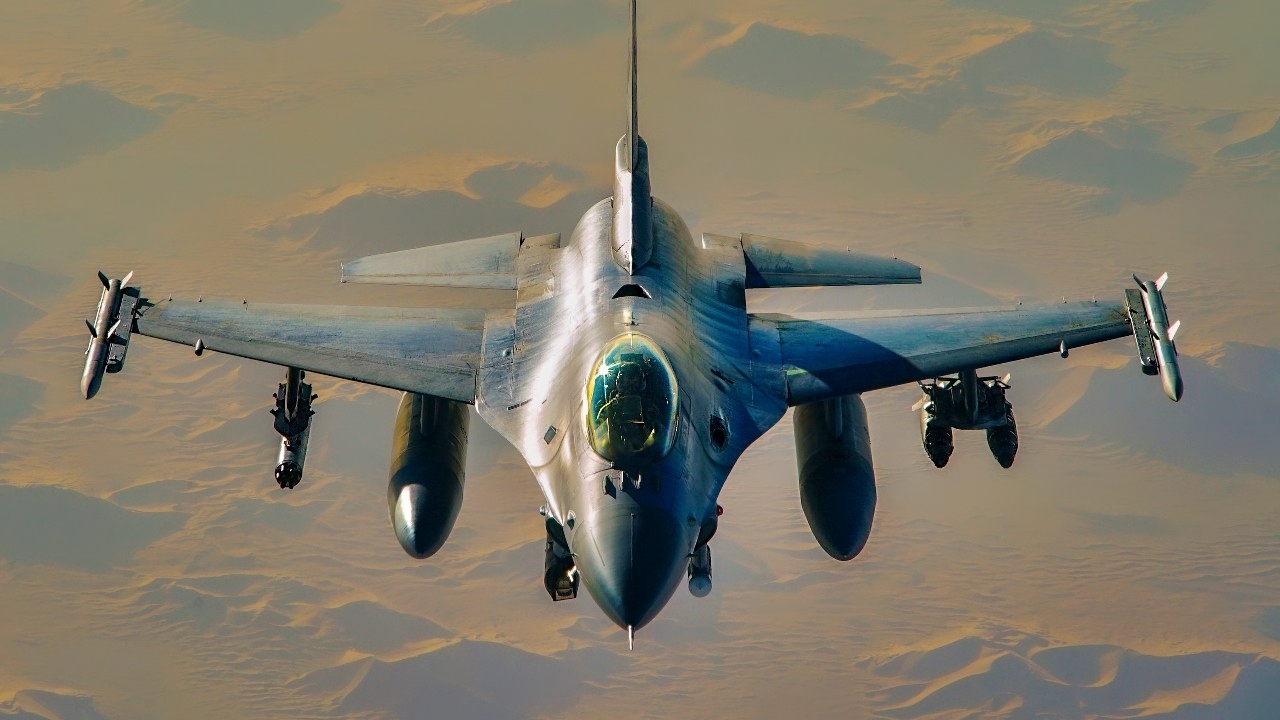
A U.S. Air Force F-16 Fighting Falcon based in the Central Command area of operations conducts armed aerial patrols in Somalia in support of Operation Octave Quartz, Jan. 9, 2020. The F-16s support to OOQ demonstrates the U.S. military’s reach and power projection across vast distances to hold adversaries such as al-Shabaab at risk with flexible, precise and lethal force that is capable of rapidly responding anywhere on the globe. The mission of OOQ is to reposition U.S. Department of Defense personnel from Somalia to other locations in East Africa. (U.S. Air Force photo by Staff Sgt. Taylor Harrison)
In October 1987, the two governments settled on a joint project to remodel either the F-15 or the F-16, and in November 1988, they signed the agreement that made it the first joint fighter program between the two countries, with General Dynamics providing F-16 technology to Mitsubishi. The chosen basis was the F-16C Block 40.
The Code The Pentagon Wouldn’t Share
Then came the part that turned a compromise into a grievance. The F-16 is aerodynamically unstable by design, built with relaxed static stability so that it cannot fly without a fly-by-wire flight-control system constantly correcting it, which makes the flight-control software the single most critical piece of the entire aircraft.
The United States refused to disclose the source code for that flight control, the one element Japan most needed to make its F-16 derivative work. So Japanese engineers were forced to develop their own flight-control software from the ground up, drawing on data from a modified Mitsubishi T-2 trainer that Japan had flown earlier in a control-configured-vehicle research program.
Japan had been pushed into the American airframe and then made to reinvent the most important piece of software inside it anyway, the very thing the partnership was supposed to provide.
Congress Forces A Harder Deal on F-2
Even the compromise nearly came apart. The 1988 agreement drew fierce criticism in the US Congress, where opponents feared the deal would surrender key American technology and technological leadership, let Japan commercialize US know-how at American expense, and leave too small a share of the work for US firms.
The incoming Bush administration ordered an interagency review in early 1989 and forced a renegotiation that limited Japanese access to software, guaranteed US contractors roughly 40 percent of the production work, and confirmed American rights to any new technology Japan developed for the program. The fight was not over even then. Negotiations deadlocked again in August 1989 over the transfer, use, and payment for Japanese technology, and during the standoff, the US Air Force suspended transfers of F-16 technical data to Japan. The issues were finally resolved in a clarifying agreement in early 1990. The whole episode left bitterness on both sides, with Japanese industrialists, convinced an all-Japanese design would have been better, irritated at being pressured into renegotiating a deal they already considered favorable to the Americans.
The Jet That Resulted
The F-2 aircraft that came out of all this was, by most measures, excellent, which is part of what made the dependence sting. The F-2 was substantially larger than the F-16, with a wing about 25 percent larger, built from a co-cured graphite-epoxy composite, a manufacturing achievement that was a first for a production fighter.
It carried what is widely regarded as the first active electronically scanned array radar on a production combat aircraft, the Mitsubishi J/APG-1, in 1995, along with Japanese electronic-warfare systems, mission computers, and an anti-ship missile loadout tuned for maritime defense, powered by the same General Electric F110 engine family used in the F-16. Japan, in other words, proved it could lead the world in cutting-edge technology, despite being denied the basic code to fly the jet. The cost reflected the path it took.
The F-2’s unit price, which includes development costs, ran roughly four times that of a contemporary F-16 Block 50/52, whose figure does not include development, a comparison that overstates the gap the way it does for most modern aircraft, though the per-jet price was high regardless.
An original plan for 141 aircraft was cut, and only 98 were ultimately built, which kept the cost per airframe elevated.
F-2: A Grudge That Outlasted The Plane
The deepest mark the F-2 left was on attitudes. The nationalist politician Shintaro Ishihara, a co-author of “The Japan That Can Say No,” wrote in 1990 that Japan’s government had decided it was “better to eat humble pie than incur Uncle Sam’s wrath,” capturing a resentment that ran well beyond him into Japanese industry, which came away convinced it had been strong-armed and shortchanged and inclined toward self-sufficiency in future weapons.
That conviction shaped what Japan did next. The F-2 is now being replaced under the Global Combat Air Program (GCAP), a sixth-generation fighter Japan is building not with the United States but with the United Kingdom and Italy, a partnership formed to deliver a next-generation aircraft by 2035, with a demonstrator targeted to fly around 2027.
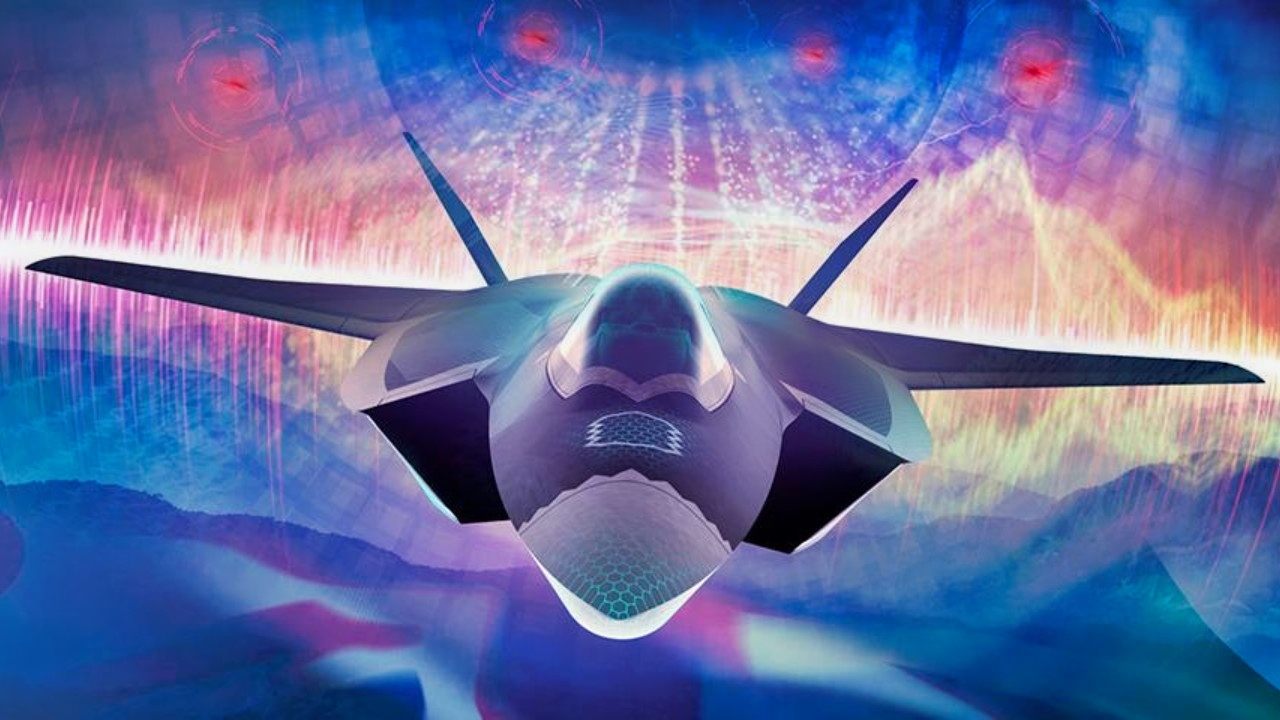
GCAP Fighter. Image Credit: Creative Commons.
For Tokyo, GCAP is a strategic industrial pivot away from its traditionally US-centric combat-aviation partnerships and toward sovereign design influence over its own fighter.
Analysts describe the program as the successor to the F-2 and a deliberate effort to preserve Japan’s freedom to modify and sustain its own aircraft, an equal trilateral partnership rather than a junior role under Washington, though the program faces real schedule and funding pressures, and the dates remain in flux.
Japan got a capable fighter from the FS-X saga, and it also got a lasting lesson.
It had set out to build its own jet, was pushed into copying the F-16, and was then denied the code that would have let it fly without years of extra work, an experience that convinced Tokyo never to hand Washington that kind of leverage again.
That decision is the reason Japan’s next fighter is being designed in London and Rome rather than in partnership with the country that built the F-16 in the first place.
About the Author: Harry J. Kazianis
Harry J. Kazianis (@Grecianformula) was the former Senior Director of National Security Affairs at the Center for the National Interest (CFTNI), a foreign policy think tank founded by Richard Nixon based in Washington, DC. Harry has over a decade of experience in think tanks and national security publishing. His ideas have been published in the NY Times, The Washington Post, The Wall Street Journal, CNN, and many other outlets worldwide. He has held positions at CSIS, the Heritage Foundation, the University of Nottingham, and several other institutions related to national security research and studies. He is the former Executive Editor of the National Interest and the Diplomat. He holds a Master’s degree focusing on international affairs from Harvard University.


