
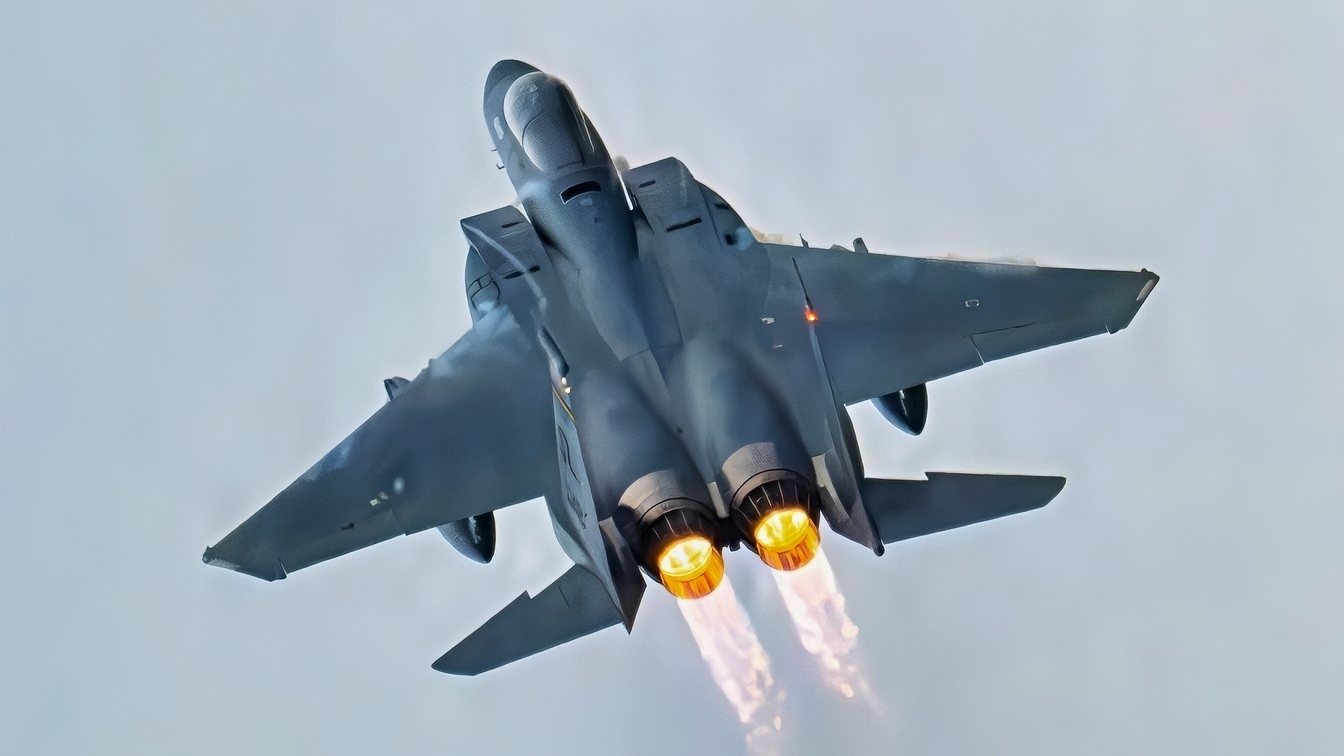
In August 1988, F-15 pilot Daniel “Fig” Leaf experienced total hydraulic failure while taxiing back to parking, leaving him with no brakes and no nose gear steering. With a security forces pickup truck carrying two airmen crossing his path and a parked F-16 from the 314th Tactical Fighter Training Squadron directly ahead, Leaf pushed the right engine into afterburner.
The F-15 That Averted Disaster
As the U.S. Air Force pushes forward with plans to expand purchases of the Boeing F-15EX Eagle II and continue deploying the aircraft across the Pacific, supporters of the Eagle platform argue that newer stealth fighters alone cannot replace what the F-15 was originally designed to do: carry enormous amounts of firepower, survive damage, and keep flying under extreme conditions.
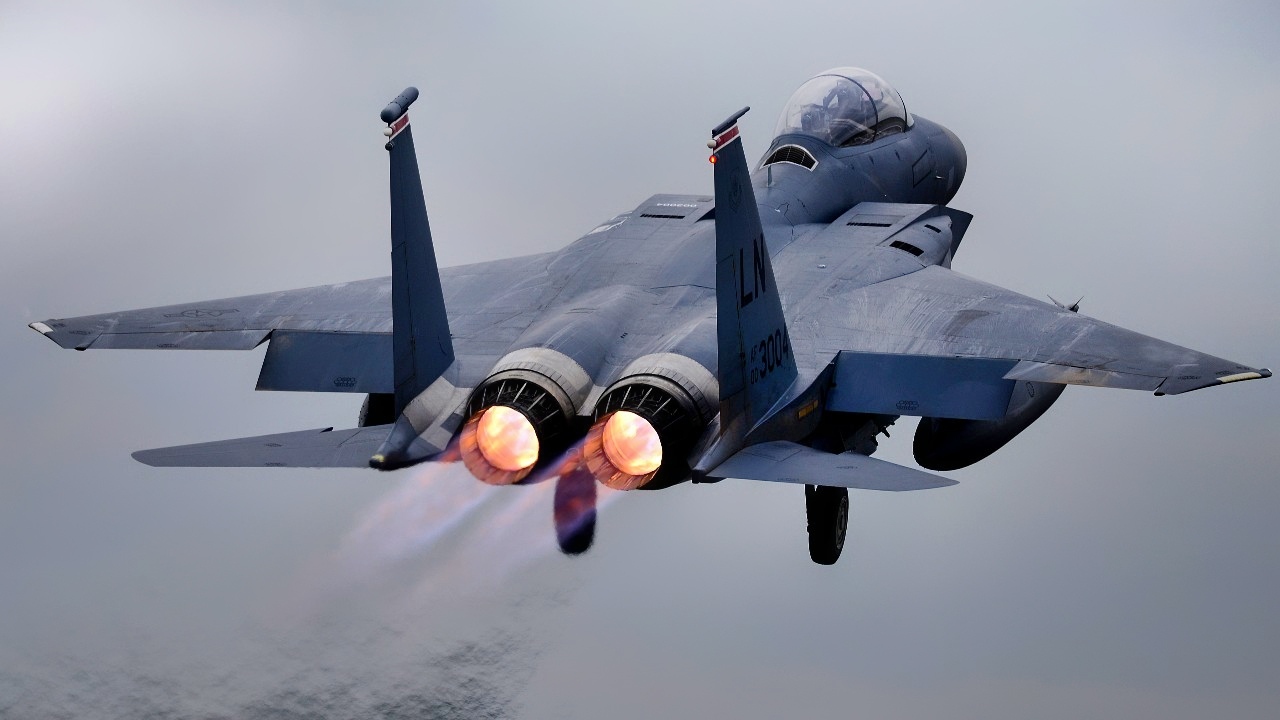
An F-15E Strike Eagle assigned to the 494th Fighter Squadron takes off for a training sortie at Royal Air Force Lakenheath, England, Oct. 26, 2018. The 494th trains regularly to ensure RAF Lakenheath brings unique air combat capabilities to the fight. (U.S. Air Force photo/ Tech. Sgt. Matthew Plew)

An F-15E Strike Eagle assigned to the 494th Fighter Squadron takes off for a training sortie at Royal Air Force Lakenheath, England, Oct. 26, 2018. The 494th trains regularly to ensure RAF Lakenheath brings unique air combat capabilities to the fight. (U.S. Air Force photo/ Tech. Sgt. Matthew Plew)

A U.S. Air Force KC-135 Stratotanker offloads fuel to U.S. Air Force F-15 Strike Eagles over the U.S. Central Command area of responsibility, April 11, 2025. The F-15E is deployed to the CENTCOM AOR to reinforce regional stability and deter aggression from violent extremist organizations.. (U.S. Air Force photo by Senior Airman Keegan Putman)
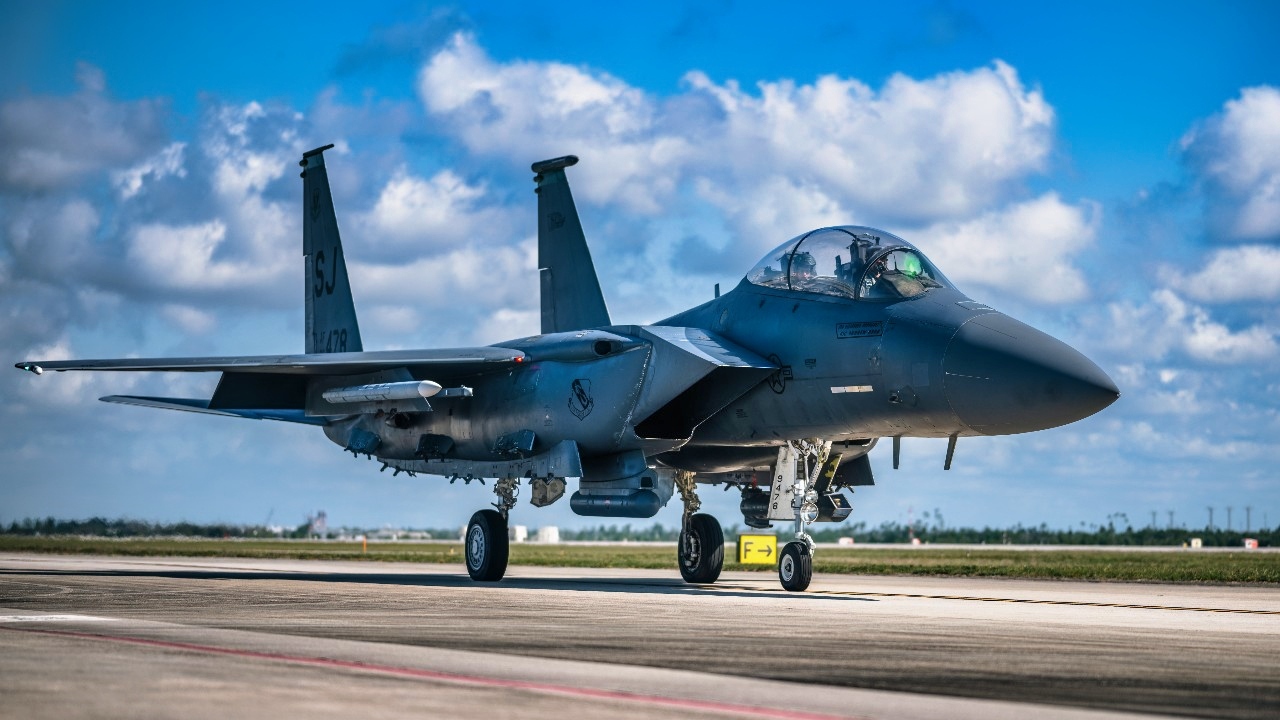
A U.S. Air Force F-15E Strike Eagle assigned to the 335th Fighter Squadron, Seymour Johnson Air Force Base, North Carolina, taxis during Checkered Flag 25-2 at Tyndall AFB, Florida, May 14, 2025. Checkered Flag, one of the Department of Defense’s largest air-to-air exercises, integrates fourth and fifth-generation aircraft to enhance mobility, deployment, and employment capabilities. (U.S. Air Force photo by Airman 1st Class Zeeshan Naeem).
The Air Force’s FY2027 budget proposal includes another 24 F-15EX aircraft, while the service continues to position the fighter as a high-capacity missile carrier for both homeland defense and future conflicts with near-peer adversaries. That reputation for raw power and survivability has existed since the aircraft first entered service during the Cold War. In one extraordinary incident from 1988, an F-15 pilot suffering a complete hydraulic failure while taxiing managed to avoid smashing into multiple aircraft and vehicles by using engine thrust alone – at one point, apparently lifting one side of the fighter off the ground to clear a parked F-16.
The incident, involving F-15 pilot Daniel “Fig” Leaf, is one of the most remarkable examples of the F-15’s engine power and handling characteristics ever described publicly.
Built to Defeat Soviet Fighters
The F-15 Eagle was developed in the aftermath of the Vietnam War, when the Air Force concluded it needed a dedicated air superiority fighter capable of defeating advanced Soviet aircraft at long range and in close combat. Unlike later multirole fighters designed to balance many missions simultaneously, the original F-15 was built around a single primary objective: to dominate enemy aircraft.
The platform entered service in the 1970s and quickly developed a reputation for its speed and radar capabilities. It was a survivable platform that could accelerate quickly, and to this day, the aircraft holds a record for achieving 104 air-to-air kills with no losses.
Its combination of payload and engine power is one reason the aircraft remains so relevant decades later. The modern F-15EX can reportedly carry up to 22 air-to-air missiles using new AMBER missile racks, giving it one of the largest missile loads of any Western fighter aircraft currently flying.

An F-16 Fighting Falcon approaches the boom of a KC-10 extender aircraft during an aerial refueling mission out of Luke Air Force Base, Ariz., Nov. 16, 2016. F-16 pilots train on aerial refueling operations to be prepared for longer mission requirements. (U.S. Air Force photo by Senior Airman James Hensley)

F-16 Fighting Falcons from the 35th and 80th Fighter Squadrons of the 8th Fighter Wing, Kunsan Air Base, Republic of Korea; the 421st Expeditionary Fighter Squadron of the 388th FW at Hill Air Force Base, Utah; the 55th EFS from the 20th FW at Shaw Air Force Base, S.C.; and from the 38th Fighter Group of the ROK Air Force, demonstrate an “Elephant Walk” as they taxi down a runway, during an exercise at Kunsan Air Base, Republic of Korea, March 2, 2012. The exercise showcased Kunsan Air Base aircrews’ capability to quickly and safely prepare an aircraft for a wartime mission. Image Credit: Creative Commons.

F-16 Fighting Falcons from both the 35th and 80th Fighter Squadrons of the 8th Fighter Wing, as well as from the 466th Fighter Squadron of the 419th Fighter Wing at Hill Air Force Base, Utah, demonstrate an elephant walk formation as they taxi down a runway during an exercise at Kunsan Air Base, Republic of Korea Dec. 2, 2011. The exercise showcased Kunsan AB aircrews’ capability to quickly and safely prepare an aircraft for a wartime mission. (U.S. Air Force photo by Staff Sgt. Rasheen Douglas/Released)
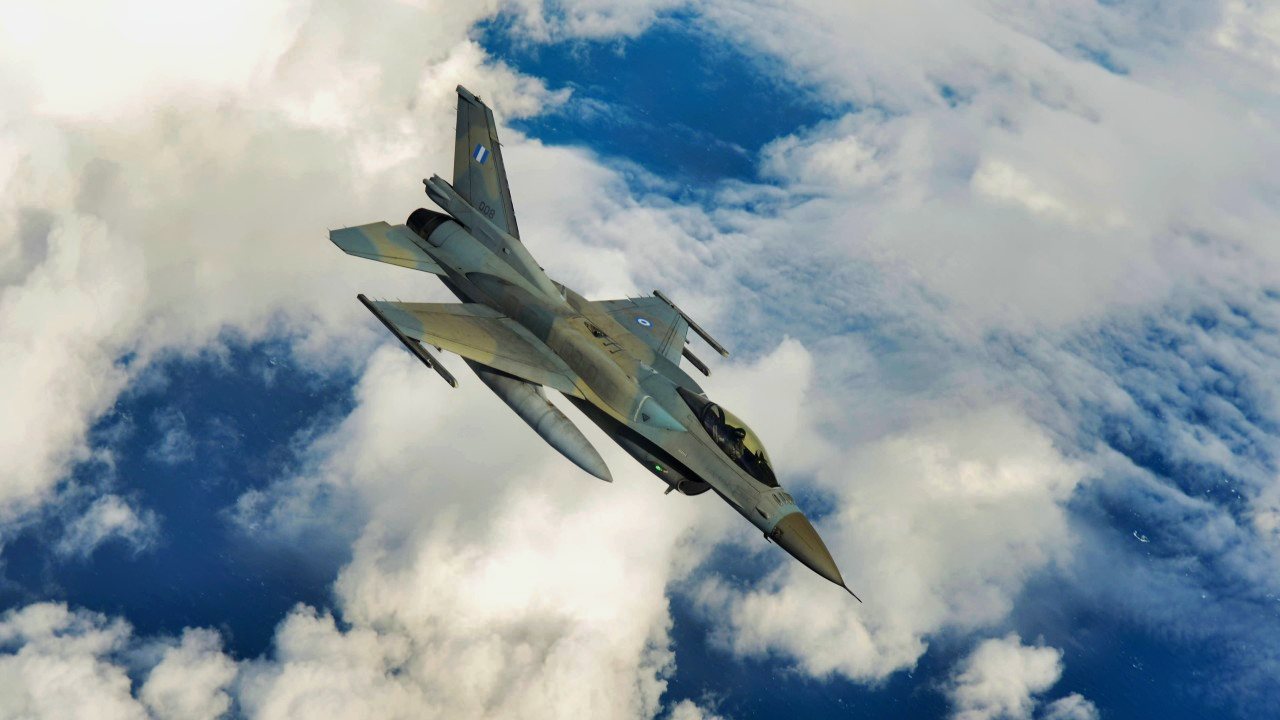
Hellenic air force F-16C Fighting Falcons fly alongside a U.S. Air Force KC-135 Stratotanker from the 100th Air Refueling Wing Oct. 26, 2017, over the Mediterranean Sea. During this flight, the KC-135 participated in aerial refueling training with 22 F-16s. (U.S. Air Force photo by Senior Airman Tenley Long)
How A Routine Taxi Became An Emergency
Leaf’s story began on August 15, 1988, after returning from a training sortie as an instructor pilot in a McDonnell Douglas F-15 Eagle. While taxiing back to the parking, the aircraft’s master caution light illuminated.
“I looked at the panel, which showed a utility A failure, so I pulled the emergency brake and steer handle, depressed the paddle switch, and kept it depressed so I could pull over to get the airplane chocked and shut down. I happened to be near the transient aircraft ramp, so I asked ground control to contact the people working at the transient alert office to bring me some chocks, because the F-15 has no parking brake, which is a rare negative thing about the F-15,” Leaf said.
The situation rapidly deteriorated moments later when a second warning light appeared. Leaf said that as he saw an airman walk under the tip of the left wing, the second light illuminated, instructing him to check hydraulics for a utility B failure – a potential total utility failure. And then, the aircraft lost its brakes entirely.
“Suddenly, the emergency brake pedals lost their pressure, so I had no brake, and opposite me was an F-4 Phantom parked on the transient ramp. My aircraft started to roll, so perhaps I should have shut down both engines and accepted the fender bender with the F-4, but that didn’t come naturally to me. In addition to having no brakes, I had no nose gear steering, so I increased power on the left engine in the hope that the aircraft would drift to the left. My aircraft lurched away from the F-4 without a collision, but started rolling faster with the increased power,” Leaf said
Using Engine Thrust to Steer the Aircraft
With no steering and no brakes, Leaf attempted something pilots are never expected to do during ground operations: steer the aircraft using engine thrust. He described how he increased power on the left engine in the hope the aircraft would move to the left, noting that the aircraft lurched away from the F-4 without a collision but started rolling faster with the increased power.
The F-15’s enormous engine output became both the problem and the solution in this scenario. Powered by two Pratt & Whitney F100 engines, the aircraft was specifically designed around a high thrust-to-weight ratio, giving it exceptional acceleration and climb performance compared to Soviet fighters of the era. Leaf later explained that he attempted to guide the aircraft toward an uphill section of taxiway in the hope the slope would slow it down – but another obstacle soon appeared.
“At the point I was about to do that, a blue security forces pickup truck with two airmen inside crossed my path,” he said. At the same time, a parked F-16 was directly ahead of him.
The Afterburner Maneuver
Leaf explained how he was faced with an almost impossible decision – to either stick with his plan and inevitably hit the truck and kill all three of them, or collide with an F-16 assigned to the 314th Tactical Fighter Training Squadron parked right ahead of him and potentially kill himself and destroy two aircraft. At the final moment, he pushed the right engine into afterburner.
“So, I pushed the right throttle into the afterburner range and closed my eyes because I didn’t want to see the explosion that was bound to kill. Under the additional power, my airplane lurched to the left. There was no explosion because I’d cleared the F-16 and yanked the power to idle,” Leaf explained.
The aircraft narrowly missed both the truck and the F-16 before Leaf guided it between light poles and off the taxiway into soft dirt, where it finally stopped. He got out of the aircraft and knelt on the ground.
The Thrust Lifted the Fighter Off the Ground
The full explanation for how the aircraft avoided the parked F-16 only emerged years later. While serving at Aviano Air Base, Leaf later spoke with future Air Force Chief of Staff David Goldfein, who had witnessed the incident while sitting in another F-16 nearby. According to Goldfein, the afterburner thrust had partially lifted the aircraft during the maneuver.
“Turns out he was in an F-16 in the row behind the damaged aircraft, waiting to taxi on his first solo flight in the F-16. He told me that when I applied the power to the right engine, there was so much thrust that it lifted the right main gear off the tarmac and lifted the right side of my airplane, which moved over the F-16, avoiding a serious collision. In short, that’s why I’m alive.”
About the Author: Jack Buckby
Jack Buckby is a British researcher and analyst specializing in defense and national security, based in New York. His work focuses on military capability, procurement, and strategic competition, producing and editing analysis for policy and defense audiences. He brings extensive editorial experience, with a career output spanning over 1,000 articles at 19FortyFive and National Security Journal, and has previously authored books and papers on extremism and deradicalization.


