
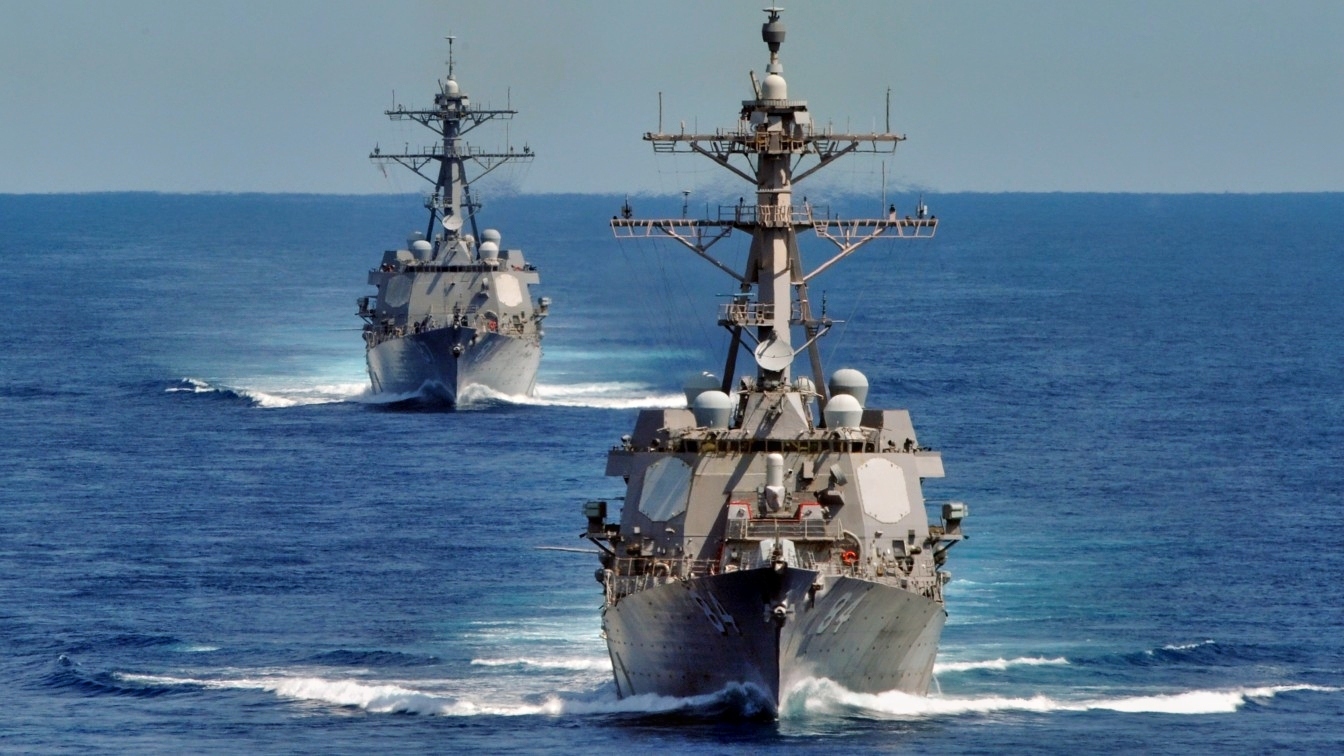
Even before the Iran War began, the world knew that the Strait of Hormuz was a risk. It’s one of a handful of reasons Iran has any leverage at all.
Despite that, the Strait is crucial to Gulf exporters for the passage of oil and liquefied natural gas (LNG), which support both Asian and European economies.

Aircraft Carrier Turn US Navy. Image Credit: US Navy.
Now, four months after the war began in February, the world has seen what happens when Iran decides to use that leverage.
And while the world is still pushing for the Strait of Hormuz to remain open and Washington seeks a lasting peace deal with Iran to ensure it, governments across the Middle East are looking for ways to prevent Iran from ever having this kind of power again.
A number of recent developments suggest that many of those countries are making permanent changes to how they export energy, investing in alternative routes and infrastructure designed to reduce reliance on Hormuz forever.
In recent days, reports described how Iraq has dramatically increased its fuel exports through Syria, while Saudi Arabia has expanded its shipments through the Red Sea.
Oman’s exports have also climbed to a two-year high. And all this is happening while Iran continues to assert control over the Strait, and commercial vessels only pass through with minimal confidence from their operators and insurers.
Gulf governments, it seems, are planning for a future in which a disruption seems likely or even certain.
Iraq Opens New Export Route
On June 19, Iraq confirmed plans to permanently diversify the country’s oil exports through Syria, even after shipping through the Strait of Hormuz begins to recover.
Iraqi Oil Ministry spokesman Saleem al-Rikabi said that Baghdad considers diversifying crude oil exports through Syria to be of the “highest importance.” State oilmaker SOMO is now working with Syrian authorities to expand its facilities in Baniyas, a Mediterranean port, where additional unloading infrastructure is needed to accommodate Iraqi exports.

Blue Ridge-Class U.S. Navy. Image Credit: Creative Commons.
It builds on news from March that Iraq has begun transporting oil via land through Syria following disruptions in the Strait of Hormuz.
Iraq has now exported more than 600,000 metric tons of oil through Syria in June alone, and it’s just one of a number of alternate transport options being deployed throughout the region.
A new pipeline is also underway that could carry up to 50,000 barrels of crude oil per day. For Iraq, the plans are crucial because they address one of the country’s biggest vulnerabilities. Before the Iran War began, almost all of its southern oil exports depended on the Strait of Hormuz.
Saudi’s Backup Plans
While Iraq is working on new export corridors, Saudi Arabia is already leaning on infrastructure built more than forty years ago to minimize the damage done by Hormuz disruption – and it’s all thanks to a previous war with Iran.
During the Iran-Iraq War in the 1980s, Saudi Arabia recognized the likelihood of future disruption in the Strait of Hormuz and began building the East-West Pipeline.
The oil pipeline stretches around 1,200 kilometers from Saudi Arabia’s oil fields to the Red Sea port of Yanbu. That decades-old investment is now paying dividends.
Saudi Arabia is expected to export almost 300,000 tons of oil from Yanbu in June – the highest in over two years.
That means shipments through the Red Sea are increasing even while Hormuz slowly recovers.
And while the pipeline cannot replace all Gulf exports for now, Saudi Arabia’s backup route has allowed the kingdom to remain significantly more flexible than many of its regional neighbors.
Oman Survives
Oman, which sits to the south of the Strait of Hormuz, has survived the crisis because of its geography.
While it technically claims part of the Strait of Hormuz, its coastline extends beyond the narrowest section of the waterway.
Reports this week revealed that Oman’s fuel oil exports reached their highest level in two years in June, with traders moving their cargoes through Omani facilities to avoid the disruption in the Strait of Hormuz.
It’s good news for Oman for now, and could be a sign of what’s to come. If Iran continues to assert control over the Strait, Oman could still emerge as a winner.
Gulf Governments Are Planning Ahead
Gulf leaders are hoping for a lasting peace deal with Iran that addresses everything from Hormuz disruption to Iran’s missile arsenal.
That’s precisely what Gulf Cooperation Council (GCC) leaders told U.S. Secretary of State Marco Rubio in Bahrain this week. But that desire to see short-term stability does not mean that, in the long term, the Gulf will look the same as it does today.
Its leaders are looking ahead and preparing for a future in which Iran continues to threaten its regional neighbors – and if plans continue at this pace, the regime in Tehran may not hold the strategic leverage it does today for very long.
About the Author: Jack Buckby
Jack Buckby is a British researcher and analyst specializing in defense and national security, based in New York. His work focuses on military capability, procurement, and strategic competition, producing and editing analysis for policy and defense audiences. He brings extensive editorial experience, with a career output spanning over 1,000 articles at 19FortyFive and National Security Journal, and has previously authored books and papers on extremism and deradicalization.


OilyToRiseIsVeryWise
June 26, 2026 at 5:57 am
the wheels on the bus go round and round.
they’d have figured it out one way or another.
the us supposedly is sittng on vast quantities yet is crying a shortage is emminent, what happened to american greatness, you can’t dig your own up, so whos lying about what now?
Leo Smith
June 26, 2026 at 6:48 am
America doesn’t rely on Arab Oil. Why does everyone in the media LIE?