

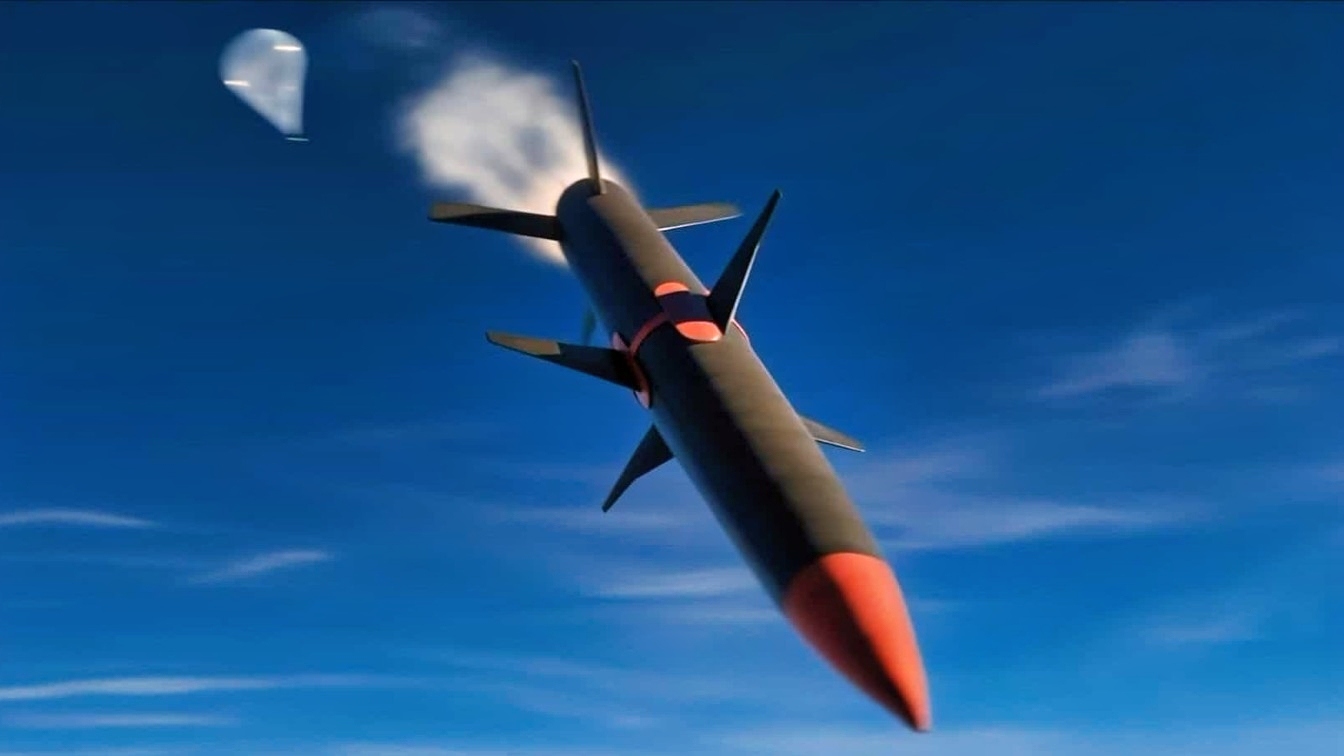
Warsaw, Poland – A Ukrainian defense enterprise called the Center of Innovative Technologies Program has developed an electronic warfare (EW) resistant missile called DART.
In the current age, when weapons that must be developed with jamming immunity as a prime design requirement, that in itself is not a particularly new innovation.

Tu-95 Bear Bomber. Image Credit: Creative Commons.
The difference with this weapon is that it is not launched from an aircraft but instead dropped from a balloon while at an altitude of 8-11 miles above the surface of the earth, according to the Ukrainian defense news site Militarnyi.
While the missile is of Ukrainian design, the balloons themselves are produced by another unspecified country.
The Center of Innovative Technologies Program, which first discussed the weapon at this month’s Eurosatory defense expo outside of Paris, revealed that the balloon portion of the weapon system is a collaborative development.
The designers of the weapon told Ukrainian news outlets that the “Aerostats are not our development, but a partner’s.”
This system is another case, as is increasingly seen, in which Ukraine adopts a foreign innovation and combines it with one of its own solutions to produce a fully functional weapon system.
The company built the DART in this unique configuration to allow it to drop from a balloon rather than from a plane or another conventional launcher, as this creates a cheap, silent, and electronic-warfare-resistant vehicle that carries guided weapons far beyond Ukraine’s territory and deep into Russia.
Nearly Undetectable Deep Strike
Representatives of Ukrainian defense industrial enterprises explained to National Security Journal that using high-altitude aerostats as the delivery platform was another example of Ukraine’s design teams coming up with some ingenious improvisation.
By using a much lower-technology solution to bring the weapon within range of its target, the designers have negated the advantage that Russia enjoys with having long-range strategic bombers.
“Ukraine does not have an aircraft with either the payload capacity or the range of Russia’s different Tupolev bomber aircraft,” he explained. These are the Cold War-era Tu-95 Bear four-turboprop-powered bomber, the Tu-22M3 Backfire, and the 1980s four jet-engine Tu-160 Blackjack that they use to launch missiles at Ukraine – while they are still inside of Russian airspace,” note one representative.

Tu-22M3 Bomber from Russia. Image Credit: Creative Commons.
“Even if the Ukraine Air Force (PSU) had bomber aircraft, flying something with that size of a radar cross section into Russian airspace would render them visible to what’s left of Moscow’s inventory of higher altitude air defense systems like the S-400. The reasons our drones are so successful and causing such damage to Russia’s oil industry, defense plants, naval assets, and military bases are that they are so small that Russian air defense does not detect them easily,” he continued.
“But of course, you cannot carry a missile on something as small as a drone. By instead carrying it on a high-altitude aerostat – a somewhat illogical and unconventional solution – that problem is solved. But it is not the only complication that is eliminated by using this manner of launch platform.”
At an altitude of 8-11 miles, the atmospheric density is minimal, so the weapon outside the engagement envelope of Russian air defense and electronic warfare systems is one advantage here, he explained. “But by launching from such a high altitude, this provides the missile with an initial reserve of potential energy and extends the operational range.”
A Blackout Weapon
According to the data published by Militarnyi, the DART’s total hull length is about 6 feet, and its empty weight is 29 pounds. The size of the warhead depends on the configuration and can range from 7 to 22 lbs.
That warhead is packed with graphite striking elements, which turn into electrically conductive filaments that are dispersed by the explosive charge in the warhead and which short out electrical grids.
Due to the thin air at the launch altitude and the potential turbulence at lower altitudes, the missile is equipped with specialized servo drives and actuator-powered control surfaces to ensure precise activation and stable flight performance across a wide range of launch conditions.
When it is initially released, the DART is guided by a navigation system. Once it reaches an altitude of about 3.7 miles, the onboard navigation is completely shut down. At this point, the solid-fuel engine is engaged, and the missile continues toward its target without changing course.
Turning off the navigation systems at this point in the flight to the target prevents Russian EW systems or any GPS spoofing systems from interfering with its continuing towards the target.
According to the developers, DART will undergo codification by the Ukrainian Ministry of Defense in the near future.
About the Author: Reuben F. Johnson
Reuben F. Johnson has thirty-six years of experience analyzing and reporting on foreign weapons systems, defense technologies, and international arms export policy. Johnson is the Director of Research at the Casimir Pulaski Foundation. He is also a survivor of the Russian invasion of Ukraine in February 2022. He worked for years in the American defense industry as a foreign technology analyst and later as a consultant for the U.S. Department of Defense, the Departments of the Navy and Air Force, and the governments of the United Kingdom and Australia. In 2022-2023, he won two awards in a row for his defense reporting. He holds a bachelor’s degree from DePauw University and a master’s degree from Miami University in Ohio, specializing in Soviet and Russian studies. He lives in Warsaw.


Brian J. Carnevale
June 28, 2026 at 6:26 pm
A Fantastic article and development. I have to tip my hat to the Ukies and there imporvazations, creativity and development of lower-cost ways to render the Ruskies’important sites, and refineries into craters of dust.
Ed
June 29, 2026 at 11:12 am
One thing you failed to mention is that Ukraine is using these DART missiles when they want to turn out the lights in ways that can allow for quicker repair than if they outright destroyed critical power transfer and generating infrastructure. This could be a strategy in the occupied territories that they can retake, and reestablish power quickly, but temporarily deny use to the enemy. They may also want to do this in areas where too much longer term damage can cause a humanitarian crisis which could be politically damaging for maintaining international support.