
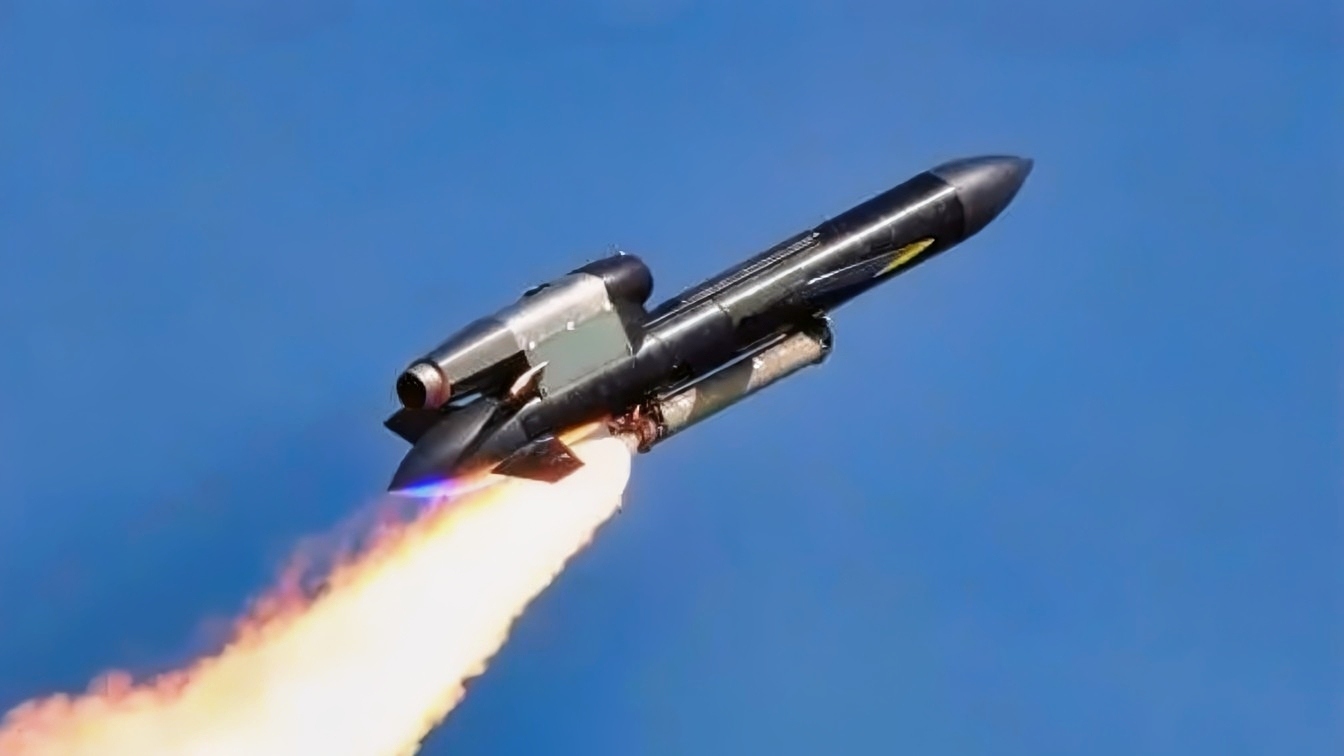
Ukraine’s long-range strike campaign is in full swing, with another long-range strike confirmed overnight on June 27 that damaged a major Russian defense production plant. Ukrainian President Volodymyr Zelenskyy confirmed that the country’s own FP-5 Flamingo cruise missile struck the Titan-Barrikady defense plant in the Volgograd region, engulfing the plant in flames.
The massive military-industrial facility is one of the most important defense manufacturers in the country and has been under international sanctions since the beginning of the Russian invasion.
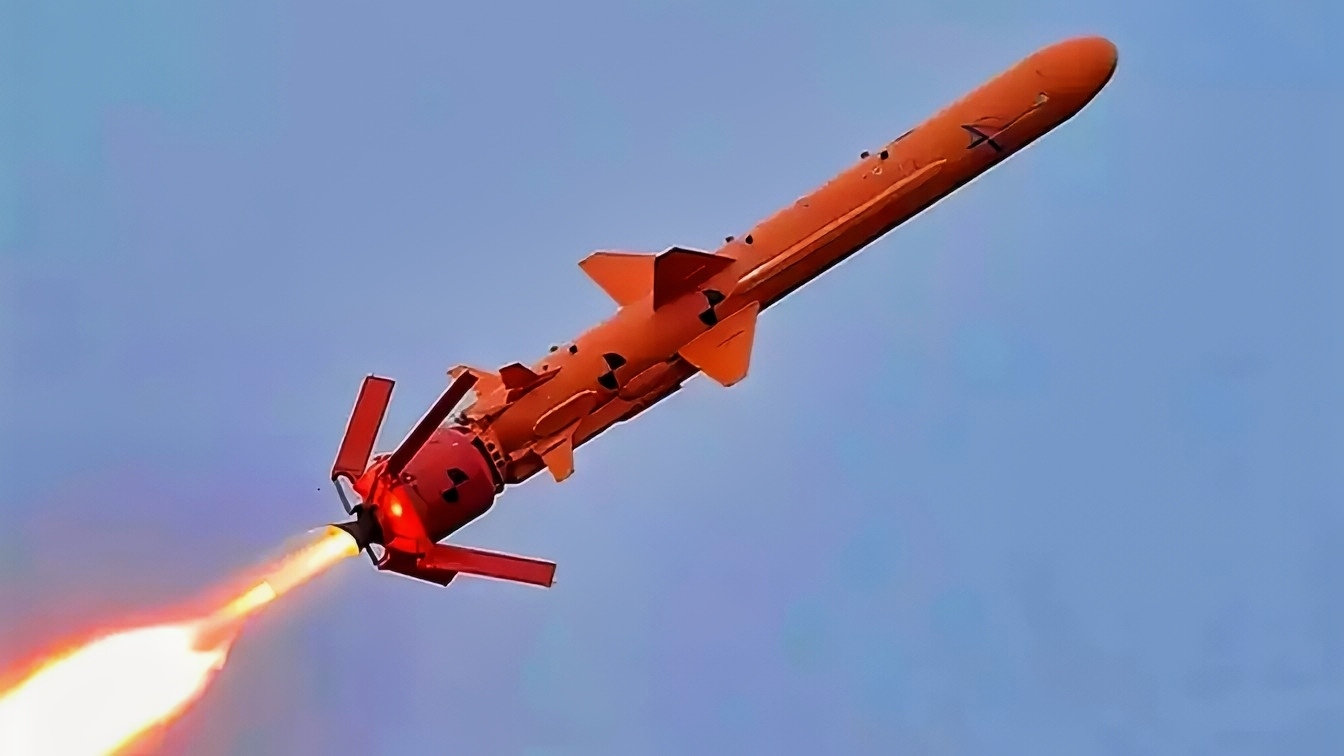
Ukraine Cruise Missile Ministry of Defense Photo
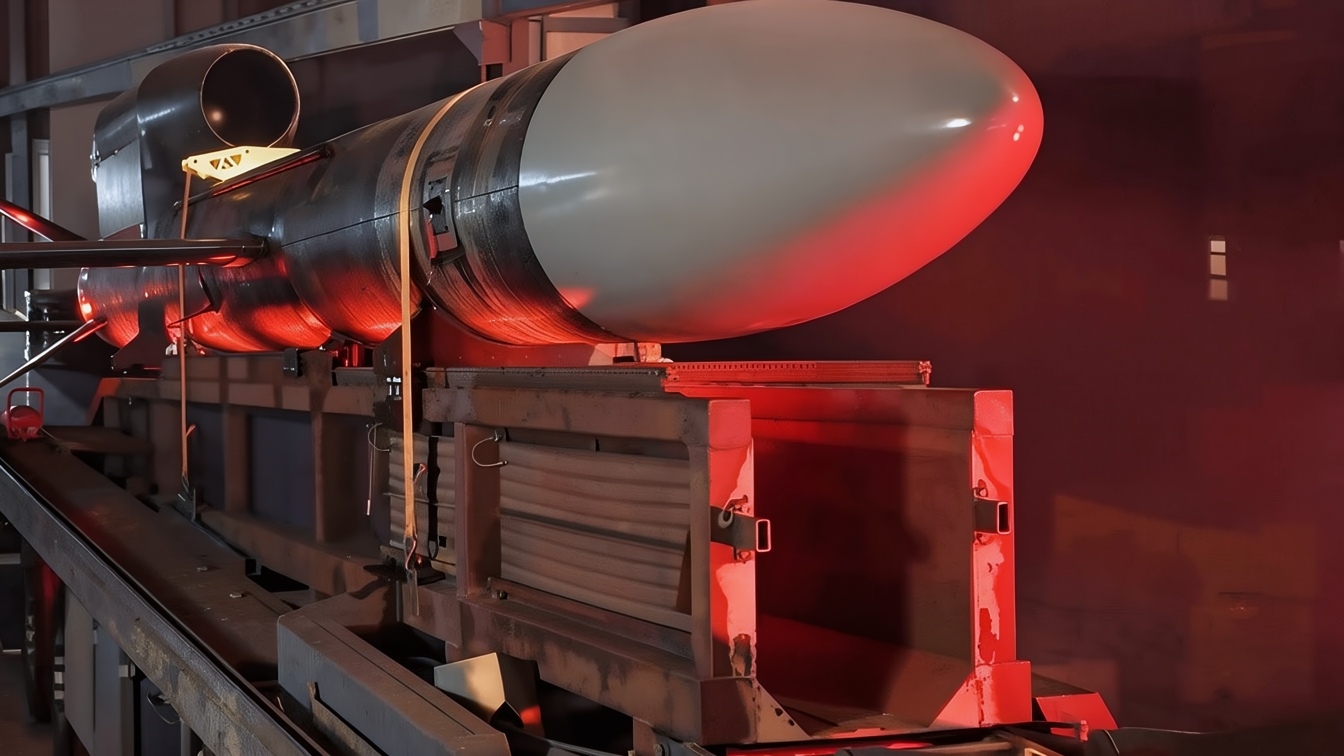
Ukraine Cruise Missile 2026. Image Credit: Creative Commons.
It produces launchers and components for Russian missile systems and is one of the key facilities supporting Russia’s war effort.
The strike was just one in a long string of attacks carried out by the FP-5. In recent months, the missile has been used alongside Ukraine’s growing fleet of long-range drones to strike everything from oil refineries and logistics hubs to military facilities.
Critical military and energy infrastructure thousands of miles behind the Russian lines is now under constant attack, and Moscow seemingly doesn’t have the capacity to defend itself fully. That raises big questions for Putin – and while the world watches and waits, it also finds itself wondering about the remarkable new weapon that made all this possible.
Despite everything, Ukraine’s military-industrial infrastructure has managed to piece together a completely new weapon that can devastate the Russian military and energy infrastructure without help from the West.
Developed entirely in Ukraine under wartime conditions, the FP-5 has evolved from a little-known domestic project into one of the most important long-range weapons in Kyiv’s arsenal.
And as Ukraine continues to expand production of this new weapon and the tempo of deep strikes rises over the next month and a half, the Flamingo is only going to attract even more attention.
Kyiv, in fact, hopes that it will be the weapon that wins the war.
What is the FP-5 Flamingo?
The FP-5 Flamingo is a domestically developed and manufactured Ukrainian long-range cruise missile produced by defense technology firm Fire Point.
The missile was publicly unveiled in August 2025 following months of speculation about Ukraine’s burgeoning missile program.
It is the biggest effort by Kyiv to date to end its dependence on foreign-supplied long-range missiles, solving a problem that has existed from the beginning of the Russian invasion: Western reluctance to provide weapons that could be used in direct strikes on Russian soil.
Today, Ukraine has the manufacturing capacity to produce sufficient Flamingo missiles for long-range strikes, alongside a wide range of other drone and missile assets.
Unlike the thousands of relatively inexpensive one-way attack drones that now dominate much of the battlefield, and which have indeed changed the nature of the conflict, the FP-5 is a true cruise missile. It is powered by a small turbojet engine and flies at low altitude.
It is designed to evade radar and carry a large warhead, making it well-suited for targeting military and industrial sites. The missile’s range has been placed at up to 3,000 kilometers. To date, Ukraine has launched strikes as far as 1,500 kilometers from the front lines.
Little is officially known in terms of the missile’s technical specifications.
We do know that it is likely to combine inertial navigation with satellite guidance and terminal guidance systems to improve its accuracy over long distances.
And the missile is understood to be considerably cheaper to manufacture than many Western cruise missiles, allowing Ukraine to expand production despite the constraints of a wartime economy.
Is This Ukraine’s Next Big Export?
The FP-5 Flamingo was designed to ensure Ukraine’s survival, but depending on how things unfold now, it could ultimately become one of the country’s most valuable exports in a post-war Ukraine.
Although there is no indication yet that Ukraine is selling the Flamingo to export customers, Fire Point has begun expanding its manufacturing partnerships in Europe. Governments across the continent are also looking for affordable long-range strike weapons that can be produced in large numbers quickly. The Flamingo fits that bill.
The Flamingo has a great combat record already, as well. Since entering operational service, the missile has repeatedly demonstrated its ability to penetrate deep into Russian territory and cause devastating damage to major infrastructure and military logistics hubs – including one of Russia’s most important defense production plants, Titan-Barrikady. Every new, successful strike is a real-world demonstration of the weapon’s capabilities that similar systems developed in peacetime cannot offer.
If Ukraine ultimately succeeds in forcing Russia to negotiate from a position of weakness, its wartime defense industry could well become one of Europe’s greatest success stories.
A post-war Ukraine could help the continent defend itself better in the future, and become a major supplier of advanced drones, missiles, and other precision weapons that NATO partners are scrambling to procure today.
About the Author: Jack Buckby
Jack Buckby is a British researcher and analyst specializing in defense and national security, based in New York. His work focuses on military capability, procurement, and strategic competition, producing and editing analysis for policy and defense audiences. He brings extensive editorial experience, with a career output spanning over 1,000 articles at 19FortyFive and National Security Journal, and has previously authored books and papers on extremism and deradicalization.


