

After days of speculation about the future of U.S.-Iran peace talks, reports confirm that negotiators from the two countries held indirect technical talks in Doha, Qatar, on Wednesday.
The technical discussions focused on the passage of commercial vessels through the Strait of Hormuz and a return to full negotiations that could bring about a lasting ceasefire.

Ford-Class Aircraft Carrier. Image Credit: Creative Commons.
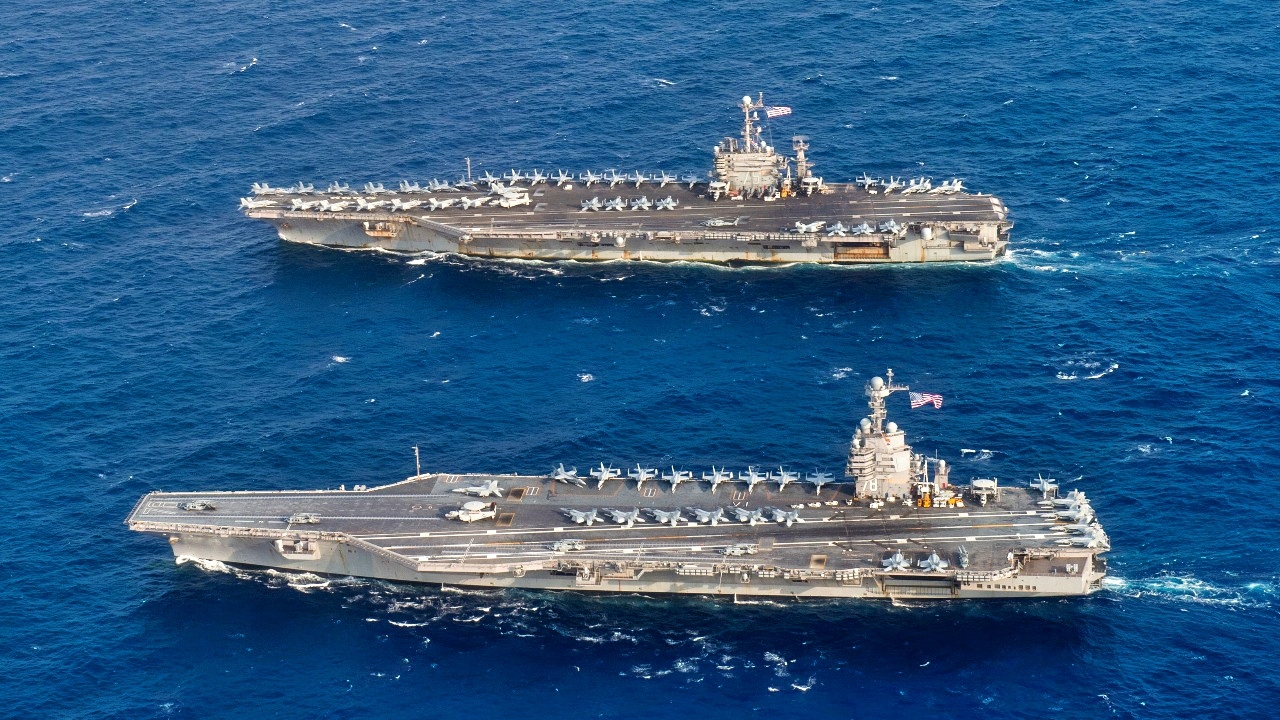
The U.S. Navy Gerald R. Ford–class aircraft carrier USS Gerald R. Ford (CVN-78) and the Nimitz-class aircraft carrier USS Harry S. Truman (CVN-75) underway in the Atlantic Ocean on 4 June 2020, marking the first time a Gerald R. Ford–class and a Nimitz-class aircraft carrier operated together underway.
The news was confirmed by a source with direct knowledge of the talks.
According to Reuters, the talks are still focusing on the memorandum of understanding (MOU), a document outlining 14 agreements that lay the foundation for longer, more detailed talks over the following 60 days.
The agreement was intended to halt hostilities and allow free passage of vessels through the Strait of Hormuz while a final agreement was made, but a series of military strikes between Israel, Lebanon, the U.S., and Iran have repeatedly challenged that agreement.
And now, instead of discussing the details of a lasting nuclear agreement, Iran and Washington are once again debating the terms of a deal intended to help them reach one.
What Just Happened
According to reports, the indirect negotiations were mediated by Pakistan and Qatar. The latest discussions began on Tuesday night and continued into Wednesday.
The talks have taken the form of negotiation “sessions” between chief negotiators and other specialists, per a Reuters source. Jared Kushner, President Donald Trump’s son-in-law, is engaging in talks with envoy Steve Witkoff.
Kushner and Witkoff also met separately with Qatari Prime Minister Mohammed bin Abdulrahman Al Thani before the negotiations began to lay the groundwork for the talks, though neither is reported to be participating directly in the technical sessions.
On the Iranian side, Deputy Foreign Minister Kazem Gharibabadi is leading a delegation that includes officials from the Iranian Foreign Ministry and the central bank.
The talks are also reportedly attended by officials from Iran’s Agriculture Ministry, suggesting the topics under discussion are fairly broad.
What Tehran Wants
Tehran has publicly identified its main priorities in no uncertain terms. Through statements issued on social media and to state media, Tehran has insisted that $6 billion in frozen Iranian assets must be released, and its sovereignty over the Strait of Hormuz must also be recognized.
Washington, however, still insists that a deal cannot be made unless Tehran is willing to give up its nuclear ambitions and allow the toll-free passage of commercial vessels through the Strait.

(Oct. 21, 2005) – Naval forces from Argentina, Brazil, Spain, Uruguay and the United States perform divisional tactical maneuvers off the coast of Brazil during UNITAS 47-06 Atlantic Phase. UNITAS is the largest multi-national naval exercise conducted with naval forces from the U.S., the Caribbean Sea, and South and Central America. The exercises focus on building multinational coalitions, while promoting hemispheric defense and mutual cooperation. U.S. Navy photo by Photographer’s Mate 2nd Class Michael Sandberg (RELEASED)
Iran Says It Is Ready for War
On Tuesday, June 30, Iran’s chief negotiator, Mohammad Bagher Ghalibaf, said that while Iran is prioritizing diplomacy with the United States, it is still ready for war.
“We are pursuing dialogue, but if the dialogue is not implemented, we are also prepared for war and will respond accordingly,” Ghalibaf said in a television interview as Iranian and U.S. delegations were expected to hold separate conversations in Doha.
And So Is Trump
President Donald Trump has also spent the past week trying to remind Iran, and the world, that military options are still on the table if his demands are not met.
Trump says that diplomacy still has a real chance of succeeding, even if he has expressed frustration in Truth Social posts and other official statements about Iranian negotiators.
Speaking to reporters on Wednesday as negotiations continued in Doha, the president sounded more optimistic, telling reporters that the U.S. and Iran were “getting along very well” and that Iran had “come a long way.”
When asked about the talks, he said that there were “very good meetings” and that the “denuclearization of Iran is moving along well.”
However, reports so far indicate that the technical discussions have not yet focused on the nuclear issue, and that the topic will only be addressed once technical talks resume full negotiations.
Behind Closed Doors…
Behind closed doors, however, the White House has reportedly been considering the possibility of more strikes against Iran.
The Trump administration, according to The Wall Street Journal, has been privately weighing its options in case the talks collapse, with Defense Secretary Pete Hegseth and Joint Chiefs Chairman Gen.
Dan Caine is reportedly preparing to resume large-scale military operations.
Unnamed sources familiar with the discussions told the newspaper that there are plans for future strikes, but that President Trump has deliberately chosen not to authorize them in hopes that diplomacy will prevail.
According to the source, the president concluded that reigniting the war right now could derail the negotiations that he hopes will lead to the dismantlement of Iran’s nuclear program.
Trump has reportedly instructed his team to continue pressing Tehran in the talks in Doha, and even signaled privately that he may be willing to extend the negotiating timetable beyond the original 60-day deadline if genuine progress is made.
It’s a suggestion that he has even made publicly to reporters, stating that he cares more about Iran “behaving” than about sticking to an agreed timeframe.
About the Author: Jack Buckby
Jack Buckby is a British researcher and analyst specializing in defense and national security, based in New York. His work focuses on military capability, procurement, and strategic competition, producing and editing analysis for policy and defense audiences. He brings extensive editorial experience, with a career output spanning over 1,000 articles at 19FortyFive and National Security Journal, and has previously authored books and papers on extremism and deradicalization.


