

A long essay today from the publication War on the Rocks posits that Russia will now expand the size of its force to gain back the initiative in its thus-far failed war in Ukraine.
The authors point out that Moscow’s military expanded severalfold after the February 2022 invasion of Ukraine, leading the reader to believe that this model of force expansion can be repeated.

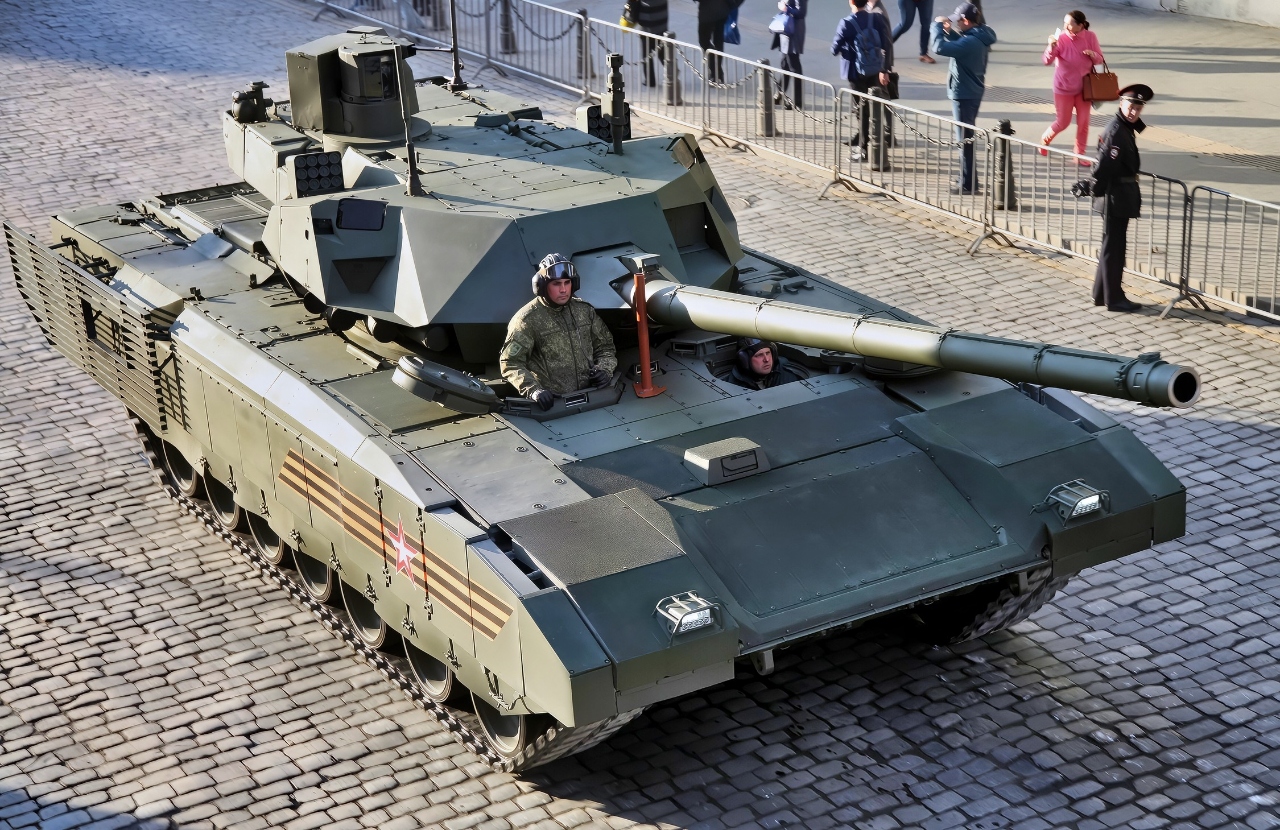
T-14 Armata. Image Credit: Creative Commons.

Main battle tank T-14 object 148 on heavy unified tracked platform Armata. Image Credit: Creative Commons.
If this is the Russian military’s brilliant plan to reverse the fortunes of war, it most likely belongs in that category of “a true triumph of hope over experience.”
What would seem to be confirmation that this will be a failed enterprise from the get-go comes from one of the more reliable sources of information on the Ukraine-Russia war – the London Daily Telegraph “Ukraine: The Latest” podcast. It is a series of live in-studio news reports and interviews on how the war is developing, delivered at a near-granular level and recorded and released online the same day, five days a week.
One of the key items in today’s broadcast is the story that “Russian recruits run dry” – begging the question of how Moscow intends to even maintain – not to mention expand – present force levels.
The Well is Running Dry
The information from the London daily’s Ukraine and defense team makes it clear that the proverbial “well” that supplies the manpower to be coaxed into signing contracts to serve in the Russian military is running dry. Hence, the podcast report is that the required manpower is simply not making itself available.
Among other data points presented in today’s reporting are:
-Daily contract sign-ups for new recruiting contracts for volunteers – soldiers known as “kontraktniki” – have fallen well below the numbers in previous years. The current daily selection rates for the Russian military are between 1070 and 1090 personnel. It is well known from the Ukrainian General Staff and other reliable reporting that the Russian daily casualty rates are well above these numbers. The Russian military is therefore operating at a daily deficit, creating a progressive net reduction in personnel.
-The recruitment of personnel for the Russian military has for years relied on the ability to draw manpower from remote and highly impoverished regions. This mechanism is falling off for two reasons. One is that the number of personnel willing to volunteer to go to the front line is reaching the point where there are simply too few left who are not serving already or have not been killed in action. Another is that regions that produced sizeable numbers of volunteers, such as Samara and Tatarstan, have drastically reduced once-very-attractive enlistment bonuses. These sign-up payments are dropping from what were once millions of roubles to the federally mandated minimum of 400,000 roubles – approximately US$ 5,200.
-Then there is Russia’s use of any number of desperate measures employed in previous years when regular methods of attracting volunteers were ineffective. Soldiers from the Democratic People’s Republic of Korea (DPRK) were sent to fight with the Russian military, but suffered at least 50 percent casualties and were no game-changer on the battlefield.
-Then there are what could only be called the “hoodwinking” of people like Africans and Indians and others to sign contracts to take what appeared on paper to be very attractive jobs. They were promised they would work as security guards at a shopping mall in Moscow, only to find out when they arrived in Russia that they were signed up to fight in President Vladimir Putin’s war in Ukraine. Other more recent mechanisms include dragooning students or foreign migrant workers.
Acts of Coercion
Then there are other reports of persons being forcibly coerced into signing contracts as “volunteers.” In some Russian cities, the police and the press gang-style recruiting officials have abandoned the practice of simply grabbing men off the street.
They are now going door-to-door looking for anyone who can be pulled into what has long been derisively referred to as “Putin’s meat grinder.”
There are now growing rumors that the Kremlin may call a second mass mobilization as a last resort. This could take place as early as this fall, but only after the parliamentary elections in mid-September, in which Putin’s United Russia party is already expected to lose support due to multiple signs that the war is going badly and causing hardship for the population.
The last mobilization in September 2022 has been described as a “tectonic shock for Russian society.” Given society’s already rising sentiment that the war should be brought to an end, conducting such a call-up now could spark mass unrest in the major cities of European Russia.
These cities have thus been spared the effects of high casualty rates on the front lines and are unlikely to take such a move lying down.
What this all means is that any plan for changing the dynamic in this war – a war that Moscow increasingly appears to be losing both on the battlefield and increasingly as well back home – would have to exhibit some level of brilliant creativity and innovation that the Russian side has yet to demonstrate.
One of the latest ploys reported today is sending alcoholics from rehabilitation centers to the front line in Ukraine, one Russian soldier has claimed.
If this is an example of how Putin intends to solve his military manpower problem, then, as one of the advisors to Tsar Nicholas II told him as his country careened towards what became World War I, “perhaps it is time to start praying.”
About the Author: Reuben F.Johnson
Reuben F. Johnson has thirty-six years of experience analyzing and reporting on foreign weapons systems, defense technologies, and international arms export policy. Johnson is the Director of Research at the Casimir Pulaski Foundation. He is also a survivor of the Russian invasion of Ukraine in February 2022. He worked for years in the American defense industry as a foreign technology analyst and later as a consultant for the U.S. Department of Defense, the Departments of the Navy and Air Force, and the governments of the United Kingdom and Australia. In 2022-2023, he won two awards in a row for his defense reporting. He holds a bachelor’s degree from DePauw University and a master’s degree from Miami University in Ohio, with a specialization in Soviet and Russian studies. He lives in Warsaw.


