

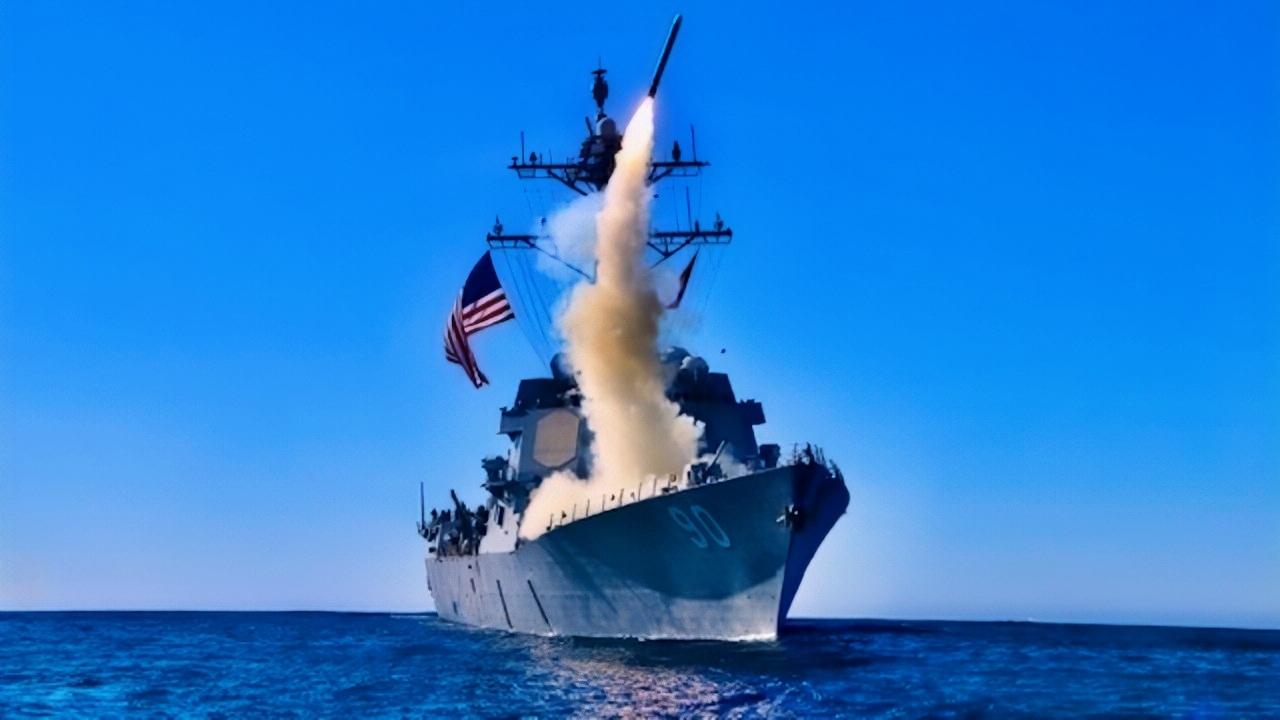
With no end in sight to the ongoing war in Iran, the conflict between Washington and Tehran seems to have entered a new and more dangerous phase of fighting. What began as a campaign centered on military targets and freedom of navigation has evolved into expanded strikes, retaliation felt across the Gulf, and growing concern that the fighting could escalate into a larger conflagration.
Where We Are Today: The Iran War Won’t Seem to End

(March 7, 2016) An F/A-18E Super Hornet assigned to the Warhawks of Strike Fighter Squadron (VFA) 97 performs a flyby during an aerial change of command ceremony above USS John C. Stennis (CVN 74). Providing a ready force supporting security and stability in the Indo-Asia-Pacific, Stennis is operating as part of the Great Green Fleet on a regularly scheduled 7th Fleet deployment. (U.S. Navy photo by Mass Communication Specialist Seaman Tomas Compian/Released)
The United States has carried out a week of continuous, consecutive nights of airstrikes inside Iran. According to American officials, the campaign is intended to degrade Iran’s military capabilities, particularly assets that threaten shipping and American forces in the Persian Gulf. The Pentagon has released relatively few operational details about those strikes, but officials describe the effort as a sustained pressure campaign rather than a single punitive strike.
Iran has responded with missile and sea drone attacks aimed at U.S. military facilities and regional partners, including sites in Bahrain, Kuwait, Jordan, and Qatar. Many of those attacks have reportedly been intercepted, but they underscore the willingness with which Tehran has to broaden the conflict geographically rather than fight only within its own borders.
This current round of fighting follows the collapse of an earlier ceasefire, leaving neither side with functioning diplomatic channels capable of halting the escalation.
Recent American Moves
Over the past week, American forces have continued nightly airstrikes against military infrastructure in southern Iran, imposed a naval blockade designed to restrict Iranian maritime activities, and carried out attacks on missile sites, Iran’s coastal defenses and logistics facilities, the country’s surveillance systems, as well as other military assets tied to Iran’s ability to threaten shipping through the Strait of Hormuz.

An F/A-18 Super Hornet from Naval Air Station Oceana, Virginia, performs an aerial demonstration over Rickenbacker International Airport, Ohio, June 16, 2024, as part of the Columbus Air Show. This year’s event featured more than 20 military and civilian planes, including a KC-135 Stratotanker from the 121st Air Refueling Wing, which served as the base of operations for military aircraft participating in the show. (U.S. Air National Guard photo by Senior Airman Ivy Thomas)
Posting to X, formerly Twitter, U.S. Central Command provided details of the latest strikes. “U.S. forces, including fighter jets, aerial drones, and warships, launched precision munitions that hit dozens of Iranian military targets such as coastal surveillance and air defense sites, military logistics infrastructure, and maritime capabilities,” Central Command explained. “This was the sixth consecutive night of U.S. strikes against Iran,” it added.
More broadly, the American objectives appear to be threefold. First, to reduce and degrade Iran’s ability to attack U.S. forces as well as allies in the region. Second, to keep the Strait of Hormuz open, protecting one of the world’s most important oil transit routes. And third, to increase pressure on Tehran in hopes that Iran’s leadership eventually returns to negotiations, but from a weaker position. American officials have repeatedly argued that sustained military and economic pressure will produce a more favorable diplomatic outcome, but that remains to be realized. But American forces have scrambled air tankers to the region, a sign of their determination to see out Washington’s end goals in this war.
Most recently, American strikes reportedly struck several Iranian bridges located in the country’s Hormozgan province. Iranian energy infrastructure has also been targeted by American forces, and Iranian authorities have urged residents to use their air conditioning units sparingly in an attempt to help ensure a regular supply of electricity.
Iranian Movements
Iran, on the other hand, has pursued a very different strategy. Rather than trying to match American airpower directly, Tehran has relied on missile and drone attacks against American bases and patterns in the region. Iran has also maintained pressure on the Strait.
Iran seems intent on raising the military and political costs of operations against the country and demonstrating American vulnerability despite having air superiority, while also preserving the leverage it has over the region thanks to the Strait. Ultimately, Tehran would like to convince Washington that a negotiated settlement is the preferred outcome.
What Neither Washington — nor Tehran — Wants
Neither side appears keen to engage in a large-scale ground war. For the United States, the strategy is to use sustained military pressure to weaken Iran’s military capacity while avoiding a long occupation or nation-building effort. The expectation is that continued strikes, sanctions, and maritime restrictions will eventually force concessions.
Iran, conversely, is hoping a strategy of endurance will be its savior. Tehran has bet that it can absorb damage while imposing enough military, economic, and political costs on the United States to make continued operations untenable.
Crucially, with midterm elections on the horizon, that strategy may have some merit. Iran’s leaders have consistently framed the conflict as one in which they need only avoid defeat rather than achieve a decisive battlefield victory, which would be exceedingly difficult.
For Iran, the desired outcome would be to live now to fight another day.
About the Author: Caleb Larson
Caleb Larson is an American multiformat journalist based in Berlin, Germany. His work covers the intersection of conflict and society, focusing on American foreign policy and European security. He has reported from Germany, Russia, and the United States. Most recently, he covered the war in Ukraine, reporting extensively on the war’s shifting battle lines from Donbas and writing on the war’s civilian and humanitarian toll. Previously, he worked as a Defense Reporter for POLITICO Europe. You can follow his latest work on X.


Pingback: The Iran War Just Entered a More Dangerous Phase — Six Straight Nights of US Strikes, and Retaliation Felt From Bahrain to Jordan
megiddo
July 18, 2026 at 1:54 pm
This Iran war by US president donaldo trump, is totally illegal and unethical, yet there’re no sanctions, no bans and no restrictions on the US.
Thus, trump on behalf of the deep state, is now freely and openly, carrying out a violent genocidal campaign or genocidal war, against the people of Iran.
No sanctions and no bans, and so US bombs are falling like nobody’s business, while trump himself threatens to impose tariffs on Canada for the smoke from its forest fires.
This is the world controlled by Washington and its allies, especially in Europe and Australia and their sidekicks.
It’s a world inspired by Asmodeus, and this spirit today controls Washington and the US white house.
The hell with US and its allies.
Pingback: The Iran War Just Entered a More Dangerous Phase — Six Straight Nights of US Strikes, and Retaliation Felt From Bahrain to Jordan – Bahrain 247 Club™
Pingback: The Iran War Just Entered a More Dangerous Phase — Six Straight Nights of US Strikes, and Retaliation Felt From Bahrain to Jordan - Bahrain CityRegions™