
The Trump administration is reportedly considering conducting one of the most ambitious special operations missions ever attempted: a ground assault on Iran designed to seize the country’s stockpile of enriched uranium from its heavily fortified nuclear facilities.
The operation would supplement airstrikes that have already caused significant damage.
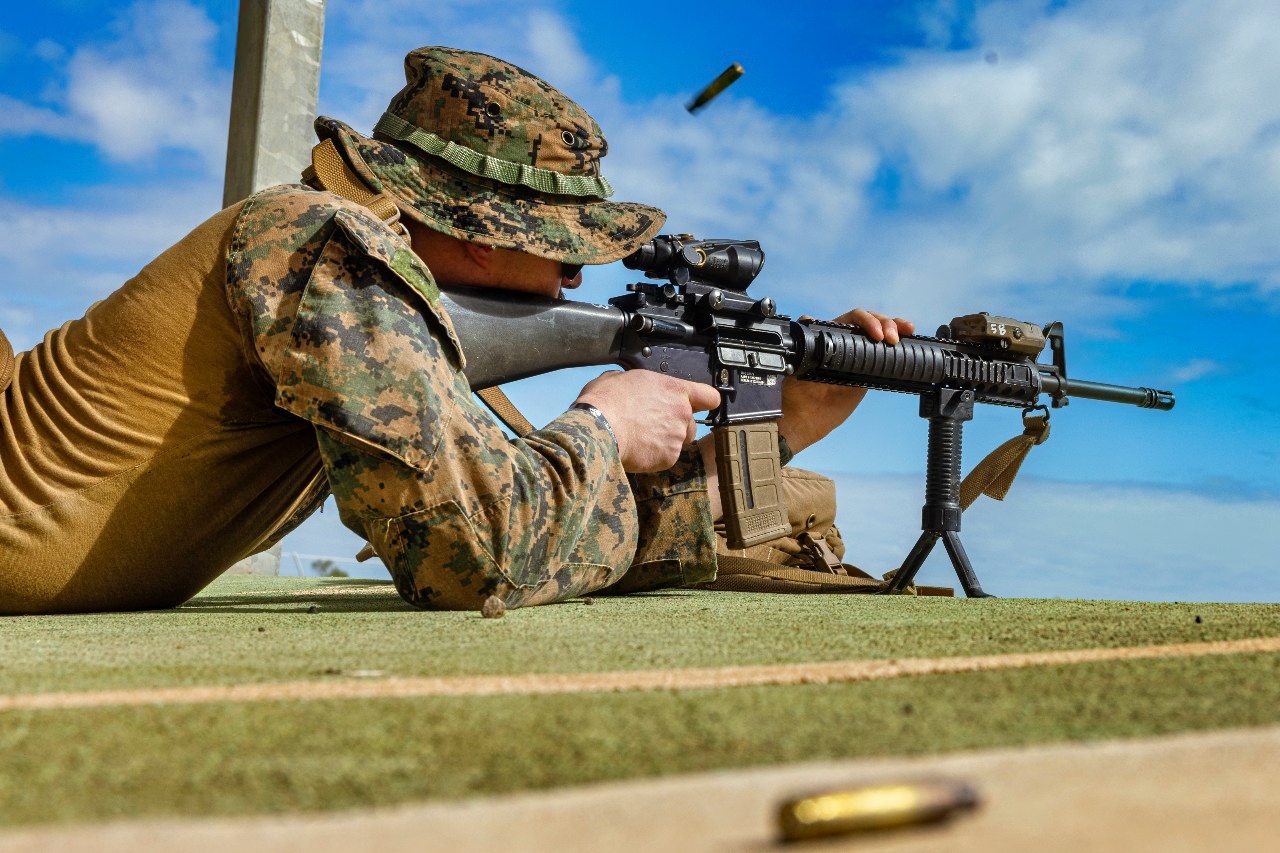
U.S. Marine Corps Sgt. Gabriel Guzman, a platoon sergeant with Combat Logistics Battalion 5 (Reinforced), Marine Rotational Force – Darwin 24.3, fires an M16A4 service rifle during a battlesight zero range at Robertson Barracks, Darwin, NT, Australia, April 23, 2024. A BZO is the elevation and windage settings required to place a single shot, or the center of a shot group, in a predesignated location. MRF-D 24.3 is part of an annual six-month rotational deployment to enhance interoperability with the Australian Defence Force and Allies and partners and provide a forward-postured crisis response force in the Indo-Pacific. Guzman is a native of Illinois. (U.S. Marine Corps photo by Cpl. Juan Torres)
The proposal follows months of military operations against Iran’s nuclear infrastructure that have set back the country’s ambitions but which have not destroyed all of the country’s highly enriched uranium.
According to reporting published Saturday, July 25, the plan being considered would require thousands of U.S. troops and elite special operations forces working alongside engineers and explosive ordnance specialists.
The troops would be required to enter Iran, secure multiple nuclear sites, and then recover radioactive material – all while under Iranian fire. The troops would then transport the nuclear material out of the country.
How We Know
Citing a source familiar with U.S. military planning, the New York Post reported on Friday that plans are underway to recover Iran’s enriched uranium, and President Donald Trump may be preparing to authorize the mission.

U.S. Army soldiers assigned to Bravo ‘Bad Bet’ Company, 2nd Battalion, 12th Cavalry Regiment, 1st Armored Brigade Combat Team, 1st Cavalry Division, conduct Table V exercises with the M1A2 Abrams Tank at Bemowo Piskie Training Area, Poland, July 12, 2024. The purpose of the training is to ensure the Abrams were fully functional and fit to fight. The 1st Cavalry Division’s mission is to engage in multinational training and exercises across the continent, strengthening interoperability with NATO allies and regional security partners, which provides competent and ready forces to V Corps, America’s forward-deployed corps in Europe. (U.S. Army photo by Spc. Kali Ecton)
According to the report, the operation would begin with thousands of conventional U.S. troops establishing security around Iran’s nuclear facilities before specialist engineers clear the bomb-damaged tunnel entrances and create protected convoy routes.
Then, once those routes have been secured, a smaller team of elite special operations personnel would enter the facilities to recover the enriched uranium itself and prepare to extract it from the tunnels.
The report also identified some of the military units that could be responsible for the mission.
Among them are SEAL Team 6’s Silver Squadron, the Army’s 2nd Ranger Battalion, and the Army’s 21st Ordnance Company – the latter of which is a specialized unit trained to handle chemical, biological, and nuclear materials.
Military Experts Weigh In
Speaking to The New York Post, Joseph Rodgers, the deputy director of the Center for Strategic and International Studies, argued that diplomacy alone won’t be enough to solve the problem.
“I hate to say it, but I think the most likely way to get rid of Iran’s nuclear material, at least what they currently have, is a military operation because the negotiations aren’t going anywhere fast,” Rodgers said.
Rodgers also described it as potentially one of the most sophisticated military operations ever attempted.
“I think this would be one of the most, if not the most, sophisticated operations in military history,” Rodgers said. “This would be a logistically heavy and difficult operation in a contested environment. Iran’s military is pretty destroyed, but they’re still more sophisticated than the Cubans that were guarding Maduro.”
Iran’s Enriched Uranium
The question of what to do with Iran’s remaining stockpile of enriched uranium has been at the center of the Iran debate since Operation Midnight Hammer.
The enriched uranium, along with what’s left of Iran’s nuclear facilities, is the material that ultimately determines whether Tehran could produce a nuclear weapon.
Uranium found naturally in the ground contains very little of an isotope known as uranium-235, which is the form of uranium that is capable of sustaining the nuclear chain reaction required to produce an explosion or generate energy.
In its natural state, only around 0.7% of uranium consists of uranium-235, making it unsuitable for either nuclear power plants or nuclear weapons.
The enriched uranium at the center of this discussion has gone through a process involving thousands of rapidly spinning centrifuges that separate and concentrate uranium-235. Over time, the material’s purity is refined using advanced machines.
Civilian nuclear power stations typically use uranium that is enriched to between 3% and 5%, while some research reactors require enrichment as high as 20%.
Nuclear weapons, however, need much higher levels of enrichment to achieve the desired effect – typically around 90%.
Iran has spent years enriching uranium to levels as high as 60% – far beyond any level normally required for civilian nuclear use.
That stock of enriched uranium, nuclear experts say, can be more quickly converted into weapons-grade uranium than simply starting from scratch using natural uranium.
And that’s why the U.S. military is eager to remove it from Iran’s possession – assuming it can all be found.
What Does Iran Have?
Exactly how much enriched uranium remains accessible to Iran is a difficult question to answer.
Before Operation Midnight Hammer, the International Atomic Energy Agency estimated that Iran possessed 440.9 kilograms, or 972 pounds, of uranium enriched to 60% purity.
That’s enough, if further enriched to weapons-grade, for roughly ten nuclear weapons.
On March 9, IAEA Director General Rafael Grossi told reporters in Paris that the agency believed a “bit more than” 200 kilograms of Iran’s 60%-enriched uranium was stored inside the underground tunnel complex at Isfahan before the latest round of fighting.
He added that it was widely believed the same quantity of material was still in there.
Grossi also said that the tunnels at Isfahan appeared to have escaped the severe damage inflicted on other parts of Iran’s nuclear program, making them the most likely storage place for a significant portion of Tehran’s near-weapons-grade uranium.
About the Author: Jack Buckby
Jack Buckby is a British researcher and analyst specializing in defense and national security, based in New York. His work focuses on military capability, procurement, and strategic competition, producing and editing analysis for policy and defense audiences. He brings extensive editorial experience, with a career output spanning over 1,000 articles at 19FortyFive and National Security Journal, and has previously authored books and papers on extremism and deradicalization.


