

Iran Promises “Devastating” Response But Also Calls for Peace – In response to Washington’s new economic sanctions announcements this week, Tehran is responding with new threats of a “devastating” response while its political leadership simultaneously calls for peace.
Iranian President Masoud Pezeshkian said on Friday, August 21, that the nearly six-month conflict should be brought to an end while Tehran can still negotiate from what he described as a “position of power.” At almost the same time, Iranian Parliament Speaker Mohammad Bagher Ghalibaf, the chief negotiator in mediated talks with Washington, issued one of his strongest warnings yet about the economic consequences of continuing the conflict with the United States.
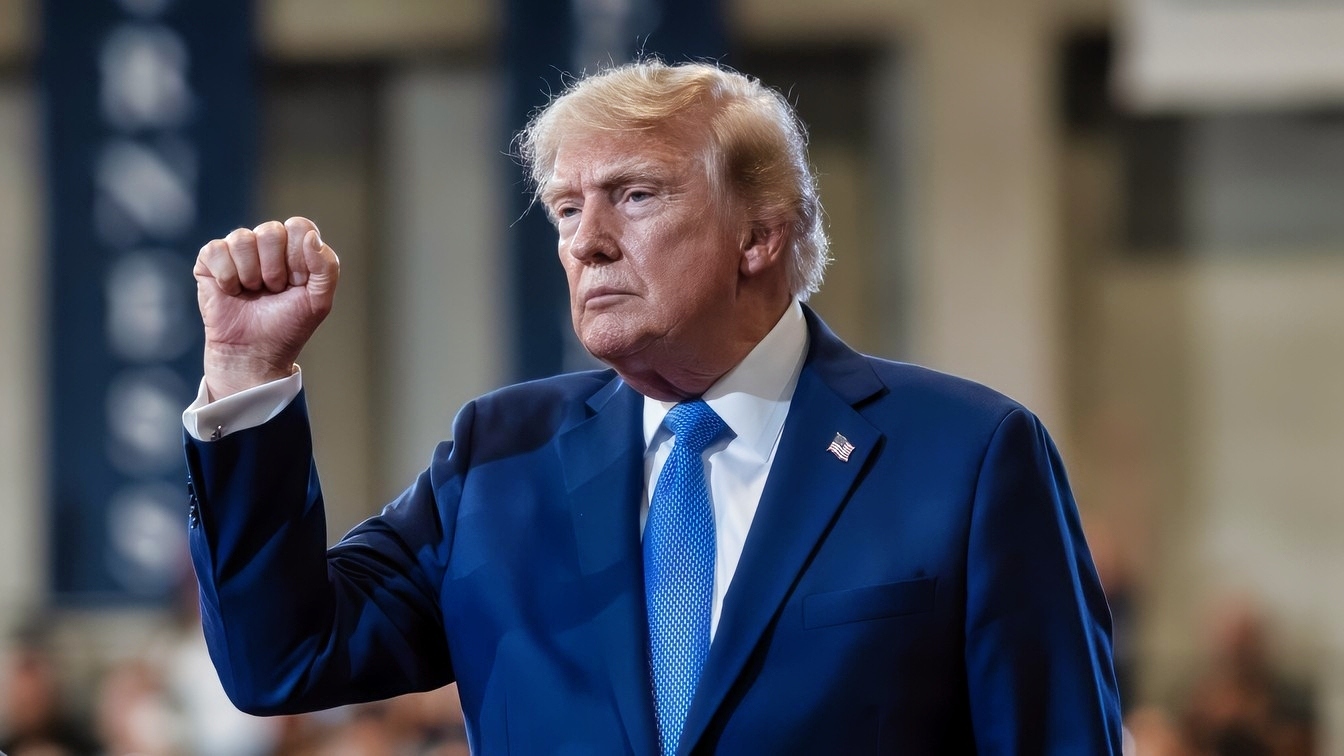
President Donald J. Trump delivers remarks at the David S. Mack Center for Training and Intelligence in Garden City, New York, Friday, August 14, 2026. (Official White House Photo by Molly Riley)
The comments come as Iran’s oil exports are squeezed by the U.S. naval blockade and the regime suffers a major lack of revenue that could prove fatal over time. The Strait of Hormuz also remains severely disrupted, and the Trump administration is pushing ahead with its promised campaign of the “toughest sanctions in history.”
It doesn’t mean Iran is preparing to surrender – at least yet. But the news suggests that some of the most powerful civilian figures in Tehran now seem to believe Iran has extracted as much leverage as it reasonably can for the war, and that waiting longer could leave the country negotiating from a weaker position.
But Trump may choose to wait.
Iran’s President Says It Is Time to End the War
Iranian President Masoud Pezeshkian publicly called for an end to the war with the United States on Friday, August 21, arguing that Tehran should seek to end the conflict while it can still negotiate from what he described as a position of strength.
“It would be better to end the war today, when we have power and dignity, and with the whole world acknowledging our victory,” he said, per the Iranian Students’ News Agency.
The remarks came during the 31st General Assembly of the Islamic Association of Iran’s Medical Community.
He also described a scenario in which Iran may agree to end the conflict, but framed it not as a surrender but as an opportunity to end it before the economic and human costs become even greater. He said that Iran could currently claim that it had withstood months of American military pressure while maintaining its ability to strike back and continue disrupting shipping through the Strait of Hormuz.
It was a surprising admission of vulnerability and suggests that President Trump’s economic warfare against Iran could prove far more consequential than continued military strikes.
The comments also appeared aimed at hardliners inside Iran who continue to oppose any compromises with Washington. Pezeshkian defended the previous agreement negotiated with the United States and criticized those questioning its terms without having to manage the war’s consequences. He also directly acknowledged the economic pressures facing the country, saying that the war and blockade had disrupted imports and exports and questioned whether Tehran could continue expensive government subsidies while simultaneously financing the conflict.
And it’s that economic argument that could ultimately end the war. Pezeshkian’s intervention came as the Trump administration prepared its new sanctions campaign and as reports revealed that the U.S. had established a nightly routine of escorting tankers through a Strait of Hormuz route on the Omani side. The disruption continues, but the economic impact facing Iran now seems like it could be enough to force Tehran to make concessions.
Iran’s Military Threatens Escalation
Iranian political leadership may understand the threat it faces, but its military is still making it abundantly clear that Tehran has not abandoned its military objectives.
Major General Ali Abdollahi, chief of staff of Iran’s Armed Forces, warned Friday that any new American threats would trigger a response across multiple domains.
“With preparedness across land, sea, air, air defense and cyberspace, Iran’s armed forces will respond to the enemy’s new threats with crushing, punishing and devastating responses,” Abdollahi said.
Meanwhile, Foreign Minister Abbas Araghchi also expressed defiance and dismissed Washington’s latest economic campaign against Iran as just another iteration of American “maximum pressure” policies.
It’s unclear, then, quite where Iran will go next, with its leadership both publicly signaling that it wants a negotiated end to the war while warning Washington that continued pressure could still trigger new exchanges of fire.
Trump Is Not Ready to Make A Deal – Yet
Washington, however, is signaling it is willing to wait.
President Donald Trump said on Friday that Iran wants an agreement but has not yet offered terms he considers acceptable.
“They would love to make a deal, but they’re not ready to make the right deal, in my opinion,” Trump told reporters as he boarded Air Force One. He also said U.S. military options were not limited despite the administration’s focus on economic warfare and reports that the U.S. is struggling with a shortage of precision-guided missiles and interceptors.
About the Author: Jack Buckby
Jack Buckby is a British researcher and analyst specializing in defense and national security, based in New York. His work focuses on military capability, procurement, and strategic competition, producing and editing analysis for policy and defense audiences. He brings extensive editorial experience, with a career output spanning over 1,000 articles at 19FortyFive and National Security Journal, and has previously authored books and papers on extremism and deradicalization.


