

Nord Stream 2 was the world’s largest offshore pipeline system and the signature project symbolizing the close ties between the Russian and German economies.
When of was completed, German Chancellor Angela Merkel touted it as one of her greatest achievements. President Vladimir Putin saw it as the most visible showcase of his cooperation with the EU.

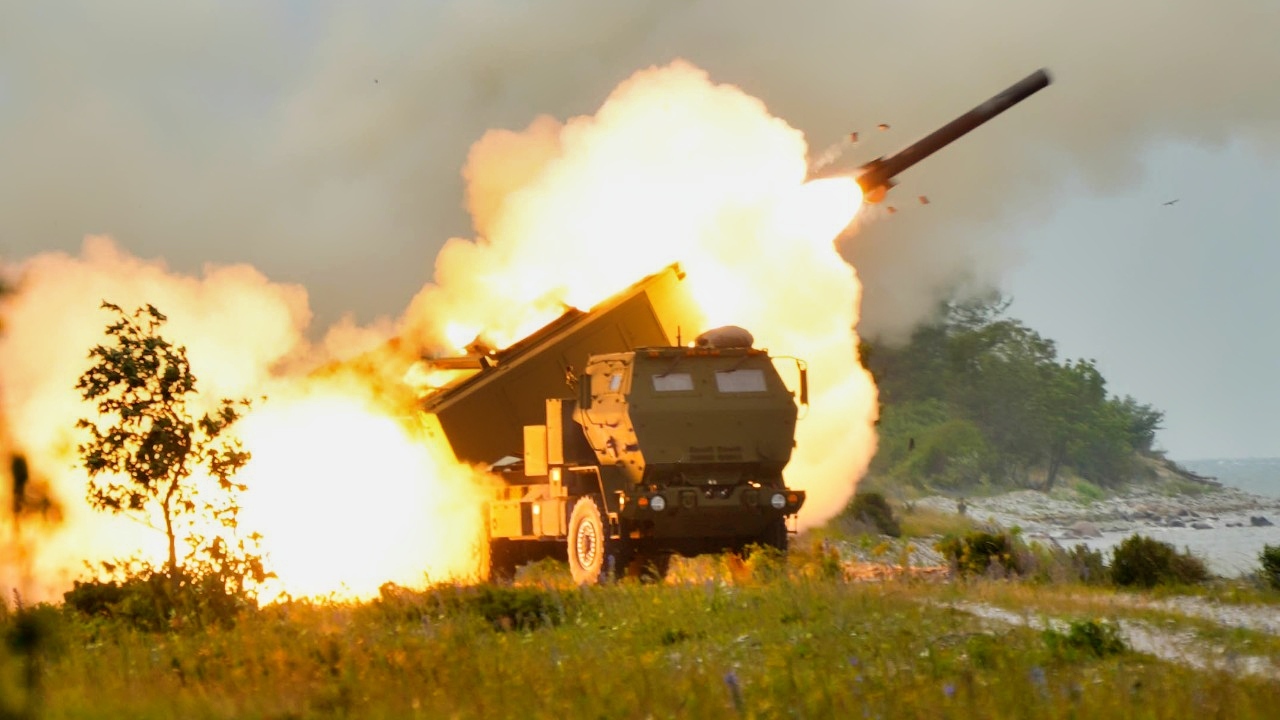
HIMARS Rocket. Image Credit: Creative Commons.

Tennessee Army National Guard Soldiers with Alpha Battery, 1-181st Field Artillery Regiment conduct a training exercise using the M142 High Mobility Artillery Rocket System (HIMARS) at Camp Shelby, Mississippi, June 9. The unit’s annual training enhances battalion readiness, focuses on mission-essential tasks and ensures Soldiers are proficient in critical skills. (U.S. Army National Guard photo by Sgt. Grayson Cavaliere)
How and why this massive energy and political project was sabotaged is a lesson for the US – or any other superpower – on the power of asymmetrical warfare.
Nord Stream took more than two decades to complete and cost more than US$ 20 billion to build.
But despite its claims of ushering in a new European era, it proved a defeat for democratic values. Values that Merkel had been anticipated to become a robust champion for prior to her taking power.
The 2013-2014 Ukrainian Maidan Revolt is sometimes called the Revolution of Dignity and is chronicled in the Netflix documentary Winter on Fire.
It was the most dramatic, democratic, populist movement by any former Soviet vassal state against more than two decades of serial efforts by Russia to undermine its government.
In a perfect world, Merkel should have been the first among EU leaders to offer unconditional support for Ukraine.
It was, after all, the pro-Moscow government in Kyiv’s decision to declare that it was abandoning the process of accession to the EU, and her role as its leader, that sparked the revolt in the first place.
After Russia conducted its first incursion into Ukraine’s territory with its 2014 occupation of Crimea, she effectively did the opposite.
As the US Council on Foreign Relations in-house journal, Foreign Affairs, wrote five months before Russia’s 2022 invasion of Ukraine: “in the wake of Russian President Vladimir Putin’s 2014 annexation of Crimea, she undermined her own sanctions regime against Russia to give Putin the much bigger prize of Nord Stream 2.”
A New Molotov-Ribbentrop Pact
In early 2014 and by the time the smoke cleared from the piles of burning tires and buildings that had been set afire in Kyiv’s main Independence Square, Nord Stream had already become one of the most hated projects in all Central Europe.
Shipping Russian gas along the seabed directly to Germany, bypassing Poland and Ukraine, would have cost Kyiv between $2 billion and $3 billion annually and would have deprived Warsaw of $200 to $500 million annually in lost natural gas transit fees.
More significantly, this pipeline from Russia to Germany would have allowed Moscow to shut off the gas valve to Ukraine and Poland without cutting off flows to higher-paying customers in western Europe.
Thus, the Nord Stream 2 agreement acquired the derisive nickname “new Molotov-Ribbentrop pact.”
The Russian invasion of Ukraine made the pipeline a high-priority target for Kyiv. This was not just to deprive Moscow of the revenue needed to fund its war effort, but also to generate the even more significant “David v. Goliath” narrative.
As I sat in Warsaw through March and April 2022, holding discussions with different groups of former special operators and intelligence operatives, we began taking friendly wagers on how soon the Ukrainians would find a way to blow it come kingdom come.
As it turned out, and unbeknownst to us, at this point a plan by Ukraine was already in the works. Some five months later in September 2022, a group of civilian divers trained to work with underwater explosives disabled the pipeline in one of the most daring acts of wartime sabotage in modern times.
Who Really Has the Cards
As detailed above, Nord Stream 2 cost billions to construct, took around two decades to build and required thousands of workers, engineers, welders and specialists. But it was put out of commission by a small team of operatives who used a rented, average-size yacht, commercially available diving gear and jury-rigged explosive charges.
Compared with the $20 billion cost of Nord Stream 2, the entire Ukrainian operation to destroy it cost only US$ 250,000.
Had the US carried out the plan, said one US former intelligence officer who spoke to National Security Journal, “we would have taken years to prepare the job instead of months and the plan would have cost hundreds of millions rather than hundreds of thousands.”
The Ukraine plot was, as is reported by the Washington Post this week, “so simple and audacious that when US national security officials first found out about the plan, long before the explosions,” it was dismissed by some of them as implausible.
Bojan Pancevski, the author of the Post’s op-ed today and the author of the recent book on the operation, describes how the impact of this bold operation will have longer-lasting effects on the conduct of warfare than on energy markets.
“The Ukrainians who carried out the operation did not set out to rewrite the rules of modern conflict. Kyiv, for better or worse, acts first and argues later,” he writes.
In this case, the rules of asymmetric warfare. The new rules say that smaller nations can cause significant damage to much bigger ones – even the US.
In the February 2025 Oval Office verbal ambush of Volodymyr Zelenskiy, the repeated shouts to the Ukrainian president were “you don’t have the cards.” Rather disingenuous diatribe given that at this point US intelligence knew that taking Nord Stream 2 had been done by Ukraine – not Poland, not British Intelligence, not one of the Baltic states.
The cards do not get much better than that.
About the Author: Reuben F. Johnson
Reuben F. Johnson has thirty-six years of experience analyzing and reporting on foreign weapons systems, defense technologies, and international arms export policy. Johnson is the Director of Research at the Casimir Pulaski Foundation. He is also a survivor of the Russian invasion of Ukraine in February 2022. He worked for years in the American defense industry as a foreign technology analyst and later as a consultant for the U.S. Department of Defense, the Departments of the Navy and Air Force, and the governments of the United Kingdom and Australia. In 2022-2023, he won two awards in a row for his defense reporting. He holds a bachelor’s degree from DePauw University and a master’s degree from Miami University in Ohio, specializing in Soviet and Russian studies. He lives in Warsaw.


