


Top U.S. military commanders have warned Defense Secretary Pete Hegseth that sustaining the current level of operations against Iran is straining America’s ability to respond to threats elsewhere, according to a classified Pentagon assessment revealed by The Washington Post.
The news of this warning comes after U.S. and Iranian forces exchanged fire over the weekend for the first time in a month, raising the risk that a conflict already six months old could again intensify.

Norfolk Naval Shipyard welcomed USS George H.W. Bush (CVN 77) for a Planned Incremental Availability Jan. 11. In addition to equipment maintenance, this availability will improve ship safety along with communications and combat system upgrades.
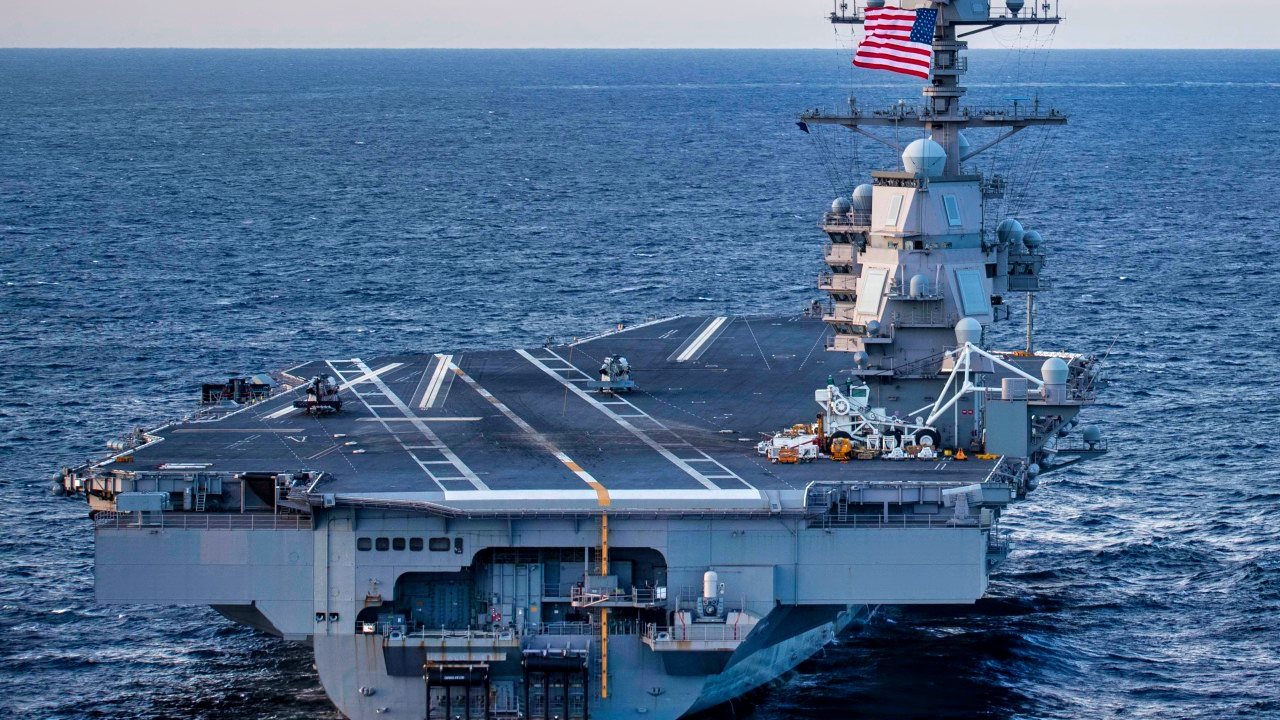
The Ford-class aircraft carrier USS Gerald R. Ford (CVN 78) and the Italian aircraft carrier ITS Cavour (CVH 550) transit the Atlantic Ocean March 20, 2021, marking the first time a Ford-class and Italian carrier have operated together underway. As part of the Italian Navy’s Ready for Operations (RFO) campaign for its flagship, Cavour is conducting sea trials in coordination with the F-35 Lightning II Joint Program Office’s Patuxent River Integrated Test Force to obtain official certification to safely operate the F-35B. Gerald R. Ford is conducting integrated carrier strike group operations during independent steaming event 17 as part of her post-delivery test and trials phase of operations. (U.S. Navy photo by Mass Communication Specialist 3rd Class Riley McDowell)
However, the concerns were recorded before this recent flare-up.
They were flagged in the Aug. 14 edition of the Secretary of Defense Orders Book, a classified document produced roughly twice a month that tracks the availability of U.S. ships, aircraft, personnel, and weapons worldwide.
Senior military leaders generally viewed the Iran operation as “too much for too long,” a person familiar with the assessment told the Post.
50K Troops on Alert
President Donald Trump has insisted that military action remains an option as Washington tries to force Tehran to reopen the Strait of Hormuz and accept U.S. terms for ending the conflict.
That has required U.S. Central Command to keep more than 50,000 troops on high alert in the region, according to the Post. Some forces are scheduled to remain through September, while others could stay into 2027.
The commanders responsible for U.S. operations in Europe, the Indo-Pacific, and Latin America, along with Chief of Naval Operations Adm.
Daryl Caudle, registered formal “non-concurs” with orders extending forces. A non-concur means the officer disagrees with the order but will still carry it out.
Army and Air Force leaders, by contrast, concurred with the extensions but warned that they carried significant risks.
One person familiar with the assessment described the overall situation as “more dire” than the routine discussions of risk involved in allocating military forces.
Just One-Quarter of Destroyers Ready
Caudle reportedly told Hegseth that barely one-quarter of the Navy’s destroyer fleet was ready to deploy, following months of providing ships for strikes, missile defense, and the blockade of Iranian ports.
Speaking recently about extended deployments, Caudle said: “I push back hard on that, but the enemy gets a vote.”
Adm. Samuel Paparo, who commands U.S. forces in the Indo-Pacific, also objected to the continuing requirement to provide an aircraft carrier strike group and destroyers for the Iran mission.
The Air Force is also facing major pressures.
Elements of the 82nd Airborne Division, which mobilized 2,000 soldiers in March, are now expected to remain deployed for a year.
Patriot air-defense units are also facing extended deployments, while numerous Air Force units are scheduled to remain in the region into 2027.
The Pentagon declined to discuss the classified deliberations, saying deployment decisions take into account of current threats, the president’s strategic priorities, and advice from senior military commanders.
U.S. Strikes Iran
On Sunday, U.S. forces struck two Iranian launchers on Larak Island in the Strait of Hormuz. U.S. Central Command said Islamic Revolutionary Guard Corps forces, designated as a Foreign Terrorist Organization by Washington, had been preparing rockets carrying sea mines.
They described the American response as a “limited, precise action” against forces posing an “imminent threat.”
Iranian officials said two people were killed and several others wounded. Tehran responded by firing ballistic missiles toward U.S. sites in Jordan. Jordan said it intercepted eight missiles that entered its airspace.
On Monday, the United Arab Emirates said it had intercepted an Iranian drone approaching over its territorial waters.
“This dangerous escalation constitutes a blatant violation of the UAE’s sovereignty, security, and stability,” the UAE Foreign Ministry said.
Iranian President Masoud Pezeshkian said Tehran was not seeking a wider war, but added that the regime “will respond decisively to aggressors.”
No Deal in Sight
Treasury Secretary Scott Bessent told Reuters that additional secondary sanctions are planned, initially focusing on banks connected to Iranian transactions.
Hegseth informed senators in July that the conflict had already cost $37.5 billion, including incurred and projected costs through September.
Prior to the war, about one-fifth of global oil passed through the Strait of Hormuz, with 100-plus ships passing through daily.
Over the weekend, Reuters reported that visible commodity-vessel transits plummeted to just five per day. These figures don’t account for ships traveling with their Automatic Identification System (AIS) transponders turned off.
Brent crude climbed above $90 as the latest fighting erupted, roughly 25% higher than at the start of the war.
About the Author: Georgia Gilholy
Georgia Gilholy is a journalist based in the United Kingdom who has been published in Newsweek, The Times of Israel, and the Spectator. Gilholy writes about international politics, culture, and education.


