

After several weeks of tension and uncertainty, with no actual military strikes, it appears the shooting has resumed in the war between the United States and Iran.
According to the New York Times, the U.S. said it attacked Iranian troops who were preparing to “launch rockets armed with mines.”

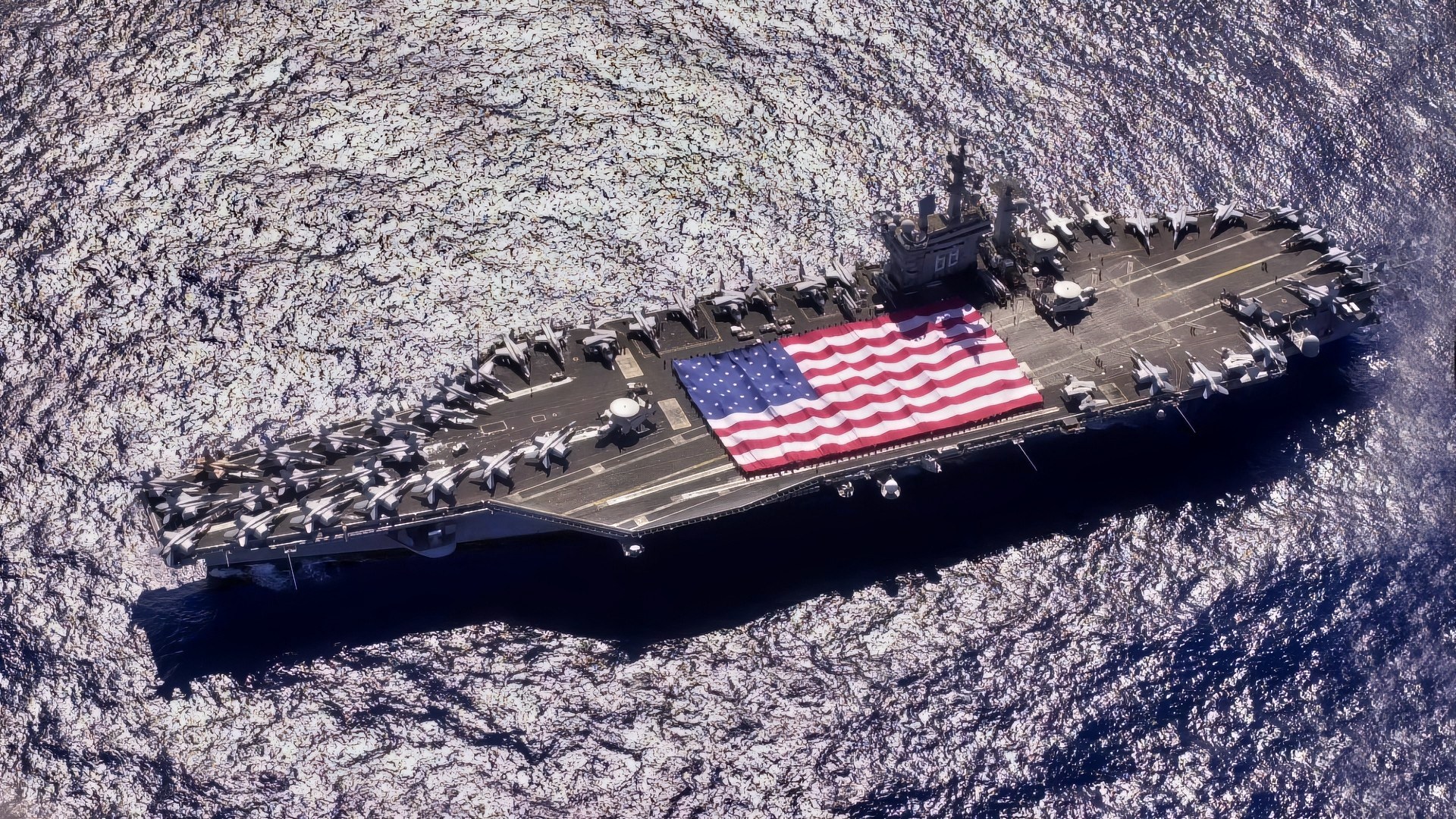
201117-N-NH257-1123 NORTH ARABIAN SEA (Nov. 17, 2020) The aircraft carrier USS Nimitz (CVN 68) steams ahead of the guided-missile cruiser USS Princeton (CG 59) while participating in Malabar 2020 in the North Arabian Sea. Malabar 2020 is the latest in a continuing series of exercises that has grown in scope and complexity over the years to address the variety of shared threats to maritime security in the Indo-Asia Pacific where the U.S. Navy has patrolled for more than 70 years promoting regional peace and security. Nimitz Carrier Strike Group is currently deployed to the 7th Fleet area of operations in support of a free and open Indo-Pacific. (U.S. Navy photo by Mass Communication Specialist 3rd Class Elliot Schaudt/Released)

(September 24, 2021). The navy’s only forward deployed aircraft carrier USS Ronald Reagan (CVN 76) transits the South China Sea. Reagan is attached to Commander, Task Force 70/Carrier Strike Group 5 conducting underway operations in support of a free and open Indo-Pacific. (U.S. Navy Photo by Mass Communication Specialist 1st Class Rawad Madanat)
A social media post by CENTCOM stated that the U.S. took “ limited, precise action against IRGC minelaying forces posing an imminent threat in the Strait of Hormuz.” This was meant to rebut claims by the Islamic Revolutionary Guard Corps (IRGC) that the U.S. had taken an “act of aggression.”
Iran’s foreign ministry, per the Times, has stated that “several people” were killed and wounded.
Iran has also stated that it fired at bases in Jordan and the United Arab Emirates where U.S. troops are hosted, something Iran did frequently during earlier phases of the conflict.
Per Axios, the IRGC-affiliated Tasnim News Agency is now claiming that two people were killed and two more were wounded.
Jordanian officials, the Times said, said they intercepted eight missiles that had entered their airspace. Iran had also claimed that it attacked the Al Minhad air base in the United Arab Emirates, although the UAE’s defense ministry, per Reuters, has denied that claim.
CENTCOM also stated that while the IRGC claims that a supertanker passing through the Southern part of the Strait of Hormuz — the part closer to Oman — that the U.S. has been bringing shipping traffic through in recent weeks — was struck, they deny that.
“No ships have hit mines in the Strait of Hormuz,” CENTCOM said in a social media post. “This is yet another IRGC attempt to intimidate regional commercial shipping through disinformation.”
The U.S. claimed, as recently as last week, that it had finished clearing mines from the Strait of Hormuz.
The View From Tehran
After that exchange of fire, the first in six weeks, Iran’s president said on Monday that Iran still wants to see a negotiated end to the conflict.
President Masoud Pezeshkian made the comments Monday during a meeting with India’s Prime Minister Narendra Modi, held on the sidelines of a regional security meeting in Kyrgyzstan.
“Nevertheless, we are still trying to achieve an agreement and understanding, and we believe that continuing the war is in no one’s interest, neither ours, nor the region’s, nor humanity’s,” Pezeshkian said Monday, per Reuters, which cited Iran’s Tasnim news agency.
“We believe the solution to the existing issues is dialogue and cooperation and that every capacity must be used to prevent the spread of insecurity and conflict.”
More Than Sanctions
In the last two weeks, the Trump Administration appeared to shift strategy, placing less emphasis on threats of military attacks and more on economic pressure.
Last week, Treasury Secretary Scott Bessent announced the launch of what was described as “Operation Economic Outcast,” an “Economic D-Day” aimed at isolating Iran from potential trading partners and punishing countries that continue to do business with Iran.
Bessent, in a speech last week, described the plans as “an economic onslaught against Iran’s financial connections around the globe.
Our objective is to sever every economic lifeline that sustains this tyrannical regime until Tehran stands alone.”
While not specifying which countries the sanctions targeted or naming China or Russia, Bessent said the new pressure would focus on “digital assets, technology, gold, aviation, and shipping.” Now that the military phase of the war appears to have restarted, it’s unclear what the status of the new sanctions regime is, although the Trump Administration has threatened further waves of sanctions.
“I would think that they are lashing out kinetically because they are losing economically,” Bessent said Monday at the G20 meeting, per Fox News.
Now What?
It’s unclear whether Monday’s strikes will lead to further escalation, or whether the two sides will pull back.
President Trump made a post to Truth Social that showed a strike on the Iranian energy hub Kharg Island, which Trump has threatened to bomb at various times throughout the conflict.
“We’re going to hit them hard,” President Trump told Fox News in an interview early Monday. “There will be a response.”
About the Author: Stephen Silver
Stephen Silver is an award-winning journalist, essayist, and film critic, and contributor to the Philadelphia Inquirer, the Jewish Telegraphic Agency, Broad Street Review, and Splice Today. The co-founder of the Philadelphia Film Critics Circle, Stephen lives in suburban Philadelphia with his wife and two sons. For over a decade, Stephen has authored thousands of articles that focus on politics, national security, technology, and the economy. Follow him on X (formerly Twitter) at @StephenSilver, and subscribe to his Substack newsletter.


