

Pentagon Pushes Back After Military Chiefs Object to Continued Troop Deployment – The Pentagon is dismissing claims that Secretary of Defense Pete Hegseth regularly ignores formal objections from senior commanders.
The Washington Post published a story on Sunday, 30th August, on Hegseth’s decision to keep more than 50,000 troops stationed in the Middle East. It’s based on an assessment released in the Thursday, 14th August edition of the Secretary of Defense Orders Book (SDOB) – a bi-monthly report on the availability of U.S. military assets across the world.
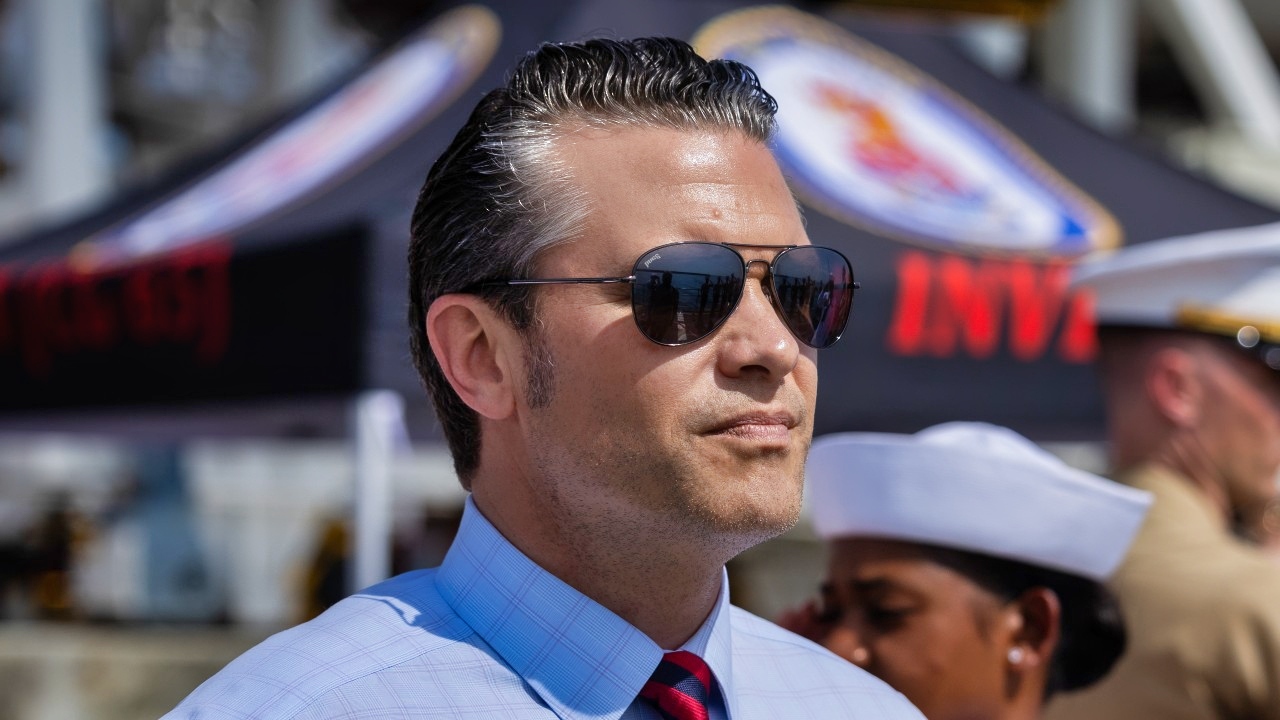
U.S. Secretary of Defense Pete Hegseth boards the Ticonderoga-class guided-missile cruiser, USS Chosin (CG 65), Panama, April 9, 2025. U.S. Southern Command and the Panamanian security forces collaborate to ensure and maintain regional stability during natural disasters, medical catastrophes or regional conflicts. (U.S. Marine Corps photo by Lance Cpl. Van Hoang)

Secretary of Defense Pete Hegseth delivers remarks during a reenlistment ceremony for Medal of Honor recipient U.S. Marine Corps Sgt. Dakota Meyer in the Hall of Heroes at the Pentagon, Washington, D.C., April 17, 2025. (DoD photo by U.S. Navy Petty Officer 1st Class Alexander Kubitza)
Four four-star generals reportedly disagreed with an order to keep troops deployed in the Middle East through September and into 2027.
Non-Concurring Decisions
The four generals – believed to be the leaders of the U.S. European Command, the U.S. Pacific Command, and the U.S. Southern Command, along with the U.S. Navy’s highest-ranking admiral – issued a “non-concur” against Hegseth’s decision to keep tens of thousands of troops in the Middle East.
This is a formal declaration that they disagree with the Defense Secretary’s decision, but will carry out the orders regardless.
As a result, 50,000 troops will remain in the Middle East through September, with some deployments potentially continuing into next year.
It was not opposition to the conflict itself that caused the objections, but rather the knock-on effects on readiness across other parts of the world. The trajectory of the ongoing war, which is now in its seventh month, remains unclear, and a permanent peace agreement is unlikely given the polarization over key issues between Washington and Tehran.
Navy Under Pressure
The U.S. Navy, which has spent much of the past six months deterring Iran in the Strait of Hormuz, is reportedly under considerable strain. First used in the initial assault and later required to enforce the blockade of Iranian ports, the Navy has been kept the busiest of America’s armed forces during the conflict. Deployments for some personnel have been extended by months.
Admiral Daryl Caudle, the head of Naval Operations, reportedly told Hegseth that the Navy would be unable to continue its current level of support for an operation with no clear end date. Pre-war availability levels have fallen markedly, the Washington Post reported, with long-term deployments impacting vessel maintenance and future availability in the event of further conflict elsewhere.
Caudle has not publicly commented on the SDOB findings, but has previously urged against deployment extensions which he described as “very challenging” for Navy personnel.
Other generals also warned against Hegseth’s decision. Admiral Samuel Paparo, head of the U.S. Indo-Pacific Command, objected to a continued requirement for aircraft carrier strike groups and destroyers that would otherwise be needed elsewhere. Similarly, the Eastern and Southern Command chiefs said that transferring ships and intelligence aircraft to the U.S. Central Command was hampering homeland security obligations.
The heads of the Army and Air Force are believed to have concurred with the decision, while warning of long-term risks.
Pentagon Pushback
Assistant to the Secretary of Defense for Public Affairs, Sean Parnell, hit back at the report on social media shortly after its initial publication.
“Publishing highly classified assessments from the Secretary’s orders book is a crime,” he wrote on Sunday. “It’s a betrayal of the force. And much of what they’re publishing is inaccurate.”
Of course, we demand candid military advice,” he continued. “Non-concurs are standard. The Secretary sees them constantly. That’s how you run a real military.”
Parnell said the U.S. is in “great shape around the world”, adding that the story was not about readiness but a disdain for President Donald Trump and Secretary Hegseth.
SDOB Disagreement
Former U.S. Ambassador to Israel, Dan Shapiro, offered a differing view in response to Parnell’s post. While acknowledging that non-concurs are “not uncommon”, Shapiro said that most are in relation to reallocations of specific systems or units from one theater to another in an internal battle for resources.
“This consensus among the top military bass should be a flashing red light that we are overstretched and can only continue the strategic blunder of this Iran war at great cost and risk – to other real time security imperatives in Europe, the Indo-Pacific, and the Western Hemisphere, and to our long-term readiness,” Shapiro wrote on social media.
A Community Note on Parnell’s post also referred to a Supreme Court ruling that protects the press’ right to publish classified information of public interest.
About the Author: Shay Bottomley
Shay Bottomley is a British journalist. He has written for the Western Standard, Business Insider, Maidenhead Advertiser, Slough Express, Windsor Express, Berkshire Live and Southend Echo.