

Ukraine struck Russia’s largest Baltic Sea port early Tuesday during an overnight drone assault that Moscow claimed involved more than 500 aircraft.
The attack damaged the port of Ust-Luga in Russia’s Leningrad region and started a fire, according to regional authorities.

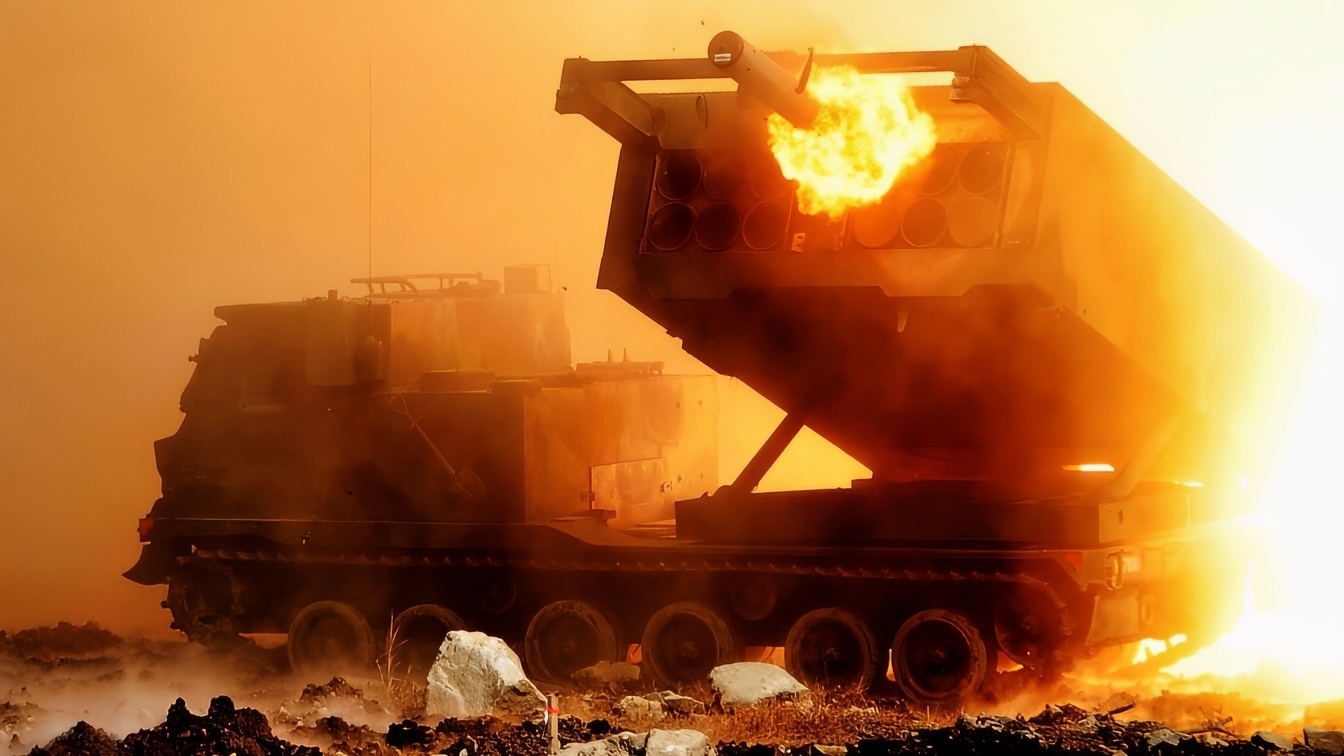
HIMARS Rocket. Image Credit: Creative Commons.

Tennessee Army National Guard Soldiers with Alpha Battery, 1-181st Field Artillery Regiment conduct a training exercise using the M142 High Mobility Artillery Rocket System (HIMARS) at Camp Shelby, Mississippi, June 9. The unit’s annual training enhances battalion readiness, focuses on mission-essential tasks and ensures Soldiers are proficient in critical skills. (U.S. Army National Guard photo by Sgt. Grayson Cavaliere)
On the other side of the border, Russia continued its own aerial campaign against Ukraine for a sixth consecutive day, killing 12 people in Kyiv and the surrounding region, Reuters reported.
Ukraine Ramps Up Long-Range Drone Attacks
Ukraine is sending increasingly large numbers of long-range drones against Russian oil, logistics, and military infrastructure, while Moscow is introducing faster jet-powered drones designed to exploit Ukraine’s dwindling air defenses.
Leningrad region Governor Alexander Drozdenko said Russian air defenses shot down 52 drones over the region during four hours of attacks.
“Damage has been recorded in the Ust-Luga port area, and there is a fire,” Drozdenko said, according to the Kyiv Post.
He later said the fire had been extinguished and no casualties had been reported.
Largest Baltic Port Ablaze
Ust-Luga is Russia’s largest Baltic port and its second-largest port overall.
The facility handles crude oil, naphtha, fuel oil, jet fuel, and gas oil.
Oil exports through Ust-Luga averaged about 700,000 barrels per day in 2025. 32.8 million metric tons of petroleum products were exported through the port last year, according to figures cited by Reuters.
The port was also hit on Aug. 14.
Russian authorities separately reported damage in the Samara region, which contains several major oil refineries.
Russia’s Defense Ministry claimed its forces destroyed 516 Ukrainian drones over 18 Russian regions, including occupied Crimea, the Moscow region, and the Black Sea overnight.
Ukraine had not confirmed responsibility for the full barrage as of Tuesday afternoon.
Drones from the attack also crossed into NATO-member Estonia.
Estonian officials said drones associated with the Ukrainian attack briefly crossed into Estonia, prompting Turkish F-16s serving with NATO’s Baltic Air Policing mission to scramble from Ämari Air Base. Estonia also activated ground air-defense units.
“NATO reacted swiftly and exactly as planned,” Estonian Foreign Minister Margus Tsahkna said.
Tsahkna blamed the danger on the wider conflict, calling such incidents “a direct consequence of Russia’s war of aggression against Ukraine.”
Russia, meanwhile, is deploying growing numbers of jet-powered drones against Ukraine.
Russian attacks killed eight people in Kyiv and another four in nearby Boryspil early Tuesday, according to Ukrainian authorities.
Six railway employees were among those killed in Kyiv. Russia said it had attacked Ukrainian military and energy infrastructure.
5 Days of Drone Barrages in Kyiv
The assault followed five straight days of drone attacks on the Ukrainian capital.
President Volodymyr Zelensky said Sunday that Russia had launched nearly 1,500 drones in just four days, including about 800 jet-powered aircraft.
“Russia’s tactic is to wear down Ukraine and Ukrainians – first and foremost, our people,” Zelensky said.
They are substantially faster than the piston-powered Shahed drones that Russia has used throughout the war, reducing the effectiveness of some of the cheaper interceptor drones Ukraine developed to destroy them.
“The most difficult task is intercepting the jet-powered ones,” Zelensky said. He also said Ukraine was relying heavily on combat aircraft against them.
Ukraine’s General Staff said Tuesday that its forces had struck drone storage, preparation, and launch facilities in occupied Donetsk and Hvardiiske in Crimea.
It also reported attacks on a Russian communications hub in Crimea, a command post in occupied Zaporizhzhia, military equipment in Luhansk, and a fuel depot in Russia’s Belgorod region.
The extent of the damage has not been independently confirmed.
“Operations against key enemy military targets are ongoing,” the General Staff said.
Russia’s Fuel Rationing
Renewed gasoline shortages have been reported in Moscow and other parts of Russia in recent weeks, with some stations limiting purchases or running out of certain grades altogether.
“We have been to five petrol stations already, and there was no fuel,” one Moscow resident told Reuters last week.
The Kremlin has responded by restricting fuel exports, loosening some fuel-quality rules and importing petroleum products.
Russia is also preparing to extend its diesel export ban through September, Reuters reported. One industry source said keeping restrictions in place until the end of 2026 had also been discussed.
In August, President Vladimir Putin said Ukraine’s strikes had opened a “Pandora’s box” of Russian retaliation.
About the Author: Georgia Gilholy
Georgia Gilholy is a journalist based in the United Kingdom who has been published in Newsweek, The Times of Israel, and the Spectator. Gilholy writes about international politics, culture, and education.


