


According to an October 12 NBC News report, President Donald Trump is scrambling to sustain the Republican Party’s ailing poll numbers going into the 2026 Midterm Elections.
Despite his public claims to the contrary, Trump clearly fears the outcome of the impending Midterms.

President Donald Trump participates in the swearing-in ceremony for Administrator of the Centers for Medicare and Medicaid Services Mehmet Oz, Friday, April 18, 2025, in the Oval Office. (Official White House Photo by Molly Riley)
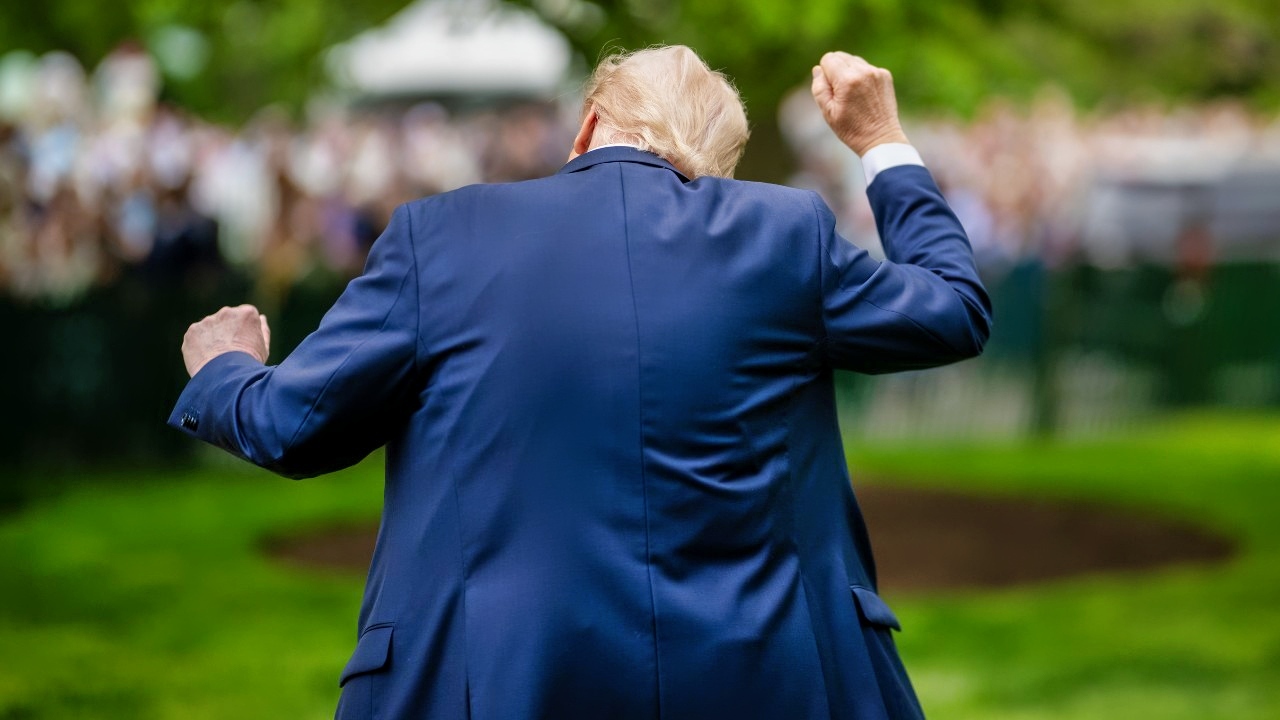
President Donald Trump departs the White House Easter Egg Roll on the South Lawn, Monday, April 21, 2025. (Official White House Photo by Daniel Torok)
If the GOP loses the Midterms, it will seriously impede the Trump administration’s future policies.
In fact, if the Democrats win sizable majorities in the House of Representatives and a Senate majority, the Trump team could soon face significant legal jeopardy.
Midterm Madness and Empty Rallies
As Trump works the campaign stops harder, he might be surprised by how small the crowds are. Whereas he once commanded legions of loyal voters at the height of his power, crowd sizes are shrinking.
NBC reports that in August 2015, around 30,000 people attended Trump’s appearance at Ladd-Pebbles Stadium in Mobile, Ala.
In October of this year, only about 8,000 attended a presidential event at the University of South Alabama’s Mitchell Center.
That wasn’t a one-off.
Trump appeared in Vandalia, Ohio, in both 2016 and October of this year.
This year, his appearance drew around 4,000 onlookers. In 2016, Trump enjoyed a crowd size of 10,000.
His approval ratings are declining, too.
A Pew Research Center survey found that Trump’s approval rating hovered around 30 percent, while a staggering 68 percent of voters disapproved.
Support has also declined sharply among voters who supported Trump in 2024 but no longer do.
Meanwhile, Republican voters are more dissatisfied with whether the president is working for them.
Around 25 percent of registered voters approved of Trump’s handling of jobs and the economy and only 20 percent approved of his handling of inflation.
A staggering two-thirds believed the economy was headed in the wrong direction.
Weakening Support
Republican candidates are also increasingly distant from the president, as they fret over Trump’s disastrous approval rating, and worry that he will be less helpful to them on the campaign trail.
Many Republican voters still support Trump.
Even among Republicans increasingly skeptical of him, many still intend to vote for their preferred congressional or Senate candidate.
But these voters’ motivation is very much in question.
After all, a Pew poll conducted from September 28 to October 4 determined that Democratic voters were 17 percentage points more likely than Republican supporters to describe themselves as extremely motivated to vote.
The question, of course, is whether turning out an increasingly dissatisfied base will be sufficient to overcome the sizable advantages that the Democratic Party enjoys heading into the midterms.
Independent voters favor Democrats by at least 16 points.
Moreover, registered Democrats outnumber registered Republicans this election cycle.
Democrats are far more energized than are Republicans this election cycle.
A staggering 63 percent of registered voters cite Trump as the main reason they’re voting in the Midterms.
Forty-four percent believe their vote is a chance to oppose the president, while only 19 percent see it as an expression of support.
Trump Plays to His Crowd–Will It Work?
What’s interesting is where the president is campaigning.
He’s flying to Republican strongholds such as Alabama, Oklahoma, Ohio, Nebraska, and Texas.
Trump is banking on his supporters coming out for him, despite whatever reservations they may have.
However, the president is not guaranteed to keep the GOP in power this November.
The bottom line is that Trump is losing his coalition, and the GOP faces weakening support for one reason only: the Iran War.
Had the president not initiated this most unpopular war on February 28, the economic fallout would never have happened.
But the president decided to attack Iran in February and, as it turns out, the Iranians could fight back — meaning the global economy was collateral damage of the war.
So long as Trump continues his war of choice, the GOP’s future will be bleak.
About the Author: Brandon J. Weichert
Brandon J. Weichert is the Senior National Security Editor. He also manages The Weichert Brief on Substack. Weichert also hosts “National Security Talk” on Rumble. He is the author of four bestselling national security books, most recently A Disaster of Our Own Making: How the West Lost Ukraine (Encounter Books). Follow him via Twitter/X @WeTheBrandon.


