

Iran is ramping up its attacks on commercial shipping through the Strait of Hormuz, as Tehran attempts to regain control over oil exports from the Persian Gulf.
The escalation comes as the world sees heavier traffic through the Strait, even though refinery capacity has been substantially reduced.
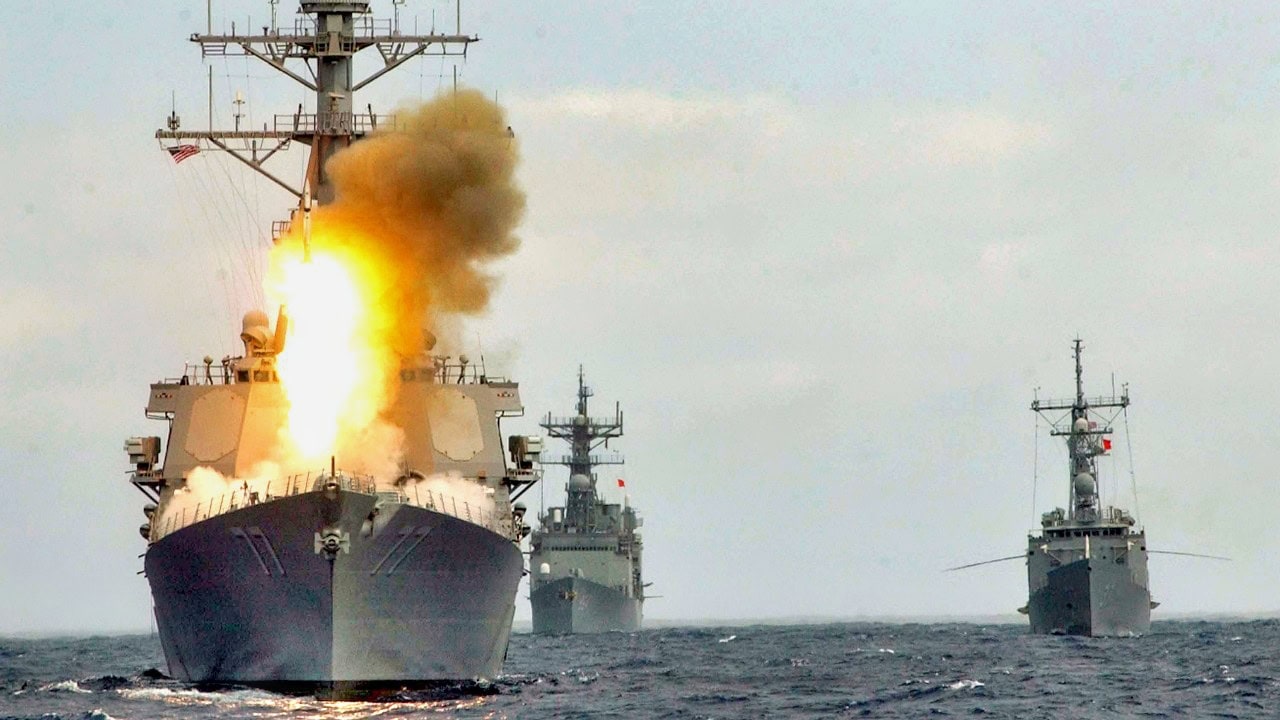
Spruance-Class Destroyer. Image Credit: U.S. Navy.
Tehran is still striking commercial ships, but it no longer has the leverage it once did over the Strait of Hormuz, a critical supply route for oil bound for the international market
On Sunday, October 11, two Indian sailors were reported missing after a drone struck an oil tanker. Another commercial vessel was also damaged in a separate attack.
Meanwhile, maritime security agencies are reporting increasingly frequent strikes against ships, and the latest shipping data suggests that oil exports through the strait are again dipping as Iran steps up its campaign following weeks of oil traffic approaching or even surpassing pre-war levels.
Two Indian Sailors Missing After Attack
According to reports in Indian media, two commercial tankers carrying Indian sailors were struck over the weekend.
The MT Petro Dolphin was struck by a drone, leaving two of its 11 Indian crew members missing. Another vessel, the Marshall Islands-flagged MT Valthera, was hit by an unidentified projectile, causing a fire.

(Left to right) Australian ANZAC Class frigate HMAS Stuart (FFH 153) and USS Jack H. Lucas (DDG 125) wait off the coast of the Pacific Missile Range Facility in Kauai, Hawaii, as they prepare for Flight Test Aegis Weapon System-32 (FTM-32), held March 28, 2024.
All 11 Indian crew members aboard that tanker were reported safe. Indian Shipping Minister Sarbananda Sonowal confirmed a search-and-rescue effort.
Another incident occurred on Saturday, October 10, off the coast of the United Arab Emirates, when an oil tanker caught fire near Ras Al Khaimah.
The UAE National Guard rescued all 22 sailors from the vessel.
Iran Expands Attacks Beyond Hormuz
The United Kingdom Maritime Trade Operations agency reported an additional attack on Sunday, October 11, that involved a tanker departing through the strait. An unidentified projectile struck the vessel’s port side.
It caused damage, but the crew escaped injury.
UKMTO also investigated an incident near the Sohar anchorage in Oman, later reclassifying it as an attack after confirming that a vessel had been struck.
The threats appear to be broadening and are no longer limited to just ships passing directly through the Strait of Hormuz. On October 7, for example, UKMTO reported that a tanker was struck by multiple projectiles about 51 nautical miles north of Madinat ash Shamal, Qatar.
This incident reportedly caused casualties.
A Reuters account published on October 8 also said Iran threatened to block other shipping routes in the general region it had not authorized.
Tehran is trying to impose even greater control over maritime traffic throughout the region, rather than simply disrupt shipments at the strait’s entrance.
Oil Shipments Fall Again
For weeks, Washington has touted the rising number of tankers moving through the Strait of Hormuz and how, on some days in September and early October, the volume of oil moving through the waterway actually exceeded pre-war daily averages.
But as Gulf oil producers became more confident, Iranian forces have intensified their efforts, and oil shipments have reportedly begun to fall again.
Oil shipments through Hormuz recovered to around 14.2 million barrels per day by early October, or around 80% of the pre-war levels.
Those numbers, however, remain significant, made possible by an elaborate system of tanker transfers, alternative export routes, and shipping arrangements designed to minimize exposure to Iranian attack.
According to a report by The Financial Times on October 8, oil flows had fallen to approximately 11 million barrels per day, with the preliminary figures for October 6 indicating that only four million barrels moved through the waterway that day.
U.S. Maintains Blockade
Meanwhile, American forces are taking steps to ensure that ships understand the U.S. naval blockade against Iranian ports remains in effect.
On Saturday, October 10, U.S. Central Command confirmed that an American fighter jet had disabled the Panama-flagged M/V Ocean Molica, also known as the Arika Sun, while in the Gulf of Oman.
CENTCOM said in a statement that the vessel had ignored repeated warnings after leaving an Iranian port, and a precision strike subsequently disabled its propulsion system.
No crew injuries were reported.
The U.S. military also said that American forces had turned back 135 commercial ships and disabled four vessels since enforcement of the blockade resumed on July 14. 10 tankers associated with the Islamic Revolutionary Guard Corps’ shadow fleet were also destroyed.
The operation came only two days after U.S. President Donald Trump ruled out any new strikes against Iranian infrastructure before the November 3 election.
About the Author: Jack Buckby
Jack Buckby is a British researcher and analyst specializing in defense and national security, based in New York. His work focuses on military capability, procurement, and strategic competition, and he produces and edits analysis for policy and defense audiences. He brings extensive editorial experience, with a career output spanning over 1,000 articles at National Security Journal, and has previously authored books and papers on extremism and deradicalization.


