


President Donald Trump has claimed he can end a war with Iran “when I want” as new figures show Pentagon costs have topped $47 billion.
Speaking during a campaign rally in Lubbock, Texas, on Tuesday, Trump said he could quickly end the war if Tehran promised never to develop nuclear weapons.

B-1B Lancer Bomber U.S. Air Force Display. Image Credit: National Security Journal.
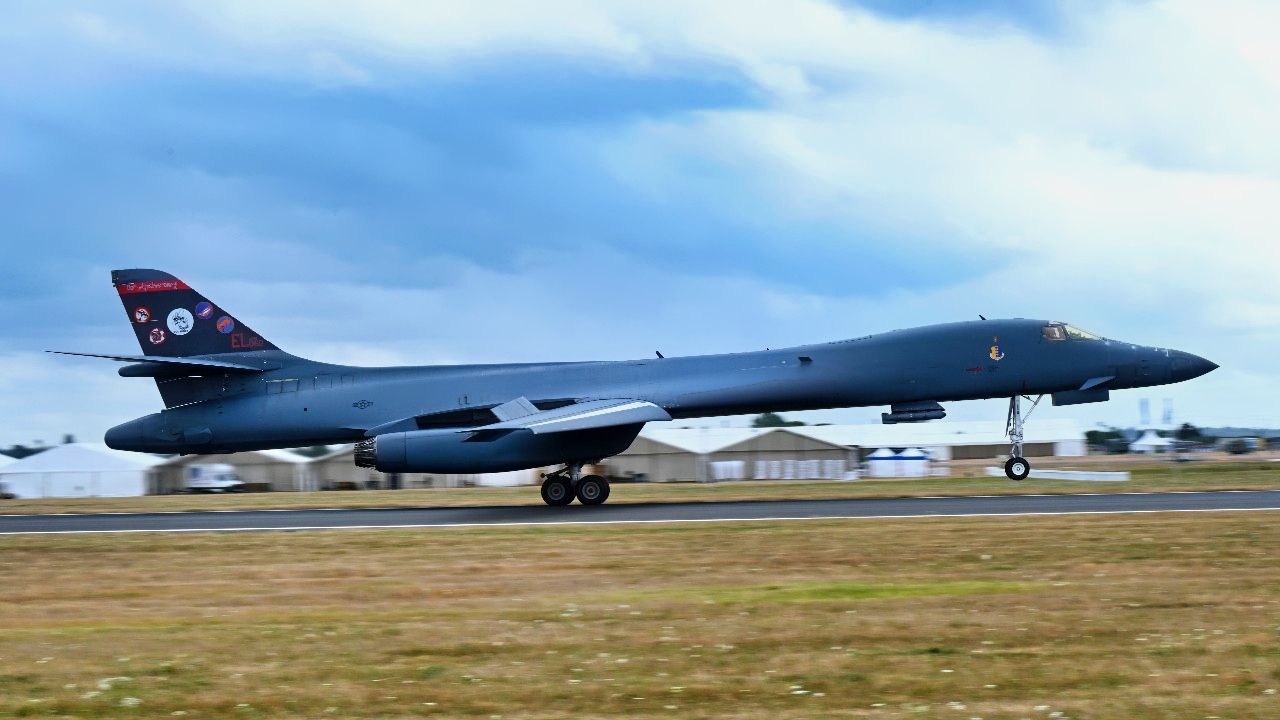
B-1B Lancer Bomber. Image Credit: Creative Commons.
The comments come less than a week before the November 3 midterm elections, as rising fuel prices and military costs are increasingly concerning voters.
Trump Claims War Can Be Ended Quickly
“Somebody asked me before,’ When will the war in Iran end?’ I said, ‘Whenever I want it to end,’ Trump said at his October 27 rally.
“It’ll be very quick, but we have to have it end properly.”
He also admitted that Americans were paying more for fuel, but said the country was gaining financially.
“Our country is making a fortune while people have to pay more at the pump,” he said to the crowd in Texas.
In a separate interview with Fox News on Sunday, Trump said he could consider attacking Tehran again.
“Do I make a deal with them or do I finish them off?” he asked his host Larry Kudlow.
No plans have currently been announced.
Pentagon Costs Top $47 Billion
New Pentagon figures Reuters obtained show the U.S. military cost has now surpassed $47 billion. U.S. Central Command has calculated the war has cost around $47.1 billion, according to CBS News.
This figure includes roughly $29 billion to replace expended munitions, $6.1 billion to replace lost equipment, and $11.9 billion for additional military activity.
The figures do not include any damage to bases in the Middle East.
Defense Secretary Pete Hegseth also said recently that, by the end of July, the cost of the conflict had reached $37.5 billion.
The Pentagon’s inspector general has also warned of “strategic inventory shortfalls.”
Trump said in September that the U.S. has “virtually unlimited amounts of Mid to High Grade Ammunition, far more than we could ever use.”
The Congressional Budget Office estimates ongoing monthly costs could range from $2 to $3 billion.
Is the War Costing American Households?
Mark Zandi, chief economist at Moody’s Analytics, calculated that the average American household has been negatively impacted by around $2,000.
He attributed about $1,100 of that to higher energy costs, $540 to increased borrowing costs, and $360 to military costs.
“The war’s inflation contributed to the Fed’s decision last month to raise rates and signal that more rate increases are coming,” Zandi wrote, adding, “No wonder the war is so unpopular.”
An Associated Press report showed prices of regular gasoline were up about 45% earlier this month.
“We expect fuel to drive elevated transportation costs for the foreseeable future,” said Andy Dyer, CEO of AFS Logistics.
Brent crude futures also reached $115.47 per barrel on Wednesday as fears of attacks on Saudi Arabian energy facilities rose.
A Reuters/Ipsos poll from October 26 showed Trump with an approval rating of just 32%, while 73% thought the cost of living was going the wrong way.
Diplomacy Continues to Stall
High-level officials from Saudi Arabia, Turkey and Pakistan met with Iranian leaders in Tehran on Monday to discuss options to de-escalate the conflict.
Iranian President Masoud Pezeshkian said Tehran was ready to work toward greater regional cooperation.
Qatari Foreign Ministry official Ibrahim bin Sultan Al Hashmi also said on Tuesday that Iranian mediators had seen positive signs. However, he noted that “they still need to show good faith”.
According to The Guardian, regional governments are working on an agreement that would see Iran open the Strait of Hormuz within four days of sanctions being lifted.
Iranian Foreign Minister Abbas Araghchi said he is “thinking about the postwar period.”
Still, Washington wants to push Tehran to make concrete concessions.
Earlier this month, Vice President JD Vance told Reuters that Iran needs to make a “meaningful” reduction in uranium enrichment if it wants a deal.
“If you don’t want a nuclear weapon, then why do you need 60% enriched fuel?” he mused.
The cost of the war for the U.S. military will now likely far exceed the current $47 billion figure, with no end to the war in sight and the U.S. military actively preparing for a new confrontation in the region.
CNN reported that U.S. forces are prepared to resume significant operations against Iran within 96 hours, should Trump give them the go-ahead.
“Do I make a deal or do I finish them off?” Trump told Fox News over the weekend.
About the Author: Georgia Gilholy
Georgia Gilholy is a journalist based in the United Kingdom who has been published in Newsweek, The Times of Israel, and the Spectator. Gilholy writes about international politics, culture, and education.


