

Ukraine this week launched a major drone attack on Russia, which hit both the Novolipetsk Steel Plant and the Azot chemical plant, Kyiv Post reported.
Novolipetsk Steel Plant is Russia’s largest steel plant and one of the world’s largest, while the Azot plant is described as a “major” chemical factory and one of Russia’s largest producers of nitrogen fertilizers. The same facility had been targeted with an attack back in July.
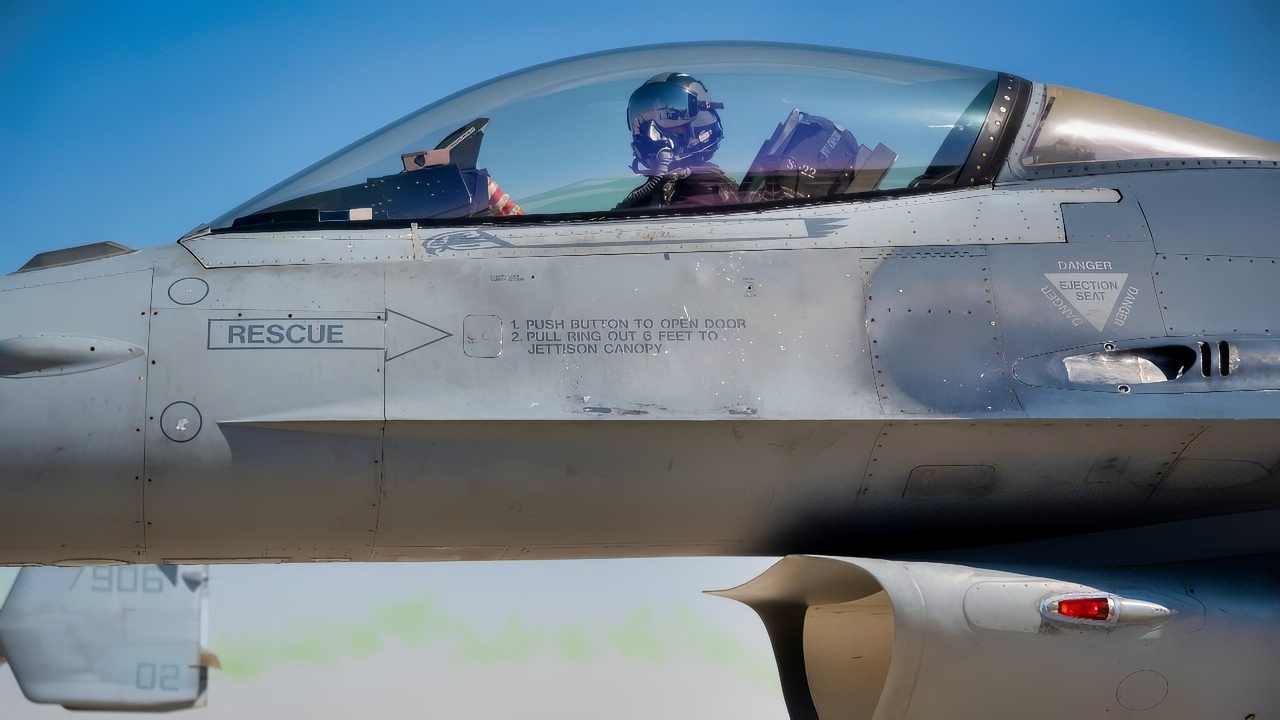
U.S. Air Force Maj. Josiah “Sirius” Gaffney, Pacific Air Forces Demonstration Team commander, prepares to fly a practice sortie before the Dubai Airshow in Dubai, United Arab Emirates, Nov. 11, 2021. In addition to the PACAF F-16 Demonstration Team routine, the air show will highlight a variety of U.S. Air Force, Navy and Marine Corps aircraft showcasing the range of U.S. military airpower capabilities. (U.S. Air Force photo by Staff Sgt. Matthew Kakaris)

Bohdan, a drone pilot from the Unmanned Systems Battalion of Ukraine’s 110th Separate Mechanized Brigade, pilots an FPV drone in Donetsk Oblast during active battle operations. Photo: David Kirichenko
Russia’s Defense Ministry claimed, overnight, that it had intercepted 531 Ukrainian drones. Igor Artamonov, the governor of the Lipetsk Oblast, claimed on Telegram that 45 drones had been shot down overnight. He also claimed that drone debris had “shattered windows in an apartment building in Lipetsk.”
Russia claimed it intercepted drones in numerous regions, including the “Belgorod, Bryansk, Voronezh, Kaluga, Kursk, Lipetsk, Oryol, Rostov, Ryazan, Smolensk, Tambov, and Tula Oblasts, as well as Moscow Oblast.”
Ukrainian monitoring channel Exilenova+ posted a video of the aftermath of the attacks.
Ukraine’s Drone Success
This week, United 24 Media, citing figures from Ukraine’s Ministry of Defense, reported that Ukrainian drones have “killed or wounded more than 302,000 Russian soldiers” since the start of this year. That adds up to more than 1,000 casualties a day on the Russian side since the war began. And in several individual months, the drone-inflicted casualty counts have exceeded 30,000, including 32,739 in September.
Ukraine can track those numbers through its DELTA battlefield management system, with the related Brave1 defense innovation cluster verifying them.
The same report cited a recent Institute for the Study of War (ISW) report saying Russia gained a net 144.5 square kilometers in the first nine months of the year, “roughly 45 times” less than Russian President Vladimir Putin has claimed.
A separate report this week from Business Insider said that a major drone maker was surprised by Ukrainian soldiers when they packed a drone with a large amount of explosives.
“One of the most surprising videos I’ve seen recently is that one of the units has managed to put the huge explosive part on our drone,” a man who works at manufacturer TechEx told Business Insider.
The drone carried “something like five or seven kilos” of explosives and flew.
One Place They Can’t Attack
Radio Free Europe/Radio Liberty reported Tuesday that Ukraine has had difficulty attacking one particular site with its drones: Russia’s main drone base in a military airfield in Crimea, photographs of which RFE obtained and published.
Hvardiyske airfield is a Soviet-era airbase, located on the peninsula that Russia has been occupying since 2014, has been a base for launching drone strikes since March 2025, and is now used as a base for daily strikes. It was a Ukrainian base before Russia invaded and occupied Crimea.
The facility has been built up over time, to the point where, the report said, it has “raised questions over why Kyiv has not been able to disable the site with its own attack drones and missiles.”
Ukraine regularly attacks other sites in Crimea, including places with drones. It has even hit Hvardiyske airfield, though it has done only minimal damage.
A former Ukrainian military official based in Crimea explained why he thinks Ukraine has struggled to attack the site.
“The main reason is that drone operations there are spread across different parts of the airfield,” the official, speaking on the condition of anonymity, told Radio Free Europe. “The launch site is in one location, the maintenance area in another, and the storage facilities are in a third.”
That infrastructure, the official added, can be easily repaired if need be. He also said that the Soviets had built an underground storage facility there, which Russia may now be using to store its attack drones — in a place that Ukraine cannot penetrate.
“The Shaheds may well be hiding there,” the official told Radio Free Europe.
Another reason it’s hard to attack is that the facility is central in Crimea and therefore can’t easily be approached by flying over the sea.
About the Author: Stephen Silver
Stephen Silver is an award-winning journalist, essayist, and film critic, and contributor to the Philadelphia Inquirer, the Jewish Telegraphic Agency, Broad Street Review, and Splice Today. The co-founder of the Philadelphia Film Critics Circle, Stephen lives in suburban Philadelphia with his wife and two sons. For over a decade, Stephen has written thousands of articles on politics, national security, technology, and the economy. Follow him on X (formerly Twitter) at @StephenSilver, and subscribe to his Substack newsletter.


