
President Donald Trump said he is “highly unlikely” to start a renewed military campaign against Iran should negotiations progress toward a “very strong agreement.”
Trump made the comments in an interview with CNN released Sunday, November 8, in which he said he would not issue an order to resume military action if discussions over Tehran’s nuclear program and the reopening of the Strait of Hormuz continued.

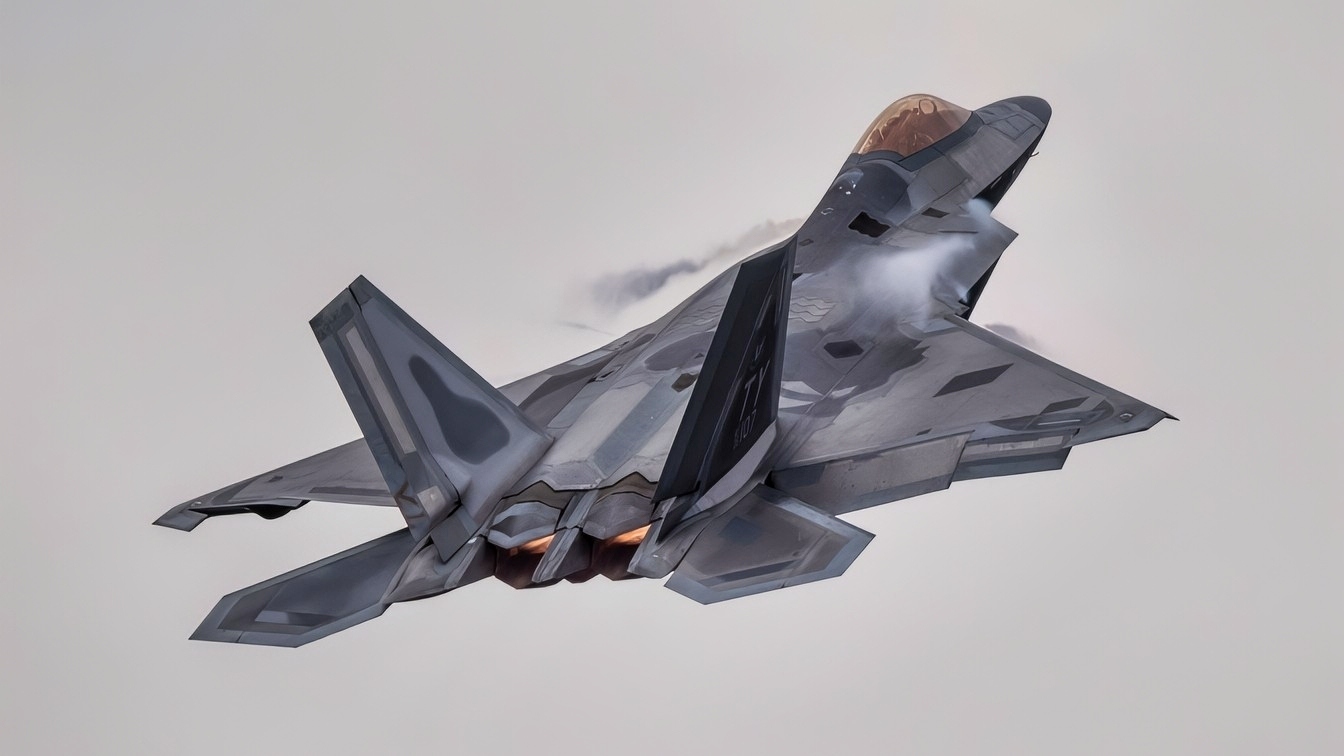
An Air Force F-22 Raptor executes a supersonic fly by over the flight deck of the aircraft carrier USS John C. Stennis. John C. Stennis is participating in Northern Edge 2009, a joint exercise focusing on detecting and tracking units at sea, in the air and on land.

The F-35 performs a demonstration at the Mather Airshow in Sacramento, California, Sept. 23, 2018. (U.S. Air Force photo by Senior Airman Lauren Parsons/Released)
It follows repeated threats to reignite the conflict during a midterm election campaign that saw the Republican Party lose control of both chambers of Congress.
Highly Unlikely That Strikes Resume
Speaking to CNN’s Jim Sciutto, Trump pointed toward American successes during the conflict so far and the impact on Iran.
“It depends on whether or not they sign a very strong agreement,” Trump said. “The answer is highly unlikely it’s going to be necessary. They’re a failing nation. It just came out, you saw this year, 301% inflation. Highly unlikely it will be necessary. I would, if necessary, but we hit them really hard. I hit them so hard. You don’t know how hard I hit them.”
He continued: “So it’s highly unlikely I’ll have to. They’re withering away financially. We’ve hit them militarily. We could finish them off.”
Trump repeatedly threatened to renew military action during the midterm election campaign. Even so, oil prices have dropped since last Tuesday’s election, with Brent crude — the global benchmark for oil prices — falling by more than 3% to below $95 per barrel following Trump’s comments to CNN on Sunday.
Option Remains Open
Despite a more optimistic diplomatic outlook, Trump left the door open for further strikes should he deem it necessary, reiterating previous threats to strike Iranian bridges and power plants.
“I’ve got three aircraft carriers here. The other one just arrived. We have three. They’re fully locked and loaded,” he told CNN. “We have 38 bridges in our sight that we can knock down in literally one hour.”
The interview followed a report from the Wall Street Journal that Defense Secretary Pete Hegseth and the U.S. Central Command chief Adm. Brad Cooper were pressing Trump to resume military action against Iran.
The Journal reports that outside advisers have told the president that his legacy depends on forcing Iran to abandon its nuclear program.
Secretary of State Marco Rubio and Treasury Secretary Scott Bessent are said to be pushing for tightened economic sanctions instead and continuing the ongoing blockade of Iranian ports.
Rubio Skeptical of Diplomatic Breakthrough
Speaking to reporters on the way to Paris for a G7 foreign ministers’ meeting, Rubio said negotiations with Tehran had been unproductive and were not approaching a breakthrough.
“The president would always prefer to solve this and every problem diplomatically,” Rubio said on Sunday. “Sometimes that’s not possible, unfortunately, but if there’s a chance to do it, we’ll explore it.”
He continued: “Right now, it hasn’t been very productive, because the Iranian demands are simply not just unacceptable, but, in some cases, outrageous and ridiculous, and really not realistic.”
Tehran’s demands include the removal of economic sanctions, the lifting of the U.S. naval blockade, and an end to the war on all fronts.
In response to Rubio’s comments, Iranian Foreign Ministry spokesperson Esmaeil Baghaei questioned whether it was “unreasonable” to demand that conditions are met before negotiations begin on the country’s nuclear program and the reopening of the Strait of Hormuz.
Qatari PM Visits Washington for Talks
President Donald Trump is set to meet Qatari Prime Minister Sheik Mohammed bin Abdulrahman bin Jassim Al Thani at the White House today (Monday, November 9) to discuss a proposal that would see a series of concessions condensed into two days.
Qatar has helped mediate between the two sides since the beginning of the conflict, in part because the ongoing disruption in the Strait of Hormuz has limited its seaborne liquefied natural gas exports.
The two-day proposal would see Washington lift its naval blockade and release some frozen Iranian funds on the first day. Tehran would formally invite International Atomic Energy Agency inspectors to bombed nuclear facilities.
The second day would bring the reopening of Hormuz, followed by nuclear negotiations focused on Iran’s highly enriched uranium stockpile.
Sheik Mohammed is also due to meet Vice President J.D. Vance, who has played a key role in negotiations on behalf of the U.S. Last week, Vance said the conflict was “the reason” for the Republican Party’s poor performance during the midterm elections.
About the Author: Shay Bottomley
Shay Bottomley is a British journalist. He has written for the Western Standard, Business Insider, Maidenhead Advertiser, Slough Express, Windsor Express, Berkshire Live and Southend Echo.