

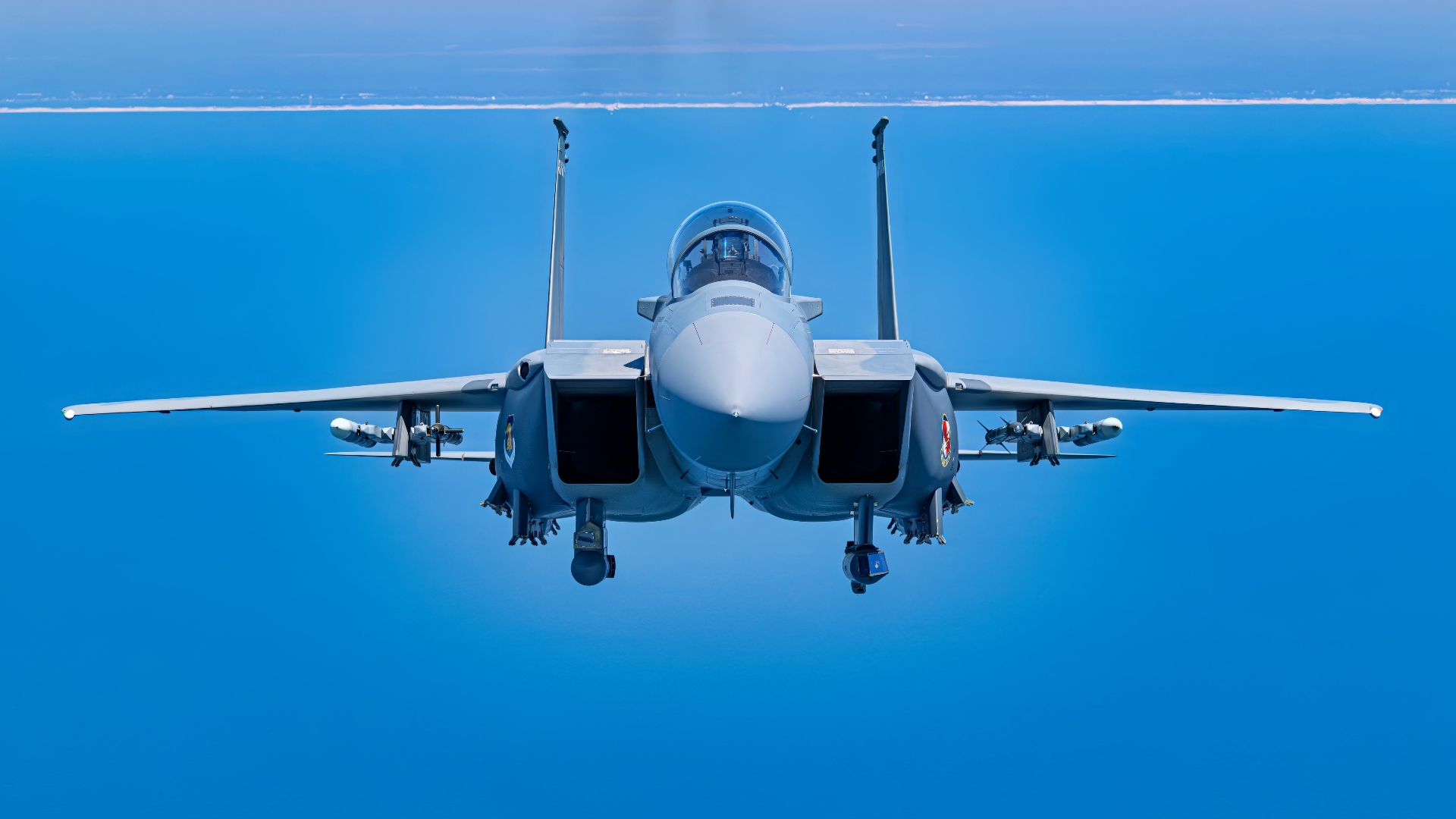
Thanks to recently posted photographs on social media, it is now apparent that at least two F-15EX Eagle II fighter jets in the Oregon National Guard are equipped with conformal fuel tanks, a measure intended to boost range and endurance.
Outfitting CFTs on F-15EX Eagle IIs helps the jets carry more fuel and weapons without necessarily sacrificing the jet’s external hard points and, therefore, its weapon payload capacity.

A U.S. Air Force F-15EX Eagle II flies over the Gulf of America, September 16, 2025. The F-15EX, from the 40th Flight Test Squadron at Eglin Air Force Base, Florida, is one of the first F-15EXs in the Air Force, and is going through developmental and operational test series at Eglin to confirm its operational capabilities before it is delivered to the combat Air Force. (U.S. Air Force photo by Staff Sgt. Blake Wiles)
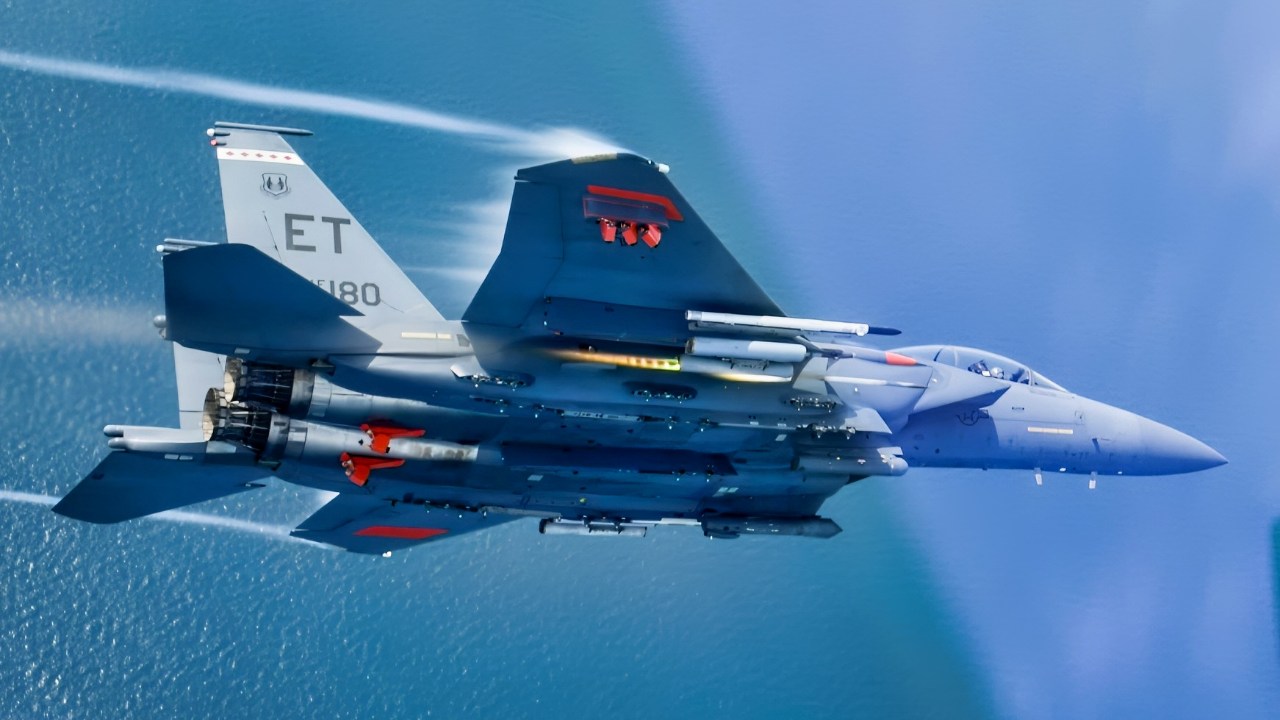
A 96th Test Wing F-15E Strike Eagle flies during a test mission May 22, 2025 over Eglin Air Force Base, Florida. The 96 TW and the 53rd Wing teamed up to test AGR-20F Advanced Precision Kill Weapon System II laser-guided rockets on the F-15E in May in an effort to get the capability to the warfighter as quickly as possible. (U.S. Air Force photo by Staff Sgt. Thomas Barley)
In any operational theatre, that would be a significant boon to the fighter jet.
But in the vast, empty wastes of the Pacific, where distances between the islands that pockmark its surface are enormous, mating CFTs to American warplanes would be a not-insignificant capabilities boost.
The F-15EX Eagle II
The F-15EX Eagle II is an adaptation of the Qatari F-15QA, itself an evolution of the two-seat F-15 Strike Eagle.
It brings a redesigned structure, digital fly-by-wire controls, a modern glass cockpit, an AESA radar, and the Eagle Passive/Active Warning Survivability System.
Its Open Mission Systems architecture is intended to make future upgrades easier than on older, legacy aircraft.
To that end, the EX version has a large payload, a newer, upgraded sensor suite, and a new digital infrastructure intended to support future upgrades.
Conformal Fuel Tanks
Conformal fuel tanks are essentially streamlined fuel tanks that generally sit along a jet’s fuselage instead of directly between the wings.
In the F-15’s case, each CFT holds about 750 gallons of additional fuel, or about 2,840 liters.
However, the CFTs also sport their own weapon attachment points. But unlike underwing drop tanks, they cannot be jettisoned while in flight.
One of their biggest advantages is their efficiency.

The Air Force’s newest fighter, the F-15EX Eagle II, was revealed and named during a ceremony April 7 at Eglin Air Force Base, Fla. The aircraft will be the first Air Force aircraft to be tested and fielded from beginning to end, through combined developmental and operational tests. (U.S. Air Force photo/Samuel King Jr.)
Because CFTs follow the aircraft’s body, they create less drag than conventional external tanks, helping preserve speed and range while leaving wing pylons free for various munitions or non-weapon attachments like targeting pods.
CFTs do, however, add some mass and drag, so a fighter equipped with CFTs is not quite as clean or as agile as a plane flown without them.
In a close-in engagement or when a crew needs to get rid of weight quickly, that inability to quickly jettison CFTs is a potential limitation.
The Pacific and Range
In the Pacific, however, a fleet of CFT-equipped aircraft could be a real advantage.
That theater raises an important question: can a fighter fight upon arrival, remain useful, and return to base?
For the base F-15EX, its range, large internal fuel capacity, and ability to take on fuel in flight make it well suited to operations across a region defined by dispersed bases and long maritime approaches.
Boeing, the American defense and aerospace prime behind the aircraft, specifically touts the airplane’s ability to carry heavy stand-off weapons and loiter, with tanker support, across vast distances.
CFTs augment the F-15EX’s capabilities.
An F-15EX configured for air superiority can carry a substantial load of air-to-air missiles—the aircraft has four more air-to-air stations than an F-15E, and Boeing has previously described some F-15EX configurations with up to 12 AMRAAM or Sidewinder missiles.
With CFTs, those missiles don’t have to compete with external fuel tanks for pylons. The result is a fighter that can patrol farther from base, escort tankers, transports, or bombers, and remain on station longer before needing to return.
Likewise, the logic extends to aircraft configured for strike.
The F-15EX can carry up to 29,500 pounds of munitions, including large standoff munitions like JASSM, and CFTs make it easier to combine that load with the fuel needed to reach distant targets.
In a theatre where airfields may be few and far between, an aircraft that can fly further with more weapons reduces dependence on forward basing and aerial refueling.
However, there is a caveat worth mentioning.
The F-15EX is not stealthy in any way, unlike its younger cousins, the F-35 and F-22.
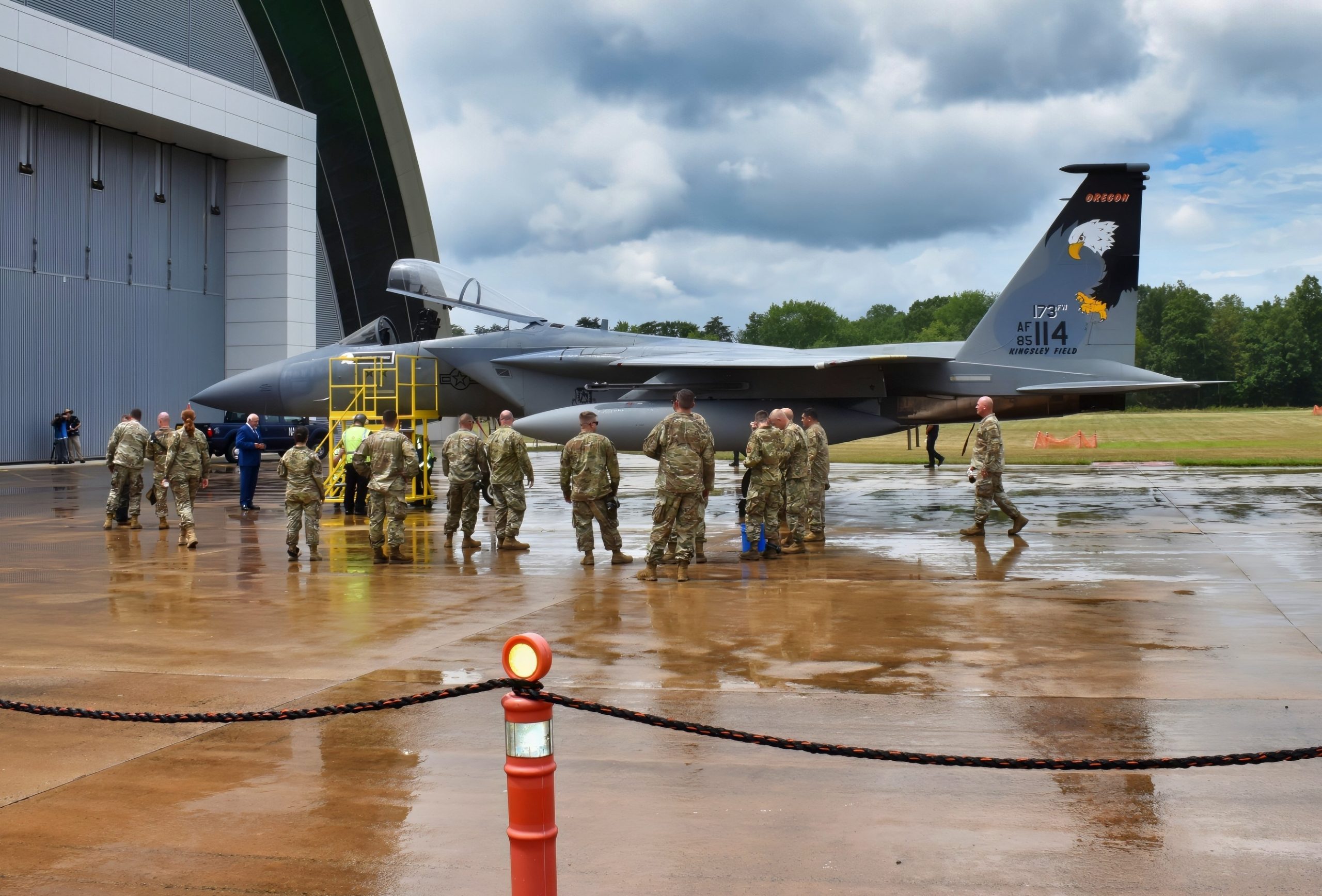
F-15C Fighter Coming in From Last Flight. Image Credit: National Security Journal.
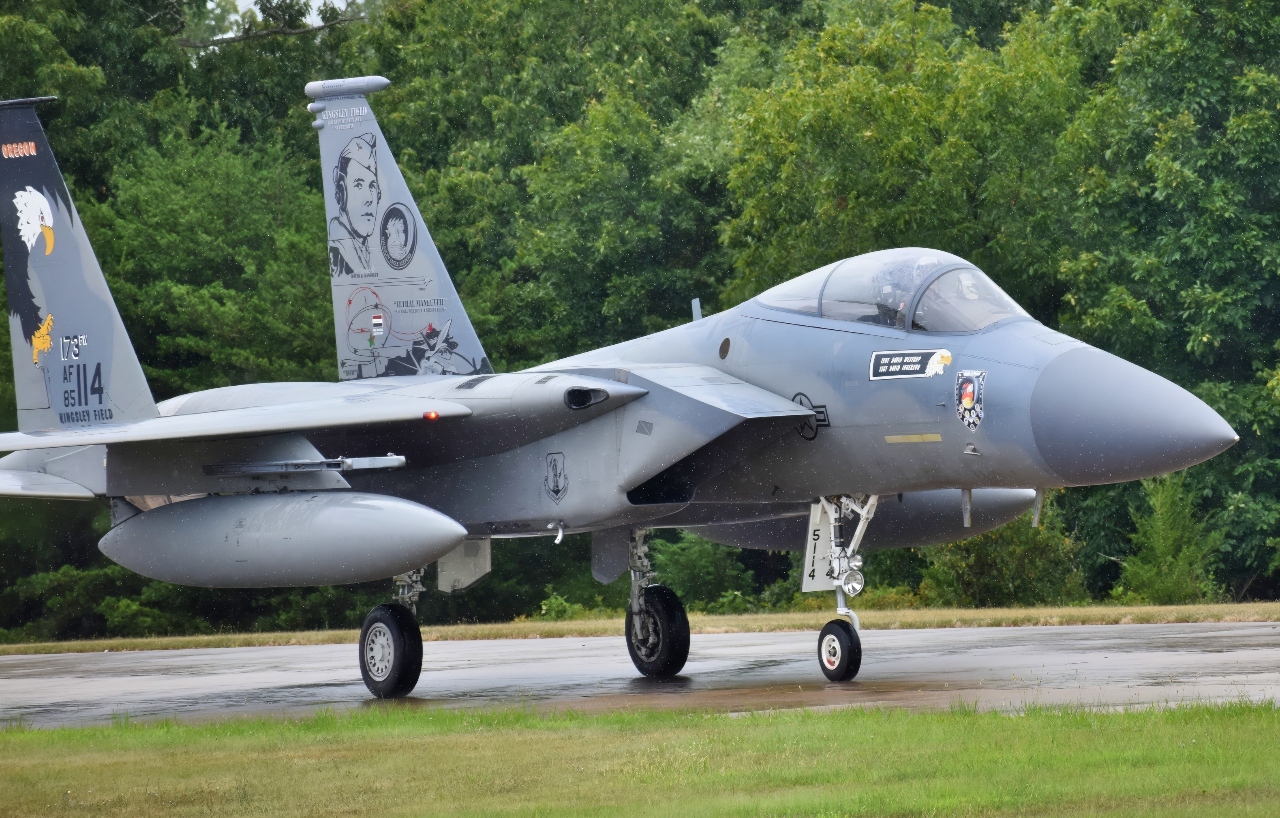
F-15C Fighter on the Tarmac. Image Credit: National Security Journal. Taken on August 13, 2025.
The F-15EX would, therefore, be best employed where enemy air defenses have been degraded, where it operates behind a stealthy screening force, or where its reach and magazine depth offset its radar signature.
The U.S. Air Force itself frames the jet as a complement to fifth-generation aircraft. Jets like the F-35 and F-22 bring stealth and sensor fusion, whereas the F-15EX Eagle II contributes significant payload capacity.
About the Author: Caleb Larson
Caleb Larson is an American multiformat journalist based in Berlin, Germany. His work covers the intersection of conflict and society, focusing on American foreign policy and European security. He has reported from Germany, Russia, and the United States. Most recently, he covered the war in Ukraine, reporting extensively on the war’s shifting battle lines in Donbas and writing on the war’s civilian and humanitarian toll. Previously, he worked as a Defense Reporter for POLITICO Europe. You can follow his latest work on X.


