

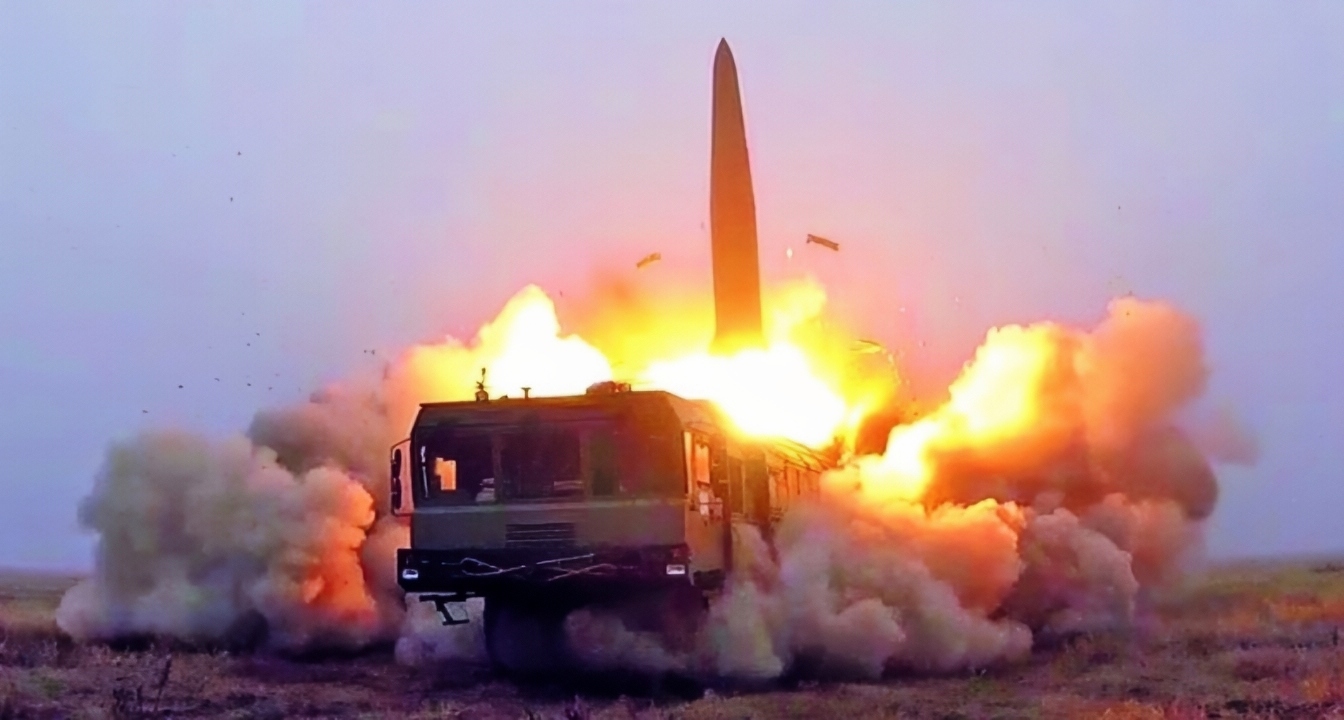
Ukraine just went after the Iskander missile, where its fuel is being refined. On the night of November 8-9, Ukrainian forces struck the Morozov Plant in Russia’s Leningrad Oblast, just outside St. Petersburg.
As the Kyiv Independent reported, Ukraine’s General Staff said the strike damaged three production workshops “at once.” The plant belongs to Rostec, Russia’s state-owned defense conglomerate, and Kyiv describes it as one of the key links in the chain that keeps the Russian military supplied with ballistic missiles.
Putin at SCO summit. Creative Commons Photo.

Putin at SCO Conference Creative Commons Image
The extent of the damage is still being assessed.
That description is quite accurate. According to the General Staff, the Morozov Plant manufactures and supplies the solid-fuel charges for the 9Kh820 rocket motor that drives the 9M723 Iskander-M. It also developed the solid fuel for the Topol-M ICBM’s engines.
“Each such strike makes it more difficult for the enemy to produce missiles for the ‘Iskander’ systems, which it uses to strike our cities,” the General Staff said.
“The chain is broken at the very beginning, long before the launch pad.”
Militarnyi reports the plant’s product line includes RDX, HMX, TNT, solid rocket propellant components, and primer compositions. It is one of the oldest enterprises in Russia’s military industry, sitting in a settlement literally named after the factory.
That is a plethora of targets residing under one roof.
The General Staff Made Its Point In Its Typical Style
Ukraine’s military announced the strike with an unusually literary touch. In its statement, carried by Ukrinform, the General Staff wrote that every Iskander fired at a Ukrainian city has a history, and “that history does not begin at the launch platform.” It begins in a workshop where the propellant is cast.
It’s a little flowery for a military press release. However, it’s also correct.
The Iskander-M is one of the most dangerous weapons Russia has used in this war. It flies a quasi-ballistic trajectory out to roughly 500 kilometers, maneuvers in its terminal phase, and gives Ukrainian air defenders very little warning.
Reliably shooting one down takes a Patriot-class interceptor, and Ukraine never has enough of those. Every Iskander Russia doesn’t build is one Kyiv doesn’t have to shoot down.
The timing drove that home. Overnight into November 10, the night after the Morozov strike, Russia launched an Iskander-M from Millerovo in the Rostov region along with 162 drones, including 96 jet-powered Shahed-type drones and Gerbera and Parodiya decoys, according to Ukraine’s Air Force.
Left Of Launch Is The Right Place To Fight
Targeting the missile’s fuel production is the smartest kind of target Ukraine can hit.
The logic is simple to understand.
You can chase a mobile launcher across the steppe, or you can go after the one place every missile has to pass through before it ever reaches a launcher.
Fixed sites don’t move. Propellant plants are hard to replace and present a much larger target than a mobile launcher.
Hromadske made the same point, noting that striking propellant production hits an earlier stage of Russia’s weapons manufacturing than going after launchers or ammo dumps.
You can’t whip up solid rocket motors in a garage. Casting large propellant grains takes specialized mixing equipment, curing facilities, and a trained workforce that doesn’t grow on trees.
Lose a casting line, and the missiles downstream wait.
However, a healthy dose of skepticism is always in order. Hromadske also noted it remains unclear whether the damage will actually disrupt production or dent Russia’s overall missile output.
Explosives plants are built in spread-out, bermed buildings precisely because they have a habit of blowing themselves up.
Three damaged workshops could mean a lost month or a lost week. Until satellite imagery or Russian supply problems tell the story, the operational impact should be treated as unknown.
This Wasn’t Ukraine’s First Targeting Of Morozov’s Plant
Ukraine has been here before.
On April 3, drones hit the industrial zone of the Morozov settlement.
At the time, Leningrad Oblast Governor Alexander Drozdenko said seven drones were shot down, and two people were hospitalized.
Ukraine’s military intelligence had already flagged the plant as a supplier of propellant components for the Iskander-M.
The West has flagged it too. The United States, the EU, the UK, Canada, and Japan have sanctioned the plant, and Ukraine added its own sanctions in August. Sanctions didn’t stop the casting lines. Drone strikes might.
A second targeting of the plant tells you three things. Kyiv thinks the target is worth the effort, and Ukrainian long-range drones can now reach a defended industrial site on the outskirts of Russia’s second city more than once.
And that the Russians have repaired the damage done in the earlier strike.
Same Night, Same Neighborhood
Morozov wasn’t the only target.
The same night, Ukrainian drones struck the Kirishi refinery, Russia’s second-largest, which supplies petroleum products across northwestern Russia, including St. Petersburg and Pulkovo Airport.
Russian officials reported 113 drones over the region.
That is a coordinated push into the backyard of Vladimir Putin’s hometown.
It also lands in an awkward political moment.
The strikes followed a roughly two-week pause in Ukrainian refinery attacks in October that coincided with pressure from President Donald Trump to lay off Russian energy facilities.
Senior Ukrainian officials told the Kyiv Independent that Kyiv never agreed to the energy ceasefire Trump announced on October 31.
Russia ignored the Trump-announced energy ceasefire. Meanwhile, Russian regions are again restricting gasoline sales.
Say what you will about the diplomatic timing.
A missile propellant plant is a military target by any definition, and Moscow is still firing Iskanders at Ukrainian cities, bridges, and power plants every week.
Russia likes to talk about where the Iskander lands. The Ukrainian drone forces are focused on where the fuel is produced.
About the Author: Steve Balestrieri
Steve Balestrieri is a National Security Columnist. He served as a US Army Special Forces NCO and Warrant Officer. In addition to writing on defense, he covers the NFL for PatsFans.com and is a member of the Pro Football Writers of America (PFWA). His work was regularly featured in many military publications.


