

In October, President Donald Trump promised not to launch any strikes against Iran until after the midterm elections in November. However, now that the elections are over and the Republicans have lost, Trump’s rhetoric has changed, and the U.S. is now trying to distance itself from the war altogether.
On Monday, the President expressed confidence that the war would end relatively soon as Washington and Tehran renew their diplomatic efforts through Qatari intermediaries.

USS Ronald Reagan (CVN 76), USS Kitty Hawk (CV 63), and USS Abraham Lincoln (CVN 72) cruise side-by-side in the Philippine Sea June 18, 2006, during exercise Valiant Shield 2006. The joint exercise consists of 28 naval vessels, more than 300 aircraft, and approximately 20,000 service members from the Navy, Army, Air Force, Marine Corps and Coast Guard. (U.S. Navy photo by Chief Photographer’s Mate Spike Call) (Released)

Aug. 8, 2017 – The Arleigh Burke-class guided-missile destroyer USS Donald Cook (DDG 75) maneuvers between the Ticonderoga-class guided-missile cruiser USS Philippine Sea (CG 58), left, and the Nimitz-class aircraft carrier USS George H. W. Bush (CVN 77), right, for a photo exercise during exercise Saxon Warrior 2017, Aug. 8. Saxon Warrior is a United States and United Kingdom co-hosted carrier strike group exercise that demonstrates allied interoperability and capability to respond to crises and deter potential threats. (U.S. Navy photo by Mass Communication Specialist 1st Class Theron J. Godbold /Released)
According to President Trump, renewed military action against Iran is highly unlikely since the U.S. is satisfied with the damage it has inflicted on the IRGC. Trump’s current strategy seems to be looking for a way out of the conflict while still claiming victory.
Is the Iran War Ending Soon?
On Monday, Trump told reporters that the war with Iran could end “fairly soon” and that Iran was “talking very politely” with the U.S. The President’s comments emerged after he met with Qatari Prime Minister Sheik Mohammed bin Abdulrahman Al Thani.
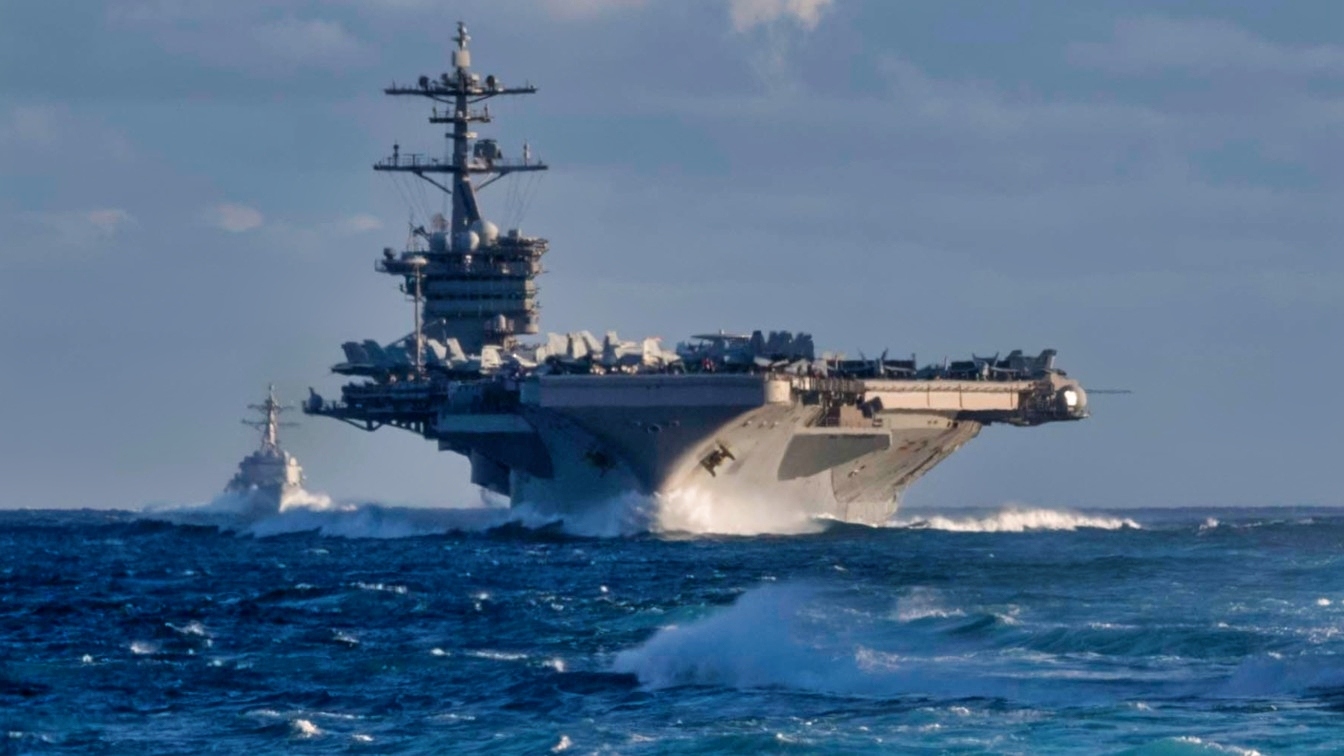
According to an Axios correspondent, Trump told Al Thani he wanted to give peace talks another chance but could change course depending on Tehran’s reaction. “We’re seeing momentum toward the end of this conflict. I think it’s going to be ending fairly soon,” Trump said. “Iran militarily is effectively over,” he continued, stating that the country’s navy has been effectively destroyed and its inflation is currently crippling its economy. While the President said that future strikes were unlikely, the option for renewed military activity is still on the table, depending on how Iran reacts. “I’ve got three aircraft carriers here… They’re fully locked and loaded.”
On November 7th, U.S. Central Command (CENTCOM) announced that it had established a new task force called Task Force Iron Gate to monitor Iran’s land border and coordinate with other government agencies to prevent the transit of “advanced weapon systems, dual-use technologies, sanctioned materials, and illegal revenue streams” across Iran’s land border and through the Caspian Sea.
The task force reportedly comprises around 20 civilian and military personnel based in Tampa, FL, and is intended to complement the U.S. naval blockade against Iran.
Writing on Truth Social, Trump said that the Gulf states “prefer the status quo,” which includes the naval blockade and the new “Operation Iron Gate.”
What Iran is Demanding
However, Iranian officials have disputed reports of renewed negotiations from Washington. Mohsen Rezaei, secretary of Iran’s National Security Council, told local news outlets that Washington should stop “manufacturing fake news about imaginary talks.” Iran’s Foreign Minister, Abbas Araghchi, likewise denied any reports of substantial talks, stating instead that talks have stalled due to the recent midterm elections in the U.S. “It will take some time for things to settle down and for the atmosphere to become conducive to the mediators resuming their visits,” he said. “We have to wait.”
Recently, Iran, through Qatari mediators, presented the U.S. with another ultimatum aimed at bringing the war to an end. The proposal, Reuters reported on November 5, will be discussed only after Washington meets Tehran’s seven demands. “On the issue of diplomacy, we have announced seven conditions to the Americans. As long as they do not execute our seven conditions, we will neither open the Strait of Hormuz nor have negotiations,” Rezaei said during a visit to Russia. The “seven demands” have been presented multiple times. Previously, Iran demanded that the U.S. immediately lift its naval blockade and sanctions against Tehran.
Iran also demanded that the U.S. and Israel cease any hostilities against Iran and its proxy group Hezbollah, located in Lebanon.
The U.S. dismissed these demands in October, calling them ridiculous and unrealistic.
Don’t Get Your Hopes Up Yet
Despite Trump’s positive outlook, other U.S. officials are less optimistic about a quick end to the war. Secretary of State Marco Rubio expressed skepticism, saying the Iranian demands are currently unacceptable to the U.S. “I wouldn’t say we’re on the verge of a breakthrough,” he told reporters. “Right now, it hasn’t been very productive because the Iranian demands are simply not just unacceptable, but in some cases outrageous and ridiculous and really not realistic.”
As things currently stand, neither side trusts the other to honor its end of any peace settlement, and neither is willing to compromise on its demands. Until this changes, the war is unlikely to end through diplomatic means in the near future.
However, the mere mention of a peace settlement with Iran is enough to provide some relief to the energy market.
Since the midterm elections and reports of ongoing negotiations, oil prices have tumbled in November.
Currently, Brent Crude is sitting at $91.79 per barrel, the lowest it’s been in nearly ten years.
Attacks against civilian tankers near the Strait of Hormuz have continued.
Still, with the Democrats set to retake the House and the Senate, and Trump seeming to shift back towards diplomacy, the energy market is regaining some of its lost confidence.
About the Author: Isaac Seitz
Isaac Seitz, a Defense Columnist, graduated from Patrick Henry College’s Strategic Intelligence and National Security program. He has also studied Russian at Middlebury Language Schools and has worked as an intelligence Analyst in the private sector.


